


x


 Oil On CanvasWallArtConstructivism
 1928Modern
 61.0 x 61.0 cm
Giclée- eller canvasprint av museumskvalitet med snabb produktion och flexibla ytbehandlingsalternativ. ( Byt till handmålad reproduktion Byt till bild)





























Välj bland våra förinställda storlekar som motsvarar konstverkets ursprungliga proportioner.

Du kan ange egna mått för att passa en specifik ram eller yta. Om det valda måttet inte överensstämmer med originalbildens proportioner kommer vi antingen att beskära konstverket eller utöka bilden med en speglad eller enfärgad kant. En digital mockup skickas för ditt godkännande innan produktionen påbörjas.
Vänligen notera att förhandsvisningen på skärmen inte återspeglar den faktiska beskärningen eller utökningen. Endast mockuppen visar den slutgiltiga kompositionen korrekt.
Även om anpassade storlekar är möjliga, rekommenderar vi att du väljer ett mått från den fördefinierade listan för att bevara de ursprungliga proportionerna.
Leverans över hela världen () på 2 veckor istället för standard 4/5 veckor. (31 juli)


Pillars
Storlek på reproduktion
Josef Albers’ "Pillars," created in 1928, is a striking example of early geometric abstraction that foreshadows the artist's later explorations of color theory. This artwork, measuring 61 x 61 cm, offers a compelling glimpse into Albers' artistic development during his time at the Bauhaus, a period marked by experimentation and a shift towards non-objective art.
Albers’ journey as an artist was significantly shaped by his enrollment in the Bauhaus school in 1920. This progressive institution championed innovative educational ideas and fostered a climate of creative exploration. Initially studying painting at a traditional art school, Albers quickly gravitated towards the glass workshop within the Bauhaus, disregarding the prescribed wall painting class. It was here that he began creating "wall glass paintings"—assemblages of opaque glass—which served as precursors to his later color studies. “Pillars” reflects this early experimentation with form and material, demonstrating a move away from representational art towards pure abstraction.
The artwork presents a meticulously structured composition characterized by vertical and horizontal lines arranged in a grid-like pattern. The color palette is restrained yet impactful, primarily featuring red, white, black, and grey tones with subtle variations. This deliberate choice of colors contributes to the overall sense of order and precision. The symmetrical arrangement emphasizes balance, while crisp, defined lines form rectangles and blocks that intersect, creating a complex visual texture. Notably, "Pillars" lacks traditional perspective or depth; it exists entirely on a flat, two-dimensional plane. The absence of recognizable objects or scenes reinforces the artwork’s purely abstract nature.
“Pillars” aligns with both Minimalist and Constructivist aesthetics. Its emphasis on geometric forms, clean lines, and a limited color palette are hallmarks of Minimalism. Simultaneously, the structured grid and focus on construction evoke influences from Constructivism, an art movement that prioritized industrial materials and rational design principles. The technique employed appears to be precise painting, likely achieved through careful brushwork or potentially masking techniques to ensure sharp lines. The artwork is executed on canvas, as evidenced by the texture of the wooden backing.
While devoid of overt symbolism or emotional narrative, "Pillars" evokes a sense of order, precision, and intellectual rigor. Some viewers may perceive a slightly sterile or clinical aesthetic due to its geometric nature. However, the interplay of colors and forms creates a subtle visual rhythm that engages the viewer's perception. Ultimately, “Pillars” invites contemplation on the fundamental elements of art—line, shape, color—and their capacity to create compelling abstract compositions.


1888 - 1976 , Tyskland
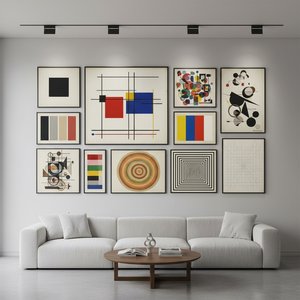
Utforska de 10 mästerverk som definierade geometrisk abstraktion! Lär känna Mondrian, Kandinsky & Malevich. Hitta inspiration och museumskvalitativa konsttryck för ditt hem på Most-Famous-Paintings.com. Upptäck hela samlingen online!
Upptäck hur svartvitt och grå abstraktion kan lyfta din inredning! Expertguider om expressionism, surrealism & mer. Hitta konst som skapar harmoni och elegans – för hemmet eller hotellet.

Utforska 10 ikoniska vita målningar av Monet, Whistler & fler! Lär känna historien bakom dessa ljusa konstverk och upptäck hur vitt används för att skapa stämning. Köp museumkvalitativa tryck på Most-Famous-Paintings.com.

Explore Josef Albers's groundbreaking color theory & the 'Homage to the Square' series. Discover how his work revolutionized visual perception and influenced modern art movements like Minimalism & Op Art. Learn about his Bauhaus roots & lasting legacy.

Upptäck hur minimalistisk abstrakt konst kan förvandla ditt hem! Expertguider, inspiration & högkvalitativa reproduktioner hos Most-Famous-Paintings. Skapa harmoni och balans idag.


Håll dig uppdaterad med de senaste konstnyheterna, exklusiva erbjudanden och inredningsidéer.
Berätta om ditt projekt så kommer våra konstexperter att ge dig 3 personliga konstförslag.
Vi skapar ett urval av 3 alternativ helt anpassat för dig – gratis!


 Förhandsvisa
 Skicka
 Dela
Dela
 Visa detaljer

 Ladda ner
 Liknande objekt
 Röntgen
 Bildspel
 Visa mer







 Glasalternativet är endast tillgängligt i storlekar under 110 cm.


