Sälj din konst
Önskelista Varukorg Cart
FörhandsvisaFörhandsvisa Förhandsgranska i ARFörhandsgranska i AR Beställ handmålad reproduktion Beställ handmålad reproduktionKöp högupplöst bild Köp högupplöst bild SkickaSkicka
Visa detaljerVisa detaljer Lägg till i favoriter Lägg till i favoriter Ladda nerLadda ner Liknande objektLiknande objekt RöntgenRöntgen BildspelBildspel

Overgrown Path (color version)

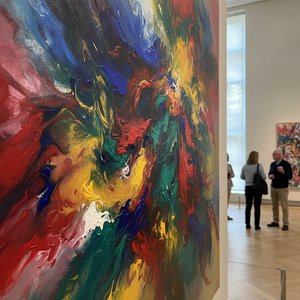
Explore 'Overgrown Path' by Karl Schrag (1962). A vibrant abstract landscape bursting with bold lines & expressive color. Expressionist, Fauvist influences – a dynamic piece for art lovers.

Karl Schrag (1912-1995) was a pivotal American printmaker & educator known for evocative etchings exploring nature, light, and atmospheric landscapes. A key figure in 1950s American art, his work is held in major museums like the MoMA & National Gall

Giclée / Konsttryck

Giclée- eller canvasprint av museumskvalitet med snabb produktion och flexibla ytbehandlingsalternativ. (Beställ handmålad reproduktion Beställ handmålad reproduktionKöp högupplöst bild Köp högupplöst bild)

Standard
custom
CM
INCH

Välj bland våra förinställda storlekar som motsvarar konstverkets ursprungliga proportioner.

bredd
höjd

Du kan ange egna mått för att passa en specifik ram eller yta. Om det valda måttet inte överensstämmer med originalbildens proportioner kommer vi antingen att beskära konstverket eller utöka bilden med en speglad eller enfärgad kant. En digital mockup skickas för ditt godkännande innan produktionen påbörjas.
Vänligen notera att förhandsvisningen på skärmen inte återspeglar den faktiska beskärningen eller utökningen. Endast mockuppen visar den slutgiltiga kompositionen korrekt.
Även om anpassade storlekar är möjliga, rekommenderar vi att du väljer ett mått från den fördefinierade listan för att bevara de ursprungliga proportionerna.

Leverans över hela världen () på 2 veckor istället för standard 4/5 veckor. (15 augusti)

why_choose_icon
Fri expressfrakt över hela världen
why_choose_icon
Högkvalitativ linnecanvas
why_choose_icon
Fullständig fraktförsäkring
why_choose_icon
Garantier för återbetalning av tullavgifter
why_choose_icon
Garantier för exakt färgåtergivning
why_choose_icon
60 dagars returrätt (endast vid fabrikationsfel)
why_choose_icon
100% pengarna tillbaka-garanti
why_choose_icon
Mängdrabatt erbjuds

Totalpris

$ 68

reproduction

Overgrown Path (color version)

Giclée / Konsttryck

Storlek på reproduktion

-

Slutgiltigt pris

$ 68


Konstnärsbiografi

A Life Etched in Light: The World of Karl Schrag

Karl Schrag, born in 1912 and passing away in 1995, occupies a significant yet often understated position within the landscape of mid-20th century American printmaking. While not a household name, his influence resonated deeply through his students and the evocative power of his etchings, which captured fleeting moments of light and atmosphere with remarkable sensitivity. Schrag’s artistic journey wasn't one of flamboyant revolution but rather a quiet dedication to mastering his craft and translating his profound connection with nature into compelling visual narratives. He emerged as a key figure in a period when printmaking was undergoing a renaissance, moving beyond mere illustration towards a more expressive and conceptually driven form. His work speaks to the American experience—a reverence for the natural world tempered by an awareness of its fragility and ephemerality.

Formative Years and the Atelier 17 Connection

Schrag’s early artistic training laid a solid foundation in traditional techniques, but it was his pivotal association with Atelier 17 that truly shaped his aesthetic direction. This legendary printmaking workshop, founded by Stanley William Hayter in Paris and later relocated to New York during World War II, became a crucible for experimentation and innovation. Atelier 17 attracted an international roster of artists—Jackson Pollock, Mark Rothko, Louise Bourgeois among them—and fostered a collaborative environment where boundaries were pushed and new approaches to etching, aquatint, and other intaglio processes were explored. Schrag’s time at Atelier 17 wasn't simply about learning technique; it was an immersion in a radical rethinking of what printmaking could *be*. He absorbed Hayter’s emphasis on automatism, surrealist influences, and the exploration of subconscious imagery, though he ultimately forged his own distinct path. The workshop encouraged artists to engage directly with the plate, treating it not as a surface for reproduction but as an active participant in the creative process. This approach—a direct engagement with the material—would become central to Schrag’s practice.

Developing a Personal Vision: Landscapes of Mood and Memory

Following his time at Atelier 17, Schrag began to develop a highly personal visual language centered on landscape. However, these were not landscapes in the traditional sense of topographical accuracy. Instead, they were evocative impressions—moody studies of light filtering through trees, atmospheric renderings of coastal scenes, and abstracted depictions of fields and marshes. His etchings often feature a limited tonal range, relying heavily on subtle gradations of gray to create a sense of depth and atmosphere. He frequently employed soft-ground etching techniques, allowing him to capture textures directly from natural materials—leaves, grasses, even the bark of trees—imbuing his plates with an organic quality. Schrag’s work is characterized by a remarkable ability to convey a feeling of solitude and contemplation. He wasn't interested in depicting grand vistas but rather in capturing the quiet beauty of overlooked corners of the natural world. His landscapes are less about *what* is depicted and more about *how* it feels to be present within that space.

Teaching and Legacy: A Generational Influence

Beyond his own artistic production, Karl Schrag had a profound impact as an educator. He taught at the Brooklyn Museum Art School for many years, nurturing generations of printmakers and instilling in them a deep respect for craftsmanship and conceptual rigor. His teaching philosophy emphasized experimentation, observation, and the importance of developing a personal voice. He encouraged his students to explore the full potential of intaglio techniques, pushing them beyond conventional boundaries while also grounding them in a solid understanding of traditional methods.
  • Schrag’s influence can be seen in the work of numerous contemporary printmakers who carry on his legacy of atmospheric landscape and subtle tonal exploration.
  • He fostered a sense of community among his students, creating a supportive environment where they could share ideas and experiment freely.
  • His dedication to teaching ensured that the techniques and principles he championed would continue to be passed down to future generations.

Historical Significance: A Quiet Voice in American Modernism

While often overshadowed by more overtly expressive movements like Abstract Expressionism, Karl Schrag’s work represents a vital strand of American modernism. He demonstrated that printmaking could be a powerful medium for conveying complex emotions and exploring subtle nuances of perception. His etchings offer a counterpoint to the bold gestures and dramatic compositions of his contemporaries, providing a more introspective and contemplative vision of the world. Schrag’s work is held in major museum collections, including the Museum of Modern Art (MoMA) and the National Gallery of Art, attesting to its enduring artistic merit. He stands as a testament to the power of quiet dedication, masterful technique, and a profound connection with the natural world—a legacy etched not just onto copper plates but into the history of American art itself.
karl schrag

karl schrag

1912 - 1995

Kortfakta

  • Artistic Movement Or Style: Modernist printmaking
  • Artists Or Movements Influenced By This Artist: ['1950s American art']
  • Artists Who Influenced This Artist: ['Ilse Szamatolski']
  • Date Of Birth: 1912
  • Date Of Death: 1995
  • Full Name: Karl Schrag
  • Nationality: American
  • Notable Artworks:
    • Various etchings
    • Landscape prints