x

Köp en högupplöst, förbättrad digital bild med betydligt högre kvalitet än förhandsvisningen online.
Varje fil är noggrant förberedd av våra interna specialister med hjälp av avancerade verktyg och professionell manuell retuschering. Vi säkerställer att varje bild har exceptionell skärpa, exakt färgåtergivning och fina detaljer.
Den slutgiltiga filen levereras via e-post inom 72 timmar, optimerad för omedelbar användning i professionella sammanhang, redaktionellt bruk och tryckmiljöer. Detta är samma kvalitet som med förtroende används av ledande designstudior, förlag och gallerier.
Ladda ner en högupplöst fil för personlig visning, utskrift och kreativa projekt. ( Beställ tryck Beställ handmålad reproduktion)
När du väljer Most-Famous-Paintings.com får du inte bara en bild – du får ett professionellt förädlat digitalt konstverk, skapat med precision och med en garanterad tillfredsställelse. Här är allt som ingår i din beställning, automatiskt:

Din högupplösta digitala bild skickas till dig via e-post inom 72 timmar efter beställning – redo för omedelbar användning.

Ditt konstverk optimeras professionellt med hjälp av avancerade AI-verktyg och manuell redigering, vilket garanterar maximal detaljrikedom, skärpa och färgnoggrannhet.

Har du råkat radera eller tappa bort din fil? Ingen oro – vi skickar den kostnadsfritt till dig när som helst.

Njut av ditt konstverk omedelbart utan tull, importavgifter eller leveranskostnader – digitala nedladdningar är alltid skattefria.

Vi säkerställer att din digitala bild återger de ursprungliga färgerna så exakt som möjligt med hjälp av professionella verktyg och färghantering.

Om du inte är nöjd med din digitala bild kommer vi att revidera den eller återbetala 100% inom 60 dagar – utan frågor.

Inte nöjd? Få full återbetalning inom 60 dagar efter att du har tagit emot din digitala fil – utan frågor och diskussioner.

Köp 3 bilder, spara 10% – Köp 5, spara 15% – Köp 10+, spara 20%. Perfekt för kreativa projekt, gallerier och byråer.
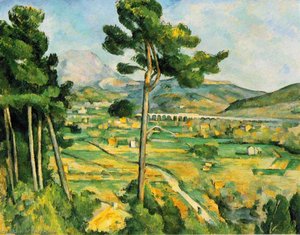
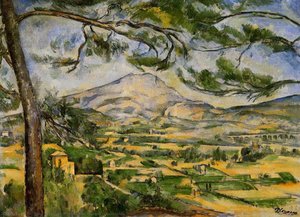
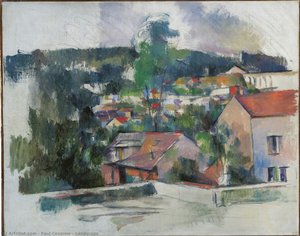
Paul Cézanne's "Untitled (2078)" isn’t merely a landscape; it’s an invitation to contemplate the very essence of perception. Painted in the twilight years of his career, around 1906, this work stands as a pivotal bridge between the fleeting impressions of Impressionism and the nascent explorations of Cubism – a testament to Cézanne's profound understanding of how we truly *see* the world. The canvas unfolds like a carefully constructed architectural study, dominated by a dense grove of trees that seem to both exist within and independently shape the surrounding space. It’s a scene rooted in the Provençal countryside near his beloved Aix-en-Provence, yet transcends simple representation, becoming instead an embodiment of Cézanne's relentless pursuit of formal structure and underlying geometry.
The style is undeniably Post-Impressionist, but one that deliberately rejects the ephemeral qualities favored by its predecessors. Cézanne wasn’t interested in capturing a momentary sunset or the shimmering effect of light; he sought to distill nature down to its fundamental components – cylinders, spheres, and cones – as he famously articulated. This is evident in the way the trees are rendered: not as soft, hazy forms, but as sharply defined planes stacked upon one another, creating an illusion of depth and solidity. The composition itself is vertically oriented, emphasizing the towering presence of the arboreal subjects and drawing the eye upwards into the atmospheric haze above.
Cézanne’s technique is immediately arresting – a deliberate departure from the smooth, blended brushstrokes of Impressionism. Instead, he employs a thick, broken application of paint known as *impasto*, building up layers of color with visible, tactile strokes. These aren't delicate whispers; they are assertive declarations, each mark contributing to the overall structure and form of the painting. Notice how the greens – ranging from deep forest hues to lighter, almost yellowish tones – are applied in distinct patches, creating a sense of texture and volume. The subtle use of ochre and yellow in the foreground grounds the scene, providing a warm counterpoint to the cool blues and greens of the sky and distant hills. The canvas itself feels alive with the artist’s hand; you can almost trace the individual movements as he built up the surface.
He utilized oil paints on canvas, meticulously layering them to achieve his desired effects. The deliberate roughness of the paint application adds a remarkable sense of immediacy and presence to the work – it feels as though Cézanne was working directly onto the canvas, capturing the essence of the scene in real-time. The scale of the *impasto* is particularly noteworthy; it’s not merely decorative but integral to the painting's structural integrity, reinforcing the idea that nature itself is a complex system of interlocking forms.
Beyond its formal qualities, “Untitled (2078)” resonates with a quiet sense of solitude and contemplation. The dense forest creates an enclosure, suggesting a retreat from the outside world – a space for introspection and connection with nature. The distant hills, rendered in muted tones, offer a subtle suggestion of human presence, perhaps a small dwelling or structure nestled within the landscape. This secondary element serves not as a focal point but rather as a reminder of our place within the larger natural order.
Cézanne’s work is deeply rooted in his personal experience and philosophical outlook. He sought to capture not just what he *saw*, but how he *felt* about what he saw – a profound appreciation for the beauty and enduring power of nature. The painting evokes a sense of timelessness, inviting viewers to lose themselves in its tranquil atmosphere and contemplate the mysteries of perception and existence. It’s a reminder that art can be both intellectually stimulating and emotionally resonant, offering a pathway to deeper understanding and connection.
Cézanne's influence on subsequent generations of artists is undeniable. His exploration of form, color, and perspective paved the way for the revolutionary developments of Cubism and other avant-garde movements. Artists like Picasso and Braque were profoundly inspired by his ability to deconstruct reality and represent it in a new and innovative way. “Untitled (2078)” stands as a prime example of this legacy – a work that continues to challenge our perceptions and inspire artists today. Reproductions, while capturing the essence of the original, can never fully replicate the tactile richness and emotional depth of Cézanne’s masterful brushwork.


1839 - 1906 , Frankrike


Håll dig uppdaterad med de senaste konstnyheterna, exklusiva erbjudanden och inredningsidéer.
Berätta om ditt projekt så kommer våra konstexperter att ge dig 3 personliga konstförslag.
Vi skapar ett urval av 3 alternativ helt anpassat för dig – gratis!


 Förhandsvisa
 Skicka
 Dela
Dela
 Visa detaljer

 Ladda ner
 Liknande objekt
 Röntgen
 Bildspel

 Visa mer