x

Handmålad olja på duk i din valda storlek och ram, tillverkad efter beställning av våra konstnärer. ( Beställ tryck Köp högupplöst bild)





























Välj bland våra förinställda storlekar som motsvarar konstverkets ursprungliga proportioner.

Du kan ange egna mått för att passa en specifik ram eller yta. Om den valda storleken inte matchar originalbildens proportioner kommer vi antingen att beskära konstverket eller utöka målningen med ytterligare handmålade element. En digital skiss skickas till dig för godkännande innan produktionen påbörjas.
Observera att förhandsvisningen på skärmen inte återspeglar den faktiska beskärningen eller utökningen. Endast skissen visar den slutgiltiga kompositionen korrekt.
Även om anpassade storlekar är möjliga, rekommenderar vi att du väljer en dimension från den fördefinierade listan för att bevara originalproportionerna.
Leverans över hela världen () på 3–4 veckor istället för standard 5 veckor. (18 augusti). Inga kompromisser med kvaliteten.


untitled (7736)
Storlek på reproduktion
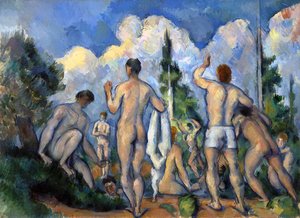
Paul Cézanne's "Untitled (7736)," a captivating post-impressionist landscape, isn’t merely a depiction of a rural scene; it’s an invitation to contemplate the very essence of perception and representation. Painted around 1895-1900, during a period of intense artistic experimentation for the artist, this work embodies Cézanne's revolutionary approach to capturing reality – not through fleeting impressions like his Impressionist predecessors, but through a deliberate restructuring of form and color. The scene unfolds with a quiet dignity: a cluster of modest houses nestled amongst rolling hills, punctuated by the suggestion of trees and a winding dirt road. Yet, it’s far from a straightforward representation; Cézanne employs a masterful orchestration of planes and angles, subtly distorting familiar forms to convey an underlying sense of spatial depth and volume.
Cézanne’s technique is arguably the most defining element of this painting. He moved decisively away from the optical realism favored by earlier generations, instead focusing on the underlying geometric structure of objects. Notice how he breaks down each house into a series of interlocking rectangular forms – a deliberate simplification that allows him to capture not just *what* something looks like, but *how* it exists in space. This is evident in the way the houses are stacked upon one another, creating an illusion of receding planes and atmospheric perspective. The trees, too, are rendered with a similar geometric precision, their branches and trunks reduced to essential lines and shapes. He wasn’t interested in mimicking nature exactly; he was striving to reveal its fundamental structure, a concept that would profoundly influence the development of Cubism decades later.
While Cézanne's approach is undeniably formalistic, "Untitled (7736)" isn’t devoid of symbolic resonance. The scene evokes a sense of rustic tranquility, suggesting a connection to the land and a celebration of rural life. The presence of figures – individuals engaged in everyday activities near the houses – adds a layer of human interaction to the landscape, grounding it in a tangible reality. The dirt road itself acts as a visual pathway, inviting the viewer into the scene and prompting reflection on journeys, both literal and metaphorical. It’s a quiet tableau that speaks volumes about the simple pleasures and enduring values of rural existence.
Despite its formal rigor, “Untitled (7736)” possesses a remarkable emotional depth. The cloudy sky lends an air of melancholy and introspection to the scene, while the muted palette – dominated by earthy browns, greens, and blues – contributes to a sense of quiet contemplation. Cézanne wasn’t simply recording a visual reality; he was attempting to capture the *feeling* of being in that place at that time. The painting invites us to slow down, to observe with care, and to appreciate the subtle beauty of the natural world. It's a testament to his ability to imbue even the most commonplace subject matter with profound artistic significance. A high-quality reproduction allows one to truly immerse themselves in this evocative atmosphere, bringing a touch of Cézanne’s contemplative vision into any interior space.


1839 - 1906 , Frankrike

Explore the profound evolution of Post-Impressionist landscapes. From Van Gogh's emotional brushwork to Cézanne's structural mastery, discover how these visionaries redefined art history through color and form in this expert guide for fine art enthusiasts.

Explore the profound beauty of pastoral art history. From Arcadian myths to Impressionist mastery, discover how timeless landscapes capture nature's serenity and transform modern interiors with museum-quality, hand-painted oil reproductions.


Håll dig uppdaterad med de senaste konstnyheterna, exklusiva erbjudanden och inredningsidéer.
Berätta om ditt projekt så kommer våra konstexperter att ge dig 3 personliga konstförslag.
Vi skapar ett urval av 3 alternativ helt anpassat för dig – gratis!


 Förhandsvisa
 Skicka
 Dela
Dela
 Visa detaljer

 Ladda ner
 Liknande objekt
 Röntgen
 Bildspel
 Visa mer







 Glasalternativet är endast tillgängligt i storlekar under 110 cm.