x

Handmålad olja på duk i din valda storlek och ram, tillverkad efter beställning av våra konstnärer. ( Beställ tryck Köp högupplöst bild)





























Välj bland våra förinställda storlekar som motsvarar konstverkets ursprungliga proportioner.

Du kan ange egna mått för att passa en specifik ram eller yta. Om den valda storleken inte matchar originalbildens proportioner kommer vi antingen att beskära konstverket eller utöka målningen med ytterligare handmålade element. En digital skiss skickas till dig för godkännande innan produktionen påbörjas.
Observera att förhandsvisningen på skärmen inte återspeglar den faktiska beskärningen eller utökningen. Endast skissen visar den slutgiltiga kompositionen korrekt.
Även om anpassade storlekar är möjliga, rekommenderar vi att du väljer en dimension från den fördefinierade listan för att bevara originalproportionerna.
Leverans över hela världen () på 3–4 veckor istället för standard 5 veckor. (20 augusti). Inga kompromisser med kvaliteten.


Composition No. 8
Storlek på reproduktion
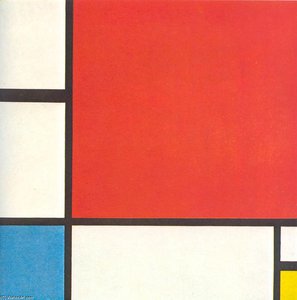
Piet Mondrian’s “Composition No. 8,” created in 1921, stands as an undeniable emblem of Neoplasticism – a movement that fundamentally reshaped the landscape of early twentieth-century art and continues to resonate with contemporary sensibilities. More than just a painting; it's a manifesto of pure abstraction, distilled into its most elemental components: black lines intersecting rectangular shapes filled with vibrant hues of red, yellow, and blue.
The artwork’s visual impact is immediately arresting due to its uncompromising geometric rigor. Mondrian meticulously crafted this piece using oil paint on canvas, rejecting any illusionistic representation in favor of a flattened plane where forms exist solely as discrete entities governed by mathematical precision. The grid structure—a hallmark of De Stijl—dominates the composition, dividing the canvas into orthogonal zones that convey an unparalleled sense of order and balance.
Beyond its formal elegance lies a profound symbolic significance. Mondrian’s intention wasn't merely to depict visual elements; he sought to express universal harmonies underlying the natural world. The selection of primary colors – red, yellow, and blue – represents fundamental forces of nature, mirroring the belief that these hues embody the essence of existence itself. Simultaneously, the black lines serve as structural anchors, emphasizing stability and conveying a deliberate rejection of organic forms—a conscious departure from Impressionism and Cubism.
Technically speaking, Mondrian approached his task with unwavering dedication. He painstakingly measured and aligned each line to achieve perfect proportions, ensuring that every element contributed to the overall equilibrium. The application of color is remarkably flat and unmodulated; there’s no blending or shading—a deliberate stylistic choice designed to heighten the painting's clarity and purity.
“Composition No. 8” transcends its aesthetic qualities to become a powerful statement about artistic philosophy. It embodies the spirit of modernity, reflecting a desire for rational thought and an unwavering belief in the transformative potential of geometric abstraction. Its enduring appeal lies not only in its visual beauty but also in its ability to inspire contemplation on fundamental questions concerning form, color, and the pursuit of universal harmony—a legacy that continues to captivate art historians and collectors alike.


1872 - 1944 , Nederländerna

Discover the profound intersection of geometry and emotion in Cubist Expressionism. Explore art history through our expert analysis of modern masters and find museum-quality, hand-painted oil reproductions of iconic masterpieces for your collection.

Master the complexities of Geometric Abstraction. Our expert guide explores the evolution from Cubist deconstruction to Bauhaus precision, decoding the power of shape and form. Perfect for art students seeking deep historical context and academic insight into modern masterpieces.

Explore the profound impact of Minimalism and Geometric Abstraction. From Mondrian to Malevich, discover how stripping art to its essential forms revolutionized modern aesthetics through our expert-led historical guide.


Håll dig uppdaterad med de senaste konstnyheterna, exklusiva erbjudanden och inredningsidéer.
Berätta om ditt projekt så kommer våra konstexperter att ge dig 3 personliga konstförslag.
Vi skapar ett urval av 3 alternativ helt anpassat för dig – gratis!


 Förhandsvisa
 Skicka
 Dela
Dela
 Visa detaljer

 Ladda ner
 Liknande objekt
 Röntgen
 Bildspel
 Visa mer







 Glasalternativet är endast tillgängligt i storlekar under 110 cm.