Sälj din konst
Önskelista Varukorg Cart
FörhandsvisaFörhandsvisa Förhandsgranska i ARFörhandsgranska i AR Beställ handmålad reproduktion Beställ handmålad reproduktionKöp högupplöst bild Köp högupplöst bild SkickaSkicka
Visa detaljerVisa detaljer Lägg till i favoriter Lägg till i favoriter Ladda nerLadda ner Liknande objektLiknande objekt RöntgenRöntgen BildspelBildspel

The Three Elder Princesses

Admire Thomas Gainsborough's masterpiece 'The Three Elder Princesses,' a stunning portrait capturing the elegance of 18th-century nobility at Hampton Court Palace. Explore its rich texture and masterful depiction of royal femininity.

Thomas Gainsborough (1727-1788): En brittisk konstnär känd för eleganta porträtt och vackra landskap, en pionjär inom sin tid och inspiration till Constable.

Giclée / Konsttryck

Giclée- eller canvasprint av museumskvalitet med snabb produktion och flexibla ytbehandlingsalternativ. (Beställ handmålad reproduktion Beställ handmålad reproduktionKöp högupplöst bild Köp högupplöst bild)

P118B $10
P118H $10
P118W $10
P438Z $10
P508JH $12
P508YH $12
P805H $10
P805Z $10
P919BZ $10
P919G $10
P919XJ $10
P959ZH $10
P968JZ $12
W106C $8
W218G $10
W218JH $8
W218Y $10
W307PJ $10
W316G $10
W316PJ $8
W316Y $10
W398PJ $8
W4111J $10
W500HY $15
W500JH $15
W692G $12
W849H $8
W940BG $15
W953PJ $8

Standard
custom
CM
INCH

Välj bland våra förinställda storlekar som motsvarar konstverkets ursprungliga proportioner.

bredd
höjd

Du kan ange egna mått för att passa en specifik ram eller yta. Om det valda måttet inte överensstämmer med originalbildens proportioner kommer vi antingen att beskära konstverket eller utöka bilden med en speglad eller enfärgad kant. En digital mockup skickas för ditt godkännande innan produktionen påbörjas.
Vänligen notera att förhandsvisningen på skärmen inte återspeglar den faktiska beskärningen eller utökningen. Endast mockuppen visar den slutgiltiga kompositionen korrekt.
Även om anpassade storlekar är möjliga, rekommenderar vi att du väljer ett mått från den fördefinierade listan för att bevara de ursprungliga proportionerna.

Leverans över hela världen () på 2 veckor istället för standard 4/5 veckor. (18 augusti)

why_choose_icon
Fri expressfrakt över hela världen
why_choose_icon
Högkvalitativ linnecanvas
why_choose_icon
Fullständig fraktförsäkring
why_choose_icon
Garantier för återbetalning av tullavgifter
why_choose_icon
Garantier för exakt färgåtergivning
why_choose_icon
60 dagars returrätt (endast vid fabrikationsfel)
why_choose_icon
100% pengarna tillbaka-garanti
why_choose_icon
Mängdrabatt erbjuds

Totalpris

$ 68

reproduction

The Three Elder Princesses

Giclée / Konsttryck

Storlek på reproduktion

-

Slutgiltigt pris

$ 68

Snabbfakta

  • Medium: Oil on canvas
  • Movement: Neoclassical
  • Artist: Thomas Gainsborough
  • Influences: Rousseau
  • Notable elements or techniques: Detailed portraiture; Luminosity
  • Title: The Three Elder Princesses
  • Artistic style: Elegant realism

Konstquiz

Det finns endast ett korrekt svar på varje fråga.

Fråga 1:
What is the artist responsible for creating?
Fråga 2:
Where can you find this painting?
Fråga 3:
What is a prominent feature of the painting's style?
Fråga 4:
Describe the clothing and hairstyles of the women depicted in 'The Three Elder Princesses'.
Fråga 5:
Thomas Gainsborough is known for his contribution to which artistic movement?

Om samlarobjektet

A Vision of Royal Grace

In the grand tapestry of eighteenth-century British portraiture, few works capture the delicate intersection of familial affection and royal dignity as exquisitely as Thomas Gainsborough’s The Three Eldest Princesses. Completed in 1784, this masterpiece serves as a luminous window into the heart of the House of Hanover, presenting a meticulously crafted tableau of Princess Charlotte, Princess Augusta, and Princess Elizabeth. As the eldest daughters of King George III and Queen Charlotte, these young women are not merely subjects of a formal commission; they are presented through Gainsborough’s Romantic lens as icons of an idealized, serene nobility. The painting transcends the rigid requirements of a royal group portrait, inviting the viewer into a moment of quiet elegance where the weight of their titles is softened by the gentle light and the tender, almost ethereal, atmosphere that defines the artist's mature style.

The composition is a masterclass in balanced arrangement, guiding the eye through a rhythmic dance of figures and textures. One princess sits with a poised, graceful stillness, while her sisters stand behind her, creating a tiered effect that lends depth and architectural stability to the group. This arrangement allows Gainsborough to showcase his unparalleled ability to render the tactile splendor of 18$th-century aristocratic life. The viewer is immediately captivated by the shimmering luster of pearls draped around their necks and the intricate, voluminous folds of their silk and satin gowns. Each brushstroke contributes to a sense of movement within the stillness, as if the very air around the princesses is infused with the soft, diffused glow characteristic of the sfumato technique.

The Mastery of Light and Texture

To behold this work is to witness Gainsborough at the height of his technical prowess. Eschewing the starker, more clinical lines of the Neoclassical movement, Gainsborough embraced a more fluid and emotive approach. His technique relies on a sophisticated layering process that achieves a breathtaking luminosity. The light does not simply strike the subjects; it seems to emanate from within the canvas itself, catching the delicate edges of lace and the subtle sheen of fine fabric. This mastery of light serves a dual purpose: it highlights the material wealth of the royal subjects while simultaneously imbuing the scene with a dreamlike, Romantic quality that softens the boundaries between reality and idealization.

For the discerning collector or interior designer, the emotional resonance of this piece lies in its ability to command a room through subtlety rather than sheer scale. The palette, though rich, is harmoniously balanced, making it an exquisite centerpiece for spaces that demand sophistication and a touch of historical grandeur. Whether placed in a sunlit gallery or a more intimate study, the painting brings with it an aura of timelessness. It is a work that rewards prolonged contemplation, revealing new nuances in the expressions of the princesses—moments of youthful innocence intertwined with the burgeoning gravity of their royal station. Owning a high-quality reproduction of such a masterpiece allows one to curate an environment steeped in the elegance of the English Golden Age, offering a permanent connection to the sublime beauty of Gainsborough’s vision.


Konstnärsbiografi

A Suffolk Beginning: The Early Life and Artistic Awakening

The story of Thomas Gainsborough, one of Britain’s most celebrated artists, unfolds not within the confines of a grand academy or bustling metropolis, but in the tranquil market town of Sudbury, Suffolk. Born in 1727, the youngest son of John Gainsborough, a weaver and wool merchant, young Thomas displayed an innate artistic sensibility from a remarkably early age. While his siblings pursued more conventional paths, Thomas’s world rapidly became consumed by drawing and painting – miniature self-portraits and delicate landscapes blossoming from his hand even before he reached ten years old. This precocious talent wasn't merely a childhood pastime; it was the burgeoning of a vision that would reshape British art. His father, recognizing this unique gift, encouraged its development, setting young Thomas on a path diverging sharply from the family trade. The Suffolk countryside itself became his first studio, imbuing his later works with a deep and abiding love for the natural world – a characteristic that would distinguish him throughout his career. This early immersion in landscape wasn’t simply about replicating what he saw; it was about *feeling* the essence of the English countryside, an emotional resonance that would permeate his canvases for decades to come.

London and the Shaping of a Style: Influences and Early Commissions

In 1740, at the age of thirteen, Gainsborough journeyed to London, embarking on formal artistic training under Hubert Gravelot, a French engraver renowned for his elegant rococo style. This exposure proved pivotal, introducing him to refined techniques and fashionable aesthetics. However, it was his association with William Hogarth and the St Martin’s Lane Academy that truly began to mold his artistic identity. Initially influenced by Hogarth's narrative approach – often depicting moral tales through crowded scenes – Gainsborough soon charted his own course, developing a distinctive style characterized by its lightness of touch, fluid brushwork, and subtle color palettes. He absorbed lessons from various masters, including the Dutch landscape painters whose atmospheric effects he admired, yet resisted strict adherence to any single school, forging a path that blended observation with imagination. Returning to Sudbury after marrying Margaret Burr in 1746, Gainsborough established himself as a portraitist for the local gentry and mercantile classes. This period honed his skills in capturing likenesses and character, but it was during his subsequent move to Ipswich, and later Bath, that he began attracting a more sophisticated clientele – individuals who appreciated not just accurate representation, but also artistic flair and emotional depth.

Bath and Beyond: Portraiture, Landscape, and Royal Patronage

The years spent in Bath (1759-1774) marked a significant turning point in Gainsborough’s career. The city was a hub of fashionable society, providing him with ample opportunities to paint portraits of the wealthy and influential. He quickly gained renown for his ability to capture not only physical resemblance but also the personality and social standing of his sitters. His portraits weren't merely depictions; they were statements about identity and status. He experimented with different lighting techniques and compositions, often incorporating elements of the surrounding landscape to create a sense of depth and atmosphere. However, even amidst the demands of portraiture, Gainsborough never abandoned his passion for landscape painting. In fact, he often seamlessly integrated landscapes into his portraits, creating compositions that celebrated both human subjects and the beauty of the natural world. This innovative approach – a hallmark of his style – set him apart from many of his contemporaries. The culmination of his success came with his move to London in 1774, where he established a studio on Pall Mall and became a founding member of the Royal Academy. He also secured royal patronage, becoming a favourite painter of King George III and Queen Charlotte, further solidifying his position as one of Britain’s leading artists. *Mrs. Thomas Gainsborough*, painted in 1785, exemplifies this period – an elegant portrait showcasing rococo style and muted tones.

The Development of His Unique Style

Gainsborough's artistic journey was marked by a constant evolution. Initially influenced by the precision and detail of Dutch masters like Rembrandt, he gradually developed his own distinctive style, characterized by loose brushwork, atmospheric effects, and a subtle use of color. He rejected the rigid formality of earlier portraiture, opting for a more relaxed and intimate approach that captured the essence of his subjects rather than simply their outward appearance. His landscapes were equally innovative, eschewing the meticulous detail of topographical paintings in favor of evocative scenes that conveyed mood and atmosphere. He was particularly adept at capturing the fleeting effects of light and shadow, creating a sense of immediacy and spontaneity. Gainsborough’s ability to synthesize these diverse influences – from Dutch landscape painting to French rococo portraiture – resulted in a truly original style that would have a profound impact on subsequent generations of British artists.

A Legacy of Innovation: Enduring Appeal and Influence

Thomas Gainsborough died in 1788, leaving behind a body of work that continues to captivate audiences today. His influence on subsequent generations of British artists is undeniable. He liberated portraiture from rigid formality, infusing it with spontaneity and emotional resonance. His loose brushwork and atmospheric effects paved the way for the Impressionists, while his lyrical landscapes inspired artists like John Constable, who deeply admired Gainsborough’s ability to capture the spirit of the English countryside. Gainsborough's legacy extends beyond technique; it lies in his profound understanding of human character and his unwavering commitment to artistic expression. He wasn’t simply a painter of portraits or landscapes; he was a storyteller, a poet of light and color, and a visionary who transformed British art. His paintings are a testament to the power of observation, imagination, and the enduring allure of the English landscape.
Thomas Gainsborough

Thomas Gainsborough

1727 - 1788 , Storbritannien

Kortfakta

  • Artistic Movement Or Style: Rococo, Porträtt
  • Artists Or Movements Influenced By This Artist:
    • Constable
    • Impressionister
  • Artists Who Influenced This Artist:
    • Gravelot
    • Hogarth
  • Date Of Birth: 1727
  • Date Of Death: 1788
  • Full Name: Thomas Gainsborough
  • Nationality: Brittisk
  • Notable Artworks:
    • Mrs. Gainsborough
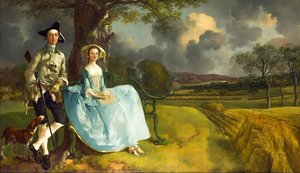
    • Mr & Mrs Andrews
  • Place Of Birth: Sudbury, Storbritannien
Utforska konstverk sorterade efter tema, stil och egenskaper.