


x


 Köp tryck Köp högupplöst digital bild
 Skicka
 Visa detaljer
 Lägg till i favoriter
 Ladda ner
 Liknande objekt
 Röntgen
 Bildspel
Handmålad olja på duk i din valda storlek och ram, tillverkad efter beställning av våra konstnärer.
Välj bland våra förinställda storlekar som motsvarar konstverkets ursprungliga proportioner.

Du kan ange egna mått för att passa en specifik ram eller yta. Om den valda storleken inte matchar originalbildens proportioner kommer vi antingen att beskära konstverket eller utöka målningen med ytterligare handmålade element. En digital skiss skickas till dig för godkännande innan produktionen påbörjas.
Observera att förhandsvisningen på skärmen inte återspeglar den faktiska beskärningen eller utökningen. Endast skissen visar den slutgiltiga kompositionen korrekt.
Även om anpassade storlekar är möjliga, rekommenderar vi att du väljer en dimension från den fördefinierade listan för att bevara originalproportionerna.
Leverans över hela världen () på 3–4 veckor istället för standard 5 veckor. (20 juli). Inga kompromisser med kvaliteten.


Commodore John Watson
Storlek på reproduktion

Tilly Kettle (1735–1786) stands as a singular figure in British art history—the first prominent English portrait painter to establish himself successfully within the vibrant cultural landscape of India during the zenith of the East India Company’s dominion. Born in London, the son of a coach painter from a family steeped in brewing tradition for five decades, Kettle's artistic journey began with foundational training under William Shipley at the Strand. This early apprenticeship placed him within a burgeoning artistic milieu eager to explore new horizons beyond the traditional confines of the English countryside.
His professional foray into portraiture commenced in the 1750s, swiftly gaining recognition for his ability to capture likenesses with remarkable accuracy and sensitivity. Kettle’s early canvases—primarily self-portraits from 1760—immediately signaled his ambition and established him as a rising talent within the Society of Artists, founded in 1761. This initial exhibition solidified his position amongst fellow artists striving for acclaim and propelled him toward greater commissions. His early career was marked by a refined ability to document the dignity and status of his subjects, notably through his work with the members of the Dartmouth family.
Beyond the borders of England, Kettle’s legacy is defined by his extraordinary expedition in 1768. Traveling alongside the East India Company, he landed at Madras, an experience that would profoundly transform his artistic vision and subject matter. This period allowed him to bridge two worlds, blending European neoclassical techniques with the exoticism and grandeur of the Indian subcontinent. His work from this era serves as a vital historical record, capturing the complex intersections of British colonial presence and local Indian life.
Kettle’s technique was characterized by a remarkable realism and an ability to render both the textures of opulent fabrics and the subtle nuances of human emotion. His repertoire spans a diverse range of subjects, from the aristocratic elegance of Georgian England to the commanding figures of the East India Company's influence in India. Some of his most significant contributions to the art world include:
Through these works, Kettle did more than merely record faces; he captured the very essence of an era defined by expansion, trade, and the meeting of disparate cultures. His ability to adapt his style to suit both the formal requirements of British portraiture and the vibrant, often overwhelming, sensory landscape of India ensures his enduring place in the annals of art history.

1735 - 1786 , United Kingdom

Upptäck 1700-talets konstnärliga skönhet! Från Boucher till David – utforska 10 ikoniska mästerverk, deras historia och stil. Hitta inspiration & museumkvalitativa reproduktioner på Most-Famous-Paintings.com.

Explore the life & work of Henry Raeburn, a master Scottish portraitist. Discover his innovative techniques, captivating portraits of the Enlightenment era, and lasting legacy in art history. Learn more at Most-Famous-Paintings.

Beställ ett unikt historiskt porträtt av professionella konstnärer. Bevara ditt arv med en personlig målning från foto eller utforska klassiska tekniker. Få expertkonsultation och museumskvalitet – kontakta oss idag!

Explore the life & art of Louise Élisabeth Vigée Le Brun, Marie Antoinette’s renowned portraitist. Discover her Rococo style, self-portraits, and influence on 18th-century French painting. A deep dive into patronage & feminine identity.
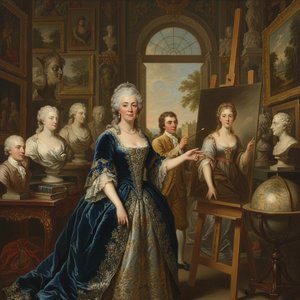
Explore the fascinating world of Sarah Churchill, Countess of Essex, a pivotal figure in 18th-century art patronage. Discover her influence on Rococo aesthetics and portraiture, and learn about commissioning artworks as a statement of power & identity.


Håll dig uppdaterad med de senaste konstnyheterna, exklusiva erbjudanden och inredningsidéer.
Berätta om ditt projekt så kommer våra konstexperter att ge dig 3 personliga konstförslag.
Vi skapar ett urval av 3 alternativ helt anpassat för dig – gratis!


 Dela
Dela


 Visa mer




































 Glasalternativet är endast tillgängligt i storlekar under 110 cm.


