x

Giclée- eller canvasprint av museumskvalitet med snabb produktion och flexibla ytbehandlingsalternativ. ( Beställ handmålad reproduktion Köp högupplöst bild)
Välj bland våra förinställda storlekar som motsvarar konstverkets ursprungliga proportioner.

Du kan ange egna mått för att passa en specifik ram eller yta. Om det valda måttet inte överensstämmer med originalbildens proportioner kommer vi antingen att beskära konstverket eller utöka bilden med en speglad eller enfärgad kant. En digital mockup skickas för ditt godkännande innan produktionen påbörjas.
Vänligen notera att förhandsvisningen på skärmen inte återspeglar den faktiska beskärningen eller utökningen. Endast mockuppen visar den slutgiltiga kompositionen korrekt.
Även om anpassade storlekar är möjliga, rekommenderar vi att du väljer ett mått från den fördefinierade listan för att bevara de ursprungliga proportionerna.
Leverans över hela världen () på 2 veckor istället för standard 4/5 veckor. (20 augusti)


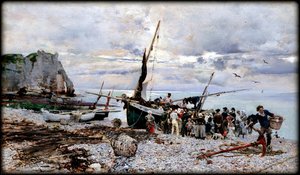
Sorting the Fish
Storlek på reproduktion

Born in the heart of Paris in 1847, Victor Gabriel Gilbert was a painter whose destiny seemed initially tethered to the humble craft of carpentry, following in the footsteps of his father. However, a natural aptitude for drawing and a resilient spirit steered him toward a much more luminous path. Lacking the means to attend the prestigious École des Beaux-Arts, Gilbert sought his education through grit and apprenticeship, studying under the artisan painter and decorator Eugène Adam and later with Charles Busson. This early immersion in the tactile world of textures and decorative arts would later manifest in his profound ability to render the organic beauty of fruit, vegetables, and the bustling atmosphere of the French capital.
Gilbert’s artistic evolution is a captivating study of a painter finding his voice amidst a sea of shifting movements. His early works, appearing at the Salon des artistes français in the 1870s, were characterized by a somber, realist palette, heavily influenced by the moody, dark tones of masters like Bonvin and Ribot. Yet, as the vibrant energy of Impressionism began to sweep through Paris, Gilbert did not merely observe the change; he embraced it. He transitioned from the heavy shadows of realism toward a brighter, more luminous approach, adopting the loose brushstrokes and spontaneous light effects that defined the era. This stylistic metamorphosis allowed him to capture not just the physical presence of his subjects, but the very ephemeral essence of light dancing across a flower market or a crowded café.
The true legacy of Victor Gabriel Gilbert lies in his role as a chronicler of Parisian life. He became the preeminent painter of Les Halles, the legendary central marketplace of Paris, transforming mundane scenes of commerce into poetic celebrations of urban existence. His oeuvre, which spans over 60 and includes hundreds of works, focuses on the rhythmic vitality of the streets. Whether depicting a florist tending to colorful blooms at the Pont Neuf or the organized chaos of a morning fish market, Gilbert possessed a rare gift for finding grandeur in the ordinary.
His technique was a masterful blend of precision and impressionistic freedom. While his compositions often utilized the soft, atmospheric light characteristic of Impressionism, he maintained a meticulous attention to detail that anchored his work in reality. One can observe his skill in the delicate textures of a ripening peach, the translucent petals of a poppy, or the heavy drape of a merchant's apron. This duality—the ability to evoke a fleeting moment while celebrating the tangible weight of objects—is what makes his paintings so enduringly tactile and emotionally resonant.
Throughout his prolific career, Gilbert earned significant acclaim within the French art establishment. His contributions were recognized with prestigious honors, including:
Beyond the accolades, Gilbert’s historical significance resides in his ability to bridge the gap between the structured traditions of 19th-century realism and the sensory revolution of Impressionism. He provided a window into a vanished era of Paris—a time of bustling street markets and a burgeoning urban culture that felt both intimate and grand. Today, his works reside in esteemed collections such as the Musée Carnavalet in Paris and the Philadelphia Museum of Art, serving as vibrant, breathing reminders of the beauty found in the daily rhythms of Parisian life.

1847 - 1933 , France


Håll dig uppdaterad med de senaste konstnyheterna, exklusiva erbjudanden och inredningsidéer.
Berätta om ditt projekt så kommer våra konstexperter att ge dig 3 personliga konstförslag.
Vi skapar ett urval av 3 alternativ helt anpassat för dig – gratis!


 Förhandsvisa
 Skicka
 Dela
Dela
 Visa detaljer

 Ladda ner
 Liknande objekt
 Röntgen
 Bildspel
 Visa mer




































 Glasalternativet är endast tillgängligt i storlekar under 110 cm.