
Sanatınızı Satın
İstek Listesi Alışveriş Sepeti Cart
Önizleme yapÖnizleme yap AR ile önizleAR ile önizle Baskı satın al Baskı satın alGörsel satın al Görsel satın al PaylaşPaylaş
Detayları GörDetayları Gör Favorilere ekle Favorilere ekle İndirİndir Benzerlerini görBenzerlerini gör X-IşınıX-Işını Slayt GösterisiSlayt Gösterisi

untitled (6991)

Franz Marc’s vibrant Expressionist painting captures a serene moment of domestic life—a woman preparing her shoes alongside a loyal dog and feathered bird—reflecting the artist's profound connection to nature and spiritual contemplation.

Franz Marc’ın ikonik hayvan tabloları, canlı renkleri ve ruhsal temalarıyla öne çıkan Alman dışavurumcu sanatçı Franz Marc (1880-1916)’nın mirasıdır. Doğanın özünü anlamaya yönelik bir arayış olan bu sanatçı yaşamında derin bir ruhsal arayış yaşadı. Münih Güzel Sanatlar Akademisi’nde eğitim aldıktan sonra Wassily Kandinsky ile birlikte Der Blaue Reiter grubunu kurdu ve Alman dışavurumculuğunun dor

El Yapımı Yağlı Boya Reproduksiyon

Sanatçılarımız tarafından sipariş üzerine hazırlanan; istediğiniz boyut ve çerçevede, tuval üzerine el boyaması yağlı boya. (Baskı satın al Baskı satın alGörsel satın al Görsel satın al)

P118B $10
P118H $10
P118W $10
P438Z $10
P508JH $12
P508YH $12
P805H $10
P805Z $10
P919BZ $10
P919G $10
P919XJ $10
P959ZH $10
P968JZ $12
W106C $8
W218G $10
W218JH $8
W218Y $10
W307PJ $10
W316G $10
W316PJ $8
W316Y $10
W398PJ $8
W4111J $10
W500HY $15
W500JH $15
W692G $12
W849H $8
W940BG $15
W953PJ $8

Standard
custom
CM
INCH

Eserin orijinal oranlarıyla uyumlu, önceden belirlenmiş boyutlarımız arasından seçim yapın.

genişlik
yükseklik

Belirli bir çerçeveye veya alana uyması için kendi boyutlarınızı girebilirsiniz. Seçtiğiniz boyut orijinal görüntünün oranlarıyla eşleşmiyorsa, sanat eserini kırparak veya ek el boyaması öğelerle resmi uzatarak ayarlayacağız. Üretim başlamadan önce onayınız için dijital bir taslak gönderilecektir.
Lütfen ekrandaki önizlemenin gerçek kırpmayı veya uzatmayı yansıtmadığını unutmayın. Nihai kompozisyonu yalnızca hazırlanan taslak doğru şekilde gösterecektir.
Özel boyutlar mevcut olsa da, orijinal oranları korumak adına önceden tanımlanmış listeden bir boyut seçmenizi öneririz.

Değiştirilebilecek örneklere dair: Yüzün müşteri fotoğrafıyla değiştirilmesi; Evcil hayvan eklenmesi (örneğin kedinin köpek ile değiştirilmesi); Arka plana gizli bir mesaj dahil edilmesi; Arka plan manzarasının veya öğelerinin değiştirilmesi.
Siparişten sonra, Most-Famous-Paintings.com ekibi talimatlar için müşteriye e-posta gönderecek ve bir taslak önizleme sunacaktır

Dünya Çapında Teslimat (); standart 5 hafta yerine 3/4 haftada. (22 Ağustos). Kaliteden ödün verilmez.

why_choose_icon
Dünya Çapında Ücretsiz Ekspres Kargo
why_choose_icon
Yüksek Kaliteli Keten Tuval
why_choose_icon
Tam Kapsamlı Nakliye Sigortası
why_choose_icon
Gümrük Vergisi İade Garantisi
why_choose_icon
Gerçek Renk Uyumu Garantisi
why_choose_icon
60 Günlük İade Politikası (Sadece Kusurlu Ürünler İçin)
why_choose_icon
%100 Para İade Garantisi
why_choose_icon
Toplu Alım İndirimi

Toplam Fiyat

$ 272

reproduction

untitled (6991)

Reproduksiyon Tekniği

Reproduksiyon Boyutu

-

Toplam Tutar

$ 272

Hızlı Bilgiler

  • Artist: Franz Marc
  • Movement: Expressionism
  • Medium: Oil on canvas
  • Influences: Vincent van Gogh
  • Notable elements or techniques: Color symbolism
  • Artistic style: Primitivism

Eser Açıklaması

A Symphony of Color and Spirit

In the quiet intimacy of a domestic moment, Franz Marc’s Untitled (6991) invites the viewer into a world where the mundane is transformed into the magnificent. The scene captures a woman with vibrant red hair, captured in the tender, rhythmic motion of preparing her shoes. At first glance, it appears to be a simple study of daily life, yet beneath the surface lies a profound exploration of the interconnectedness between humanity and the natural world. Accompanied by the loyal presence of a dog and the ethereal flight of a bird, the composition transcends mere realism to become a spiritual dialogue. Marc, a pioneer of German Expressionism, utilizes this domestic setting to bridge the gap between human existence and the primal, untouched purity of nature.

The painting serves as a masterclass in the Expressionist rejection of objective reality. Rather than striving for the photographic accuracy of the Impressionists, Marc employs a bold, flattened perspective and a palette that pulses with life. His technique is defined by a heavy, tactile impasto, where thick layers of pigment mixed with linseed oil create a sculptural quality on the canvas. This physical texture does more than just hold color; it captures light and movement, imbuing every brushstroke with a palpable energy. The rich, saturated hues—from the deep blues to the soft pinks of the woman's patterned dress—work in harmony to evoke an emotional resonance that speaks directly to the soul, making this piece a captivating centerpiece for any collection focused on emotive power.

Symbolism and the Expressionist Soul

To understand this work is to understand Marc’s unique spiritual philosophy. For the artist, animals were not merely subjects but symbols of an inherent goodness and spiritual clarity that human intellect often obscures. The dog in the composition embodies instinct and unwavering loyalty, acting as a grounded companion to the human figure, while the bird, positioned near the top left, serves as a visual metaphor for transcendence and the soaring heights of spiritual aspiration. Even the woman’s meticulous actions—the careful application of her footwear—symbolize a sense of purpose and the beauty found in diligent, mindful living.

Created during the turbulent years leading up to World War I, the artwork reflects the profound anxieties and the intense yearning for meaning prevalent in German intellectual circles. As society faced the encroaching shadows of rationalism and materialism, Marc sought to communicate universal truths through emotionally charged imagery. For collectors and interior designers alike, this painting offers more than just aesthetic beauty; it provides a window into a pivotal moment in art history. It is an evocative piece that brings a sense of depth, historical weight, and a serene, spiritual vitality to any sophisticated space, making it an enduring choice for those who appreciate art that speaks to the eternal.

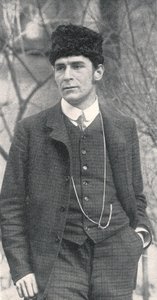
Sanatçı Özgeçmişi

Franz Marc (1880-1916): Pioneer of German Expressionism

Franz Moritz Wilhelm Marc, born on February 8, 1880, in Munich, Germany, was a painter whose brief but intensely focused career irrevocably altered the course of German Expressionism. His story is one of profound spiritual seeking translated into a vibrant visual language—a quest to understand the essence of life through the purity he found in the natural world, particularly within the animal kingdom. Initially influenced by his father, Wilhelm Marc, a landscape painter, young Franz’s artistic path wasn't immediately certain. He briefly contemplated theology, grappling with questions of faith and existence before ultimately dedicating himself to art at the Academy of Fine Arts in Munich. These early explorations into religious thought would remain deeply embedded within his work, shaping his belief that art could be a conduit for spiritual experience. His academic training provided him with technical foundations, but it was encounters with the works of Vincent van Gogh during visits to Paris that truly ignited his artistic vision. Van Gogh’s emotive use of color and raw expression resonated profoundly with Marc, liberating him from conventional techniques and setting him on a path toward a more subjective and emotionally charged style.

Early Influences and Artistic Development

Marc's formative years were marked by a fascination with both Romantic literature and theology—a duality that would permeate his artistic sensibility throughout his life. His father’s landscape paintings instilled in him an appreciation for the grandeur of nature, while his mother’s Calvinist upbringing fostered a contemplative spirit. He studied drawing first with Gabriel Hackl and then painting with Wilhelm von Diez at Munich Academy, absorbing the stylistic conventions of academic naturalism alongside nascent explorations into Impressionistic color innovations. However, it was his encounter with Van Gogh's paintings during Parisian excursions that fundamentally reshaped his artistic perspective. As Marc himself eloquently expressed, “Van Gogh is for me the most authentic, the greatest, the most poignant painter I know.” He recognized in Van Gogh’s bold use of color and unflinching portrayal of emotion a liberation from formal constraints—a freedom to express inner spiritual truths without resorting to representational accuracy. This influence propelled him toward simplification and heightened emotional intensity, mirroring Symbolist ideals that championed the artist as martyr.

The Birth of Der Blaue Reiter

Marc’s artistic journey took an extraordinary turn in 1907 with his relocation to Paris—a pivotal moment fueled by a desire for creative renewal following a period of personal turmoil. During this time, he immersed himself in the vibrant artistic milieu of the city and encountered artists who profoundly impacted his stylistic evolution. Notably, Robert Delaunay’s exploration of abstract forms and chromatic harmonies broadened Marc's horizons beyond traditional representation. This encounter spurred him toward experimentation with geometric abstraction—a departure from Impressionistic color palettes that signaled a decisive shift toward conveying spiritual concepts through simplified shapes and bold hues. Simultaneously, he cultivated friendships with fellow artists who shared his conviction that art could transcend the material realm and engage in dialogue with deeper existential questions. He joined August Macke and Wassily Kandinsky to establish *Der Blaue Reiter* (The Blue Rider) in 1911—a collective dedicated to forging a new artistic path rooted in Symbolist principles. This group’s inaugural exhibition showcased not only Marc's own work but also that of other avant-garde artists, cementing Der Blaue Reiter’s reputation as the epicenter of German Expressionism and initiating a dialogue about art’s capacity for spiritual expression.

Animal Painting: A Spiritual Quest

Marc’s artistic preoccupation with animals began in earnest around 1907—a fascination driven by both anatomical curiosity and a profound belief that animals embodied an inherent purity and connection to nature absent from human society. He viewed animals as symbols of innocence, harmony, and spiritual transcendence—subjects he approached with reverence and meticulous attention to detail. Unlike Impressionists who sought to capture fleeting visual impressions, Marc aimed to distill the essence of his subjects into their fundamental forms—reducing figures to geometric shapes that conveyed emotional intensity without resorting to realistic depiction. Paintings like *The Tiger* (1912) exemplify this stylistic approach—a monumental composition characterized by assertive color choices and a deliberate simplification of form that encapsulates Marc’s artistic vision. He believed animals possessed an inner luminosity—a spiritual radiance—that mirrored the divine presence he perceived in the natural world. This conviction fueled his relentless pursuit of expressive abstraction, mirroring Symbolist ideals that championed the artist as martyr.

Legacy and Recognition

Franz Marc tragically perished on March 4, 1916, during the Battle of Verdun—a devastating loss for the art world and a poignant reminder of the fragility of artistic creativity amidst the tumult of wartime conflict. Despite his untimely demise, Marc’s influence endured—inspiring generations of artists who embraced his stylistic innovations and championed his unwavering commitment to conveying spiritual truths through abstract forms and symbolic color. His paintings continue to captivate audiences today with their emotional depth and profound contemplation of existential themes—a testament to the enduring power of art to transcend the boundaries of time and place. Marc’s legacy extends beyond his artistic achievements; he remains a symbol of intellectual integrity, spiritual courage, and unwavering devotion to his craft—a figure whose work continues to resonate with viewers seeking solace and inspiration in the face of adversity. His contribution to German Expressionism solidified his position as one of the most important artists of the 20th century—a visionary who dared to explore the intersection between art, spirituality, and the sublime beauty of the natural world.
Franz Marc

Franz Marc

1880 - 1916 , Almanya

Kısa Bilgiler

  • Artistic Movement Or Style: Dışavurumculuk
  • Artists Who Influenced This Artist:
    • Vincent van Gogh
    • Robert Delaunay
  • Date Of Birth: 8 Şubat 1880
  • Date Of Death: 4 Mart 1916
  • Full Name: Franz Moritz Wilhelm Marc
  • Nationality: Alman
  • Notable Artworks:
    • Tierschicksale
    • Kızıl Geyik
    • Gökyüzü Şelalesi
  • Place Of Birth: Münih, Almanya
Temalara, stillere ve özelliklere göre düzenlenmiş sanat eserlerini keşfedin.




































