x

Hızlı üretim ve esnek bitiş seçenekleriyle müze kalitesinde giclée veya kanvas baskı. ( El yapımı tablo satın al Görsel satın al)





























Eserin orijinal oranlarıyla uyumlu, önceden belirlenmiş boyutlarımız arasından seçim yapın.

Belirli bir çerçeveye veya alana uyması için kendi ölçülerinizi girebilirsiniz. Seçtiğiniz boyut orijinal görüntünün oranlarıyla eşleşmiyorsa, sanat eserini kırpacağız veya görüntüyü aynalanmış ya da düz dolgulu bir kenarlıkla genişleteceğiz. Üretim başlamadan önce onayınız için bir dijital taslak gönderilecektir.
Lütfen ekrandaki önizlemenin gerçek kırpma veya genişletmeyi yansıtmadığını unutmayın. Nihai kompozisyonu yalnızca taslak doğru bir şekilde gösterecektir.
Özel boyutlar mevcut olsa da, orijinal oranları korumak için önceden tanımlanmış listeden bir boyut seçmenizi öneririz.
Dünya Çapında Teslimat (); standart 4/5 hafta yerine 2 haftada. (17 Ağustos)


Grande vue de Mariakerke
Reproduksiyon Boyutu
In the quietude of the Belgian countryside, there exists a scene that transcends mere topography to touch upon the very essence of nostalgia and solitude. James Ensor’s Grande vue de Mariakerke is not simply a depiction of a village nestled in a valley; it is an invitation into a world where the earth breathes through thick, textured strokes of paint. The composition unfolds as a sweeping vista, dominated by expansive fields of tall grasses and reeds that sway under the weight of a dramatic, heavy sky. At the heart of this landscape lies a small, tranquil village, anchored by a prominent church tower that reaches upward, acting as a silent sentinel between the terrestrial realm and the swirling, atmospheric heavens above. The horizontal format of the work emphasizes the immense breadth of the Belgian plains, creating an immersive experience that draws the viewer into a state of quiet contemplation.
The emotional resonance of this piece lies in its delicate balance between peace and a subtle, underlying melancholy. There is a profound sense of stillness, yet the landscape feels vibrantly alive, as if caught in a moment of transition between light and shadow. For the collector or the interior designer, this artwork offers a unique atmospheric depth; it possesses the ability to anchor a room with its grounded, earthy tones while simultaneously providing a window into a dreamlike, emotive space. It is a work that does not merely decorate a wall but breathes life into an environment, offering a sense of historical weight and poetic grace.
To look closely at Grande vue de Mariakerke is to witness the physical struggle and triumph of the artist’s hand. Ensor employs a masterful impasto technique, where the paint is applied so thickly that it creates a sculptural quality on the canvas. This tactile approach is most evident in the undulating fields of grass and the turbulent, billowing clouds, where every brushstroke contributes to a sense of movement and energy. The visible texture catches the light, creating miniature shadows within the painting itself, which lends an incredible depth to the vegetation and the sky.
While Ensor is often celebrated for his later, more grotesque and masked figures, this particular work reveals a profound stylistic kinship with the Impressionist movement, particularly the expressive spirit of Vincent van Gogh. The color palette is vibrant yet tempered by the naturalistic tones of the Belgian landscape—rich ochres, deep greens, and moody blues that coalesce under a diffused, overcast light. This use of color and gestural brushwork allows the artist to prioritize emotional impact over strict realism, utilizing atmospheric perspective to make distant objects appear paler and more ethereal. The result is a painting that feels less like a photographic record and more like a subjective, sensory memory of a place.
Historically, this work serves as a vital link in the evolution of modern art, capturing a pivotal moment when the traditions of landscape painting began to merge with the burgeoning movements of Expressionism. Born in Ostend, Ensor was a figure who bridged the gap between the observational beauty of Impressionism and the raw, psychological intensity of the 20th century. In Grande vue de Mariakerke, we see an artist experimenting with the landscape as a vessel for internal feeling, moving away from academic precision toward a more liberated, personal truth.
The symbolism within the piece is subtle yet profound. The church tower, a recurring motif in Ensor’s work, represents the enduring presence of community and faith amidst the vast, indifferent beauty of nature. The expansive, untamed fields evoke themes of isolation and the sublime, reminding the viewer of the smallness of human structures when compared to the eternal cycles of the natural world. For those seeking a high-quality reproduction, this painting offers more than just aesthetic beauty; it provides a piece of art history that speaks to the enduring human connection to the land, making it an exquisite choice for any curated collection or sophisticated interior design project.

James Sidney Edouard Ensor (Ostend, 13 April 1860-19 November 1949) was a Belgian painter and printmaker, an important influence on expressionism and surrealism who lived in Ostend for almost his entire life. He was associated with the artistic group Les XX.
Ensor’s father, James Frederic Ensor, born in Brussels to English parents, was a cultivated man who studied engineering in England and Germany. Ensor’s mother, Maria Catharina Haegheman, was Belgian. Ensor himself lacked interest in academic study and left school at the age of fifteen to begin his artistic training with two local painters. From 1877 to 1880 he attended the Académie Royale des Beaux-Arts in Brussels, where one of his fellow students was Fernand Khnopff. Ensor first exhibited his work in 1881.
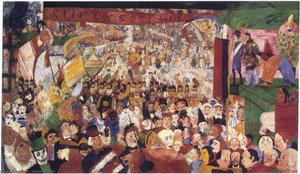
During the late 19th century much of Ensor’s work was rejected as scandalous, particularly his painting Christ’s Entry Into Brussels (1888–89). The Belgium art critic Octave Maus famously summed up the response from contemporaneous art critics to Ensor's innovative (and often scathingly political) work: “Ensor is the leader of a clan. Ensor is the limelight. Ensor sums up and concentrates certain principles which are considered to be anarchistic. In short, Ensor is a dangerous person who has great changes. ... He is consequently marked for blows. It is at him that all the harquebuses are aimed. It is on his head that are dumped the most aromatic containers of the so-called serious critics.” Some of Ensor's contemporaneous work reveals his defiant response to this criticism.
Ensor’s artistic style evolved dramatically over time, reflecting a profound engagement with psychological exploration and social critique. Initially influenced by Rembrandt, Redon, Goya, Japanese woodcuts, Brueghelian images and contemporary spoofs, Ensor developed a highly personal iconography and design. He rejected French Impressionism and Symbolism and lent himself to the expressive qualities of light, line, colour and the grotesque and macabre motifs such as carnival masks and skeletons, which he rendered in massive tableaux such as *The Aureoles of Christ* (1885–86) and *Skeletons Fighting over a Hanged Man* (1891). These grotesque metamorphoses culminate in Ensor’s most well-known and monumental mask tableau: *Christ’s Entry Into Brussels* (1888–89, oil on canvas, Los Angeles, J. Paul Getty Museum).
Ensor is now widely recognized as a pivotal figure in the transition from 19th-century Symbolism to early 20th-century Expressionism and Surrealism—a true pioneer of modern art. His fearless exploration of the subconscious, his embrace of grotesque imagery, and his rejection of academic conventions paved the way for future generations of artists who dared to challenge artistic norms. Despite facing initial resistance, Ensor eventually gained recognition in his later years, being named a Baron by King Albert I in 1929 and awarded the Légion d’honneur in 1933. He died in Ostend in 1949, leaving behind a body of work that continues to captivate, disturb, and inspire.

1860 - 1949 , Belçika

Explore the profound evolution of Post-Impressionist landscapes. From Van Gogh's emotional brushwork to Cézanne's structural mastery, discover how these visionaries redefined art history through color and form in this expert guide for fine art enthusiasts.


En son sanat haberlerinden, özel tekliflerden ve dekorasyon fikirlerinden haberdar olun.
Projenizden bize bahsedin; sanat uzmanlarımız size özel 3 sanat eseri önerisi sunsun.
Size Özel 3 Seçeneği Ücretsiz Olarak Hazırlayalım!


 Önizleme yap
 Paylaş
 Paylaş
 Detayları Gör

 İndir
İndir
 Benzerlerini gör
 X-Işını
 Slayt Gösterisi

 Tümünü Gör







 Cam seçeneği yalnızca 110 cm altındaki boyutlar için mevcuttur.