x

Sanatçılarımız tarafından sipariş üzerine hazırlanan; istediğiniz boyut ve çerçevede, tuval üzerine el boyaması yağlı boya. ( Baskı satın al Görsel satın al)





























Eserin orijinal oranlarıyla uyumlu, önceden belirlenmiş boyutlarımız arasından seçim yapın.

Belirli bir çerçeveye veya alana uyması için kendi boyutlarınızı girebilirsiniz. Seçtiğiniz boyut orijinal görüntünün oranlarıyla eşleşmiyorsa, sanat eserini kırparak veya ek el boyaması öğelerle resmi uzatarak ayarlayacağız. Üretim başlamadan önce onayınız için dijital bir taslak gönderilecektir.
Lütfen ekrandaki önizlemenin gerçek kırpmayı veya uzatmayı yansıtmadığını unutmayın. Nihai kompozisyonu yalnızca hazırlanan taslak doğru şekilde gösterecektir.
Özel boyutlar mevcut olsa da, orijinal oranları korumak adına önceden tanımlanmış listeden bir boyut seçmenizi öneririz.
Dünya Çapında Teslimat (); standart 5 hafta yerine 3/4 haftada. (16 Ağustos). Kaliteden ödün verilmez.


The Rower
Reproduksiyon Boyutu
James Ensor's "The Rower," painted circa 1883, is not merely a depiction of a man at work; it’s a carefully constructed tableau brimming with psychological depth and unsettling ambiguity. This intimate portrait, rendered in the artist’s signature dark palette and characterized by his distinctive use of masks and symbolic imagery, invites viewers to contemplate themes of isolation, struggle, and the inherent tension between outward appearance and inner turmoil – hallmarks of Ensor's enduring artistic vision.
The scene unfolds within a relatively small canvas, dominated by the imposing presence of the boat itself. Its substantial size immediately establishes a sense of scale and effort, suggesting a demanding undertaking. The rower, positioned centrally, is an embodiment of focused determination. His posture, his grip on the oar, and the slight furrow in his brow all convey a palpable sense of exertion and unwavering resolve. Yet, this apparent strength is subtly undermined by the surrounding atmosphere – a muted, almost oppressive darkness that seems to press in from all sides.
Ensor’s masterful manipulation of light and shadow is crucial to understanding the painting's emotional resonance. The rower exists within a realm of subdued tones, punctuated by sharp contrasts – the bright white of his hat, the dark wood of the oars, and the murky depths of the water. This interplay creates a dramatic effect, drawing attention to key elements while simultaneously obscuring others, fostering a sense of mystery and unease. Notably, Ensor frequently employed masks in his work, often representing hidden identities or suppressed emotions. While not overtly visible in “The Rower,” the suggestion of masked figures lurking in the background – hinted at by the indistinct shapes on either side – reinforces this thematic concern.
Further adding to the painting’s complexity is Ensor's characteristic use of symbolism. The rower’s solitary journey across the water can be interpreted as a metaphor for life’s challenges, a relentless struggle against unseen forces. The boat itself might represent the individual’s vessel, navigating an uncertain and potentially perilous course. The lack of a clear destination or horizon line contributes to this feeling of disorientation and existential questioning – a common thread in Ensor's oeuvre.
"The Rower" stands as a pivotal work in the development of Expressionist painting, predating many of the movement’s key figures. Ensor’s willingness to distort reality and prioritize emotional impact over strict representation was revolutionary for his time. He rejected the conventions of academic art, embracing instead a raw, subjective approach that sought to capture the inner landscape of the human experience. His use of bold colors, unsettling imagery, and psychologically charged compositions paved the way for future generations of artists who challenged traditional notions of beauty and truth.
Most-Famous-Paintings offers meticulously crafted hand-painted reproductions of James Ensor’s “The Rower,” allowing art enthusiasts to experience the power and complexity of this iconic painting firsthand. Each reproduction is created by skilled artisans using archival-quality materials, ensuring that the colors and details faithfully capture the original's nuanced atmosphere. Whether adorning a study, a gallery wall, or simply serving as a source of contemplation, a Most-Famous-Paintings reproduction of “The Rower” provides a tangible connection to one of the 19th century’s most innovative and unsettling artistic voices.

James Sidney Edouard Ensor (Ostend, 13 April 1860-19 November 1949) was a Belgian painter and printmaker, an important influence on expressionism and surrealism who lived in Ostend for almost his entire life. He was associated with the artistic group Les XX.
Ensor’s father, James Frederic Ensor, born in Brussels to English parents, was a cultivated man who studied engineering in England and Germany. Ensor’s mother, Maria Catharina Haegheman, was Belgian. Ensor himself lacked interest in academic study and left school at the age of fifteen to begin his artistic training with two local painters. From 1877 to 1880 he attended the Académie Royale des Beaux-Arts in Brussels, where one of his fellow students was Fernand Khnopff. Ensor first exhibited his work in 1881.
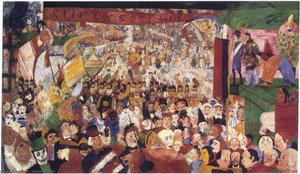
During the late 19th century much of Ensor’s work was rejected as scandalous, particularly his painting Christ’s Entry Into Brussels (1888–89). The Belgium art critic Octave Maus famously summed up the response from contemporaneous art critics to Ensor's innovative (and often scathingly political) work: “Ensor is the leader of a clan. Ensor is the limelight. Ensor sums up and concentrates certain principles which are considered to be anarchistic. In short, Ensor is a dangerous person who has great changes. ... He is consequently marked for blows. It is at him that all the harquebuses are aimed. It is on his head that are dumped the most aromatic containers of the so-called serious critics.” Some of Ensor's contemporaneous work reveals his defiant response to this criticism.
Ensor’s artistic style evolved dramatically over time, reflecting a profound engagement with psychological exploration and social critique. Initially influenced by Rembrandt, Redon, Goya, Japanese woodcuts, Brueghelian images and contemporary spoofs, Ensor developed a highly personal iconography and design. He rejected French Impressionism and Symbolism and lent himself to the expressive qualities of light, line, colour and the grotesque and macabre motifs such as carnival masks and skeletons, which he rendered in massive tableaux such as *The Aureoles of Christ* (1885–86) and *Skeletons Fighting over a Hanged Man* (1891). These grotesque metamorphoses culminate in Ensor’s most well-known and monumental mask tableau: *Christ’s Entry Into Brussels* (1888–89, oil on canvas, Los Angeles, J. Paul Getty Museum).
Ensor is now widely recognized as a pivotal figure in the transition from 19th-century Symbolism to early 20th-century Expressionism and Surrealism—a true pioneer of modern art. His fearless exploration of the subconscious, his embrace of grotesque imagery, and his rejection of academic conventions paved the way for future generations of artists who dared to challenge artistic norms. Despite facing initial resistance, Ensor eventually gained recognition in his later years, being named a Baron by King Albert I in 1929 and awarded the Légion d’honneur in 1933. He died in Ostend in 1949, leaving behind a body of work that continues to captivate, disturb, and inspire.

1860 - 1949 , Belçika

Explore the profound history and technical mastery of woodcut relief printing. From ancient origins to German Expressionism, discover how artists use the subtractive process to create iconic works. A definitive guide for art students, collectors, and historians.

Discover the technical mastery behind Most-Famous-Paintings.com's premium Giclée canvas prints. Our guide for elite collectors explores archival pigment inks, museum-grade substrates, and the science of high-fidelity reproduction to ensure lasting beauty and historical accuracy.


En son sanat haberlerinden, özel tekliflerden ve dekorasyon fikirlerinden haberdar olun.
Projenizden bize bahsedin; sanat uzmanlarımız size özel 3 sanat eseri önerisi sunsun.
Size Özel 3 Seçeneği Ücretsiz Olarak Hazırlayalım!


 Önizleme yap
 Paylaş
 Paylaş
 Detayları Gör

 İndir
İndir
 Benzerlerini gör
 X-Işını
 Slayt Gösterisi
 Tümünü Gör







 Cam seçeneği yalnızca 110 cm altındaki boyutlar için mevcuttur.