x

Музейна якість друку جيкле або на полотні з оперативним виготовленням та різноманітними варіантами фінішної обробки. ( Замовити репродукцію ручної роботи Купити цифрове зображення)





























Обирайте з наших стандартних розмірів, що відповідають оригінальним пропорціям твору мистецтва.

Ви можете вказати власні розміри, щоб репродукція ідеально підійшла до конкретної рами або інтер'єру. Якщо обраний вами розмір не відповідає пропорціям оригіналу, ми або обріжемо полотно, або розширимо зображення за допомогою дзеркального відображення чи суцільної заливки країв. Перед початком виробництва вам буде надіслано цифровий макет для затвердження.
Будь ласка, зверніть увагу, що попередній перегляд на екрані не відображає фактичне обрізання або розширення. Тільки макет точно покаже фінальну композицію.
Хоча можливість замовлення індивідуальних розмірів доступна, ми рекомендуємо обирати формат із попередньо визначеного списку, щоб зберегти оригінальні пропорції.
Доставка по всьому світу () за 2 тижні замість стандартних 4/5 тижнів. (18 Серпень)


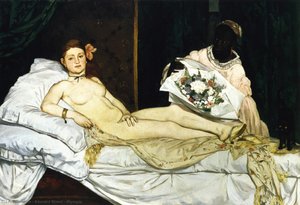
Olympia
Розмір репродукції
Édouard Manet's Olympia (1863) isn't merely a painting; it’s an audacious declaration, a seismic shift in the landscape of 19th-century art. Initially met with outrage and derision by Parisian society, this seemingly simple depiction of a nude woman has become one of the most iconic and endlessly debated works in Western art history. The canvas immediately confronts the viewer with a stark realism, devoid of the idealized beauty favored by academic painters of the time. Olympia, a courtesan, lies on her bed, attended by her black servant, Laure, who presents her with flowers – an act laden with complex social and economic implications. Manet deliberately avoids romanticizing the scene; there’s no idyllic pastoral setting, no mythological narrative to soften the blow of Olympia's nakedness. Instead, he offers a brutally honest portrayal of modern life, one that challenged the prevailing artistic conventions and sparked a furious debate about taste, morality, and representation.
Beyond the immediate depiction of a nude woman, Olympia is saturated with symbolic meaning. The inclusion of Laure, a black servant, was particularly controversial. It challenged the racial stereotypes prevalent in French society at the time and implicitly addressed issues of colonialism and slavery. The flowers presented by Laure are not a gesture of romantic affection but rather a transaction – a payment for services rendered. The gaze of Olympia, direct and unflinching, confronts the viewer with an uncomfortable awareness of her power and agency. The inclusion of the clock in the background subtly references time and mortality, adding another layer to the painting’s complex narrative.
Olympia debuted at the 1863 Salon, Paris's most prestigious art exhibition. The reaction was immediate and overwhelmingly negative. Critics condemned Manet for his unflinching realism, his lack of classical training, and his perceived vulgarity. They accused him of copying Delacroix’s *Saturn* and of depicting a prostitute in a manner that was both shocking and morally reprehensible. However, despite the initial outrage, Olympia ultimately played a crucial role in paving the way for Impressionism and other modern art movements. Manet's refusal to conform to academic standards forced the art world to confront new possibilities in representation and subject matter. His work demonstrated that beauty could be found not just in idealized forms but also in the complexities of everyday life, forever changing the course of art history.


1832 - 1883 , Франція
Відкрийте 25 культових картин Едуара Мане – імпресіонізм, скандали та геній! Історія мистецтва, техніки живопису та шедеври для вашого дому. Репродукції картин високої якості на Most-Famous-Paintings.com.

Explore the life & art of Édouard Manet, a pivotal figure bridging Realism and Impressionism. Discover his revolutionary techniques, controversial masterpieces like 'Olympia,' and lasting impact on modern art history.
Відкрийте для себе 10 шедеврів імпресіонізму від Моне, Ренуара та Дега! Історія створення, унікальні техніки та вплив на мистецтво. Купуйте репродукції картин імпресіонізм преміум-якості на . Дослідіть колекцію онлайн!

Пориньте у світ імпресіонізму! Відкрийте 10 культових картин Моне, Ренуара та Дега. Історія мистецтва, кольори та техніка – все для натхнення вашого дому. Репродукції музейної якості на Most-Famous-Paintings.com.

Journey through Impressionistic Realism with 10 iconic masterpieces by Monet, Renoir & Van Gogh. Explore art history, techniques & find museum-quality reproductions for your home at Most-Famous-Paintings.com. Discover all masterpieces online!


Будьте в курсі останніх новин зі світу мистецтва, ексклюзивних пропозицій та ідей для декорування.
Розкажіть нам про свій проєкт, і наші експерти з мистецтва підготують для вас 3 персоналізовані пропозиції щодо творів мистецтва.
Дозвольте нам підібрати 3 варіанти спеціально для вас — безкоштовно!


 Переглянути в інтер'єрі
 Надіслати як листівку
 Поділитися
 Детальніше

 Завантажити
 Схожі експонати
 Рентгенівське дослідження
 Слайд-шоу

 Читати далі







 Скляний варіант доступний лише для розмірів до 110 см