


x

 OilWallArtDutch Golden Age
 1660
1660 76.0 x 62.0 cm
 Музей Метрополітен
Написана вручну олією на полотні у вашому розмірі та рамі, виготовлена на замовлення нашими художниками. ( Замовити принт Купити цифрове зображення)





























Обирайте з наших стандартних розмірів, що відповідають оригінальним пропорціям твору мистецтва.

Ви можете вказати власні розміри, щоб репродукція ідеально підійшла до конкретної рами або інтер'єру. Якщо вибраний вами розмір не відповідає пропорціям оригіналу, ми або обріжемо полотно, або доповнимо картину додатковими елементами, промальованими вручну. Цифровий макет буде надіслано вам на затвердження перед початком виробництва.
Зверніть увагу, що попередній перегляд на екрані не відображає фактичне обрізання або розширення зображення. Тільки макет точно покаже остаточну композицію.
Хоча ми можемо виготовити виріб у нестандартному розмірі, для збереження оригінальних пропорцій рекомендуємо обирати варіанти зі встановленого списку.
Доставка по всьому світу () за 3–4 тижні замість стандартних 5 тижнів. (22 Серпень). Без жодних компромісів у якості.


Curiosity
Розмір репродукції
Gerard ter Borch's “Curiosity,” painted around 1660-62, isn’t a grand historical scene or a dramatic portrait; instead, it offers a profoundly intimate glimpse into the quiet domesticity of the Dutch Golden Age. This remarkable work, measuring just 76 x 62 cm, immediately draws the viewer in with its masterful use of light and shadow, creating an atmosphere of subtle tension and unspoken connection. The painting depicts three women – a seamstress meticulously working at her needle, a lady absorbed in a book, and a third figure observing them from a distance – within a modestly furnished room. It’s a scene brimming with understated observation, capturing the nuances of human interaction with remarkable psychological depth.
Ter Borch was a pioneer of Dutch genre painting, renowned for his ability to portray everyday life with an unparalleled level of realism and emotional sensitivity. Unlike many of his contemporaries who favored heroic subjects or elaborate compositions, Ter Borch focused on the ordinary – the moments of quiet contemplation, the subtle gestures, and the unspoken relationships that define human experience. “Curiosity” exemplifies this approach perfectly; it’s not about showcasing wealth or status but rather exploring the complexities of female companionship and the quiet drama of domestic life.
The painting's power lies in Ter Borch’s extraordinary technical skill. He employs a technique known as ‘chiaroscuro,’ dramatically contrasting areas of light and shadow to create a sense of depth and volume. Notice how the soft, diffused light illuminates the women’s faces and hands, while the background remains shrouded in darkness, drawing our attention to their immediate presence. The textures are equally compelling – the delicate weave of the seamstress's dress, the smooth surface of the book, the rough fabric of the chair—all rendered with painstaking detail.
Ter Borch’s meticulous approach is evident in his rendering of fabrics and drapery. He doesn’t simply depict them; he captures their tactile quality, allowing us to almost feel the weight and texture of each garment. This attention to detail extends to every element of the scene, creating a remarkably immersive experience for the viewer. The subtle variations in tone and shading contribute significantly to the painting's overall sense of realism and immediacy.
The composition itself is laden with symbolic meaning. The seamstress, focused on her work, represents diligence and industry – a valued trait in 17th-century Dutch society. The lady reading suggests intellectual pursuits and a connection to the wider world beyond the domestic sphere. And the woman observing them from afar—a figure often interpreted as the artist’s wife, Gesina ter Borch—hints at a subtle power dynamic and perhaps a hint of melancholy. Her averted gaze invites speculation about her thoughts and feelings.
The inclusion of the dog adds another layer of complexity to the scene. It represents loyalty, companionship, and the simple pleasures of domestic life. The dog’s presence further emphasizes the intimacy of the setting and the close-knit relationships between the women. “Curiosity” isn't merely a portrait; it’s a carefully constructed tableau that invites us to contemplate the mysteries of human connection and the quiet beauty of everyday moments.
Most-Famous-Paintings offers exquisite, hand-painted reproductions of Gerard ter Borch’s “Curiosity,” meticulously crafted by our team of skilled artists using traditional techniques. Each reproduction captures the original painting's luminous quality and psychological depth, allowing you to bring this remarkable work into your home or office. Available in a range of sizes, our high-quality prints are perfect for collectors, interior designers, and anyone who appreciates the beauty and artistry of Dutch Golden Age painting. Explore our selection today and experience the timeless allure of “Curiosity.”

Gerard ter Borch (Dutch: Gerard Terburg; December 1617 – 8 December 1681), also known as Gerard Terborch, was a Dutch Golden Age painter who profoundly impacted the artistic landscape of his time. Born in Zwolle, Netherlands, he emerged from a family steeped in artistic tradition—his father, Gerard ter Borch the Elder, was himself a respected artist—and quickly established himself as a master of genre painting, marking a pivotal moment in Dutch art history.
Early Life and Influences
Notable Works and Achievements
Museum Collections Featuring Ter Borch’s Work
Legacy and Impact
Ter Borch’s influence extended far beyond his contemporaries, notably impacting artists like Gabriel Metsu, Gerrit Dou, Eglon van der Neer, and Johannes Vermeer. His groundbreaking approach to genre painting—focusing on capturing the complexities of human emotion and portraying scenes from daily life with remarkable realism—established a new paradigm for artistic expression. He is considered a cornerstone of Dutch art history, shaping the stylistic trajectory of subsequent generations of painters.
For more information about Gerard ter Borch’s life and work, visit Most-Famous-Paintings.com/@/gerard-ter-borch Explore the museum Boijmans van Beuningen Rotterdam, Netherlands, featuring some of Ter Borch’s contemporaries at Most-Famous-Paintings.com/@@/a@d3arrk-museum-boijmans-van-beuningen-rotterdam-netherlands Learn more about the Dutch Golden Age and its notable artists at https://en.wikipedia.org/wiki/Dutch_Golden_Age

1617 - 1681 , Нідерланди

Explore the captivating world of Gerard ter Borch, a master of Dutch Golden Age genre painting. Discover his intimate scenes, masterful light, and lasting influence on art history. Learn more at Most-Famous-Paintings.
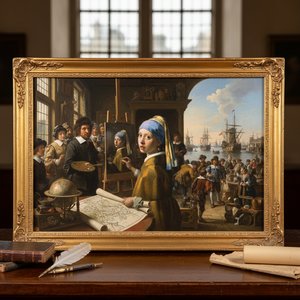
Explore the Dutch Golden Age of painting! Discover key artists like Vermeer & ter Borch, their innovative techniques, and the rich cultural context behind these Baroque masterpieces. Learn about collecting & appreciating this iconic art period.

Explore the Dutch Golden Age of painting (1600-1700) with Most-Famous-Paintings. Discover Rembrandt, Vermeer & other masters. Learn about techniques, history & find museum-quality reproductions.

Explore the captivating world of Dutch Golden Age genre painting! Discover realistic depictions of daily life, masterful artists like Ostade & Metsu, and hidden symbolism. Learn about this influential art movement with Most-Famous-Paintings.

Explore the rich history of genre painting! Discover Dutch Masters & European artists who captured everyday life with stunning realism. Learn about symbolism, techniques & lasting influence.


Будьте в курсі останніх новин зі світу мистецтва, ексклюзивних пропозицій та ідей для декорування.
Розкажіть нам про свій проєкт, і наші експерти з мистецтва підготують для вас 3 персоналізовані пропозиції щодо творів мистецтва.
Дозвольте нам підібрати 3 варіанти спеціально для вас — безкоштовно!


 Переглянути в інтер'єрі
 Надіслати як листівку
 Поділитися
 Детальніше

 Завантажити
 Схожі експонати
 Рентгенівське дослідження
 Слайд-шоу
 Читати далі







 Скляний варіант доступний лише для розмірів до 110 см


