x

 Oil On CanvasWallArtNeoclassical Style
 Early Modern
 275.0 x 203.0 cm
 Гранд-Пале
Музейна якість друку جيкле або на полотні з оперативним виготовленням та різноманітними варіантами фінішної обробки. ( Замовити репродукцію ручної роботи Купити цифрове зображення)





























Обирайте з наших стандартних розмірів, що відповідають оригінальним пропорціям твору мистецтва.

Ви можете вказати власні розміри, щоб репродукція ідеально підійшла до конкретної рами або інтер'єру. Якщо обраний вами розмір не відповідає пропорціям оригіналу, ми або обріжемо полотно, або розширимо зображення за допомогою дзеркального відображення чи суцільної заливки країв. Перед початком виробництва вам буде надіслано цифровий макет для затвердження.
Будь ласка, зверніть увагу, що попередній перегляд на екрані не відображає фактичне обрізання або розширення. Тільки макет точно покаже фінальну композицію.
Хоча можливість замовлення індивідуальних розмірів доступна, ми рекомендуємо обирати формат із попередньо визначеного списку, щоб зберегти оригінальні пропорції.
Доставка по всьому світу () за 2 тижні замість стандартних 4/5 тижнів. (20 Серпень)


Andromache Mourning Hector
Розмір репродукції
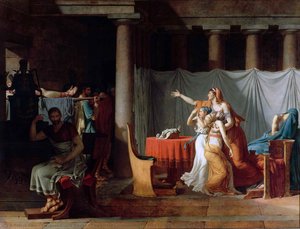
In the quiet, heavy atmosphere of Jacques-Louis David’s 1783 masterpiece, Andromache Mourning Hector, time seems to suspend itself in a moment of eternal grief. This monumental canvas does not merely depict a scene from Homeric legend; it captures the very essence of human loss. As the widow of the Trojan hero Hector, Andromache is seen cradling her young son, Astyanax, over the lifeless body of her husband. The painting serves as a profound meditation on the fragility of life and the enduring strength of familial devotion. For the discerning collector or lover of classical tragedy, this work offers more than visual beauty; it provides a window into the soul of the Neoclassical era, where the weight of history meets the raw intimacy of personal heartbreak.
The narrative depth of the piece draws its power from the epic traditions of the Iliad and Virgil’s Aeneid. David masterfully reconstructs a moment of profound vulnerability, transforming a legendary battlefield consequence into a domestic tragedy. The presence of secondary figures in the periphery adds layers of complexity to the composition, suggesting a world that continues to move even as the central protagonists are frozen in their mourning. This tension between the monumental scale of the event and the quiet, localized agony of the family creates an emotional resonance that is both haunting and deeply relatable to any viewer.
Technically, Andromache Mourning Hector represents a pivotal moment in David’s career, marking his ascent to the prestigious Académie Royale. Moving away from the light, decorative flourishes of the Rococo period, David embraced an austere grandeur characterized by anatomical precision and sculptural clarity. His use of oil on canvas allows for a breathtakingly subtle tonal gradation, particularly evident in the way light falls across the pale, marble-like skin of the fallen Hector. Through the expert application of chiaroscuro, David directs the viewer's eye toward the focal point of the anguish: the expressive, sorrowful face of Andromache.
Every brushstroke is calculated to enhance the solemnity of the subject. The artist’s commitment to classical ideals is visible in the idealized form of Hector, whose noble features remain dignified even in death. For those looking to integrate such a piece into a sophisticated interior, the painting offers a commanding presence. Its large-scale dimensions and rich, somber palette make it an ideal centerpiece for a gallery wall or a formal study, providing a sense of historical gravity and intellectual depth that contemporary works often struggle to replicate.
Beyond its literal depiction, the painting is rich with symbolic resonance. The contrast between the small, innocent Astyanax and the fallen warrior Hector symbolizes the loss of future generations and the devastating cost of war. The heavy drapery and the stark, dramatic lighting serve as metaphors for the shroud of grief that envelops the Trojan royal family. This interplay of light and shadow does more than create depth; it mirrors the psychological state of a widow caught between the memory of a hero and the reality of her abandonment.
For interior designers and art enthusiasts, a high-quality reproduction of this work brings an air of timeless elegance and academic prestige to any space. It is a piece that invites contemplation, sparking conversations about history, heroism, and the human condition. Whether placed in a sunlit salon or a moody, library-style room, David’s masterpiece remains a cornerstone of Western art, offering a perennial source of inspiration for those who find beauty in the profound and the permanent.

1748 - 1800 , Франція

Explore the life & art of Jacques-Louis David, leading Neoclassical painter of the French Revolution. Discover iconic works like 'The Death of Marat' and his lasting impact on art history. Expert analysis & high-quality reproductions at Most-Famous-Paintings.

Explore the captivating world of Neoclassical portraiture! Discover the power & ideals behind masterpieces by David, Girodet & more. Expert analysis, custom reproductions & art appraisal at Most-Famous-Paintings.

Explore the captivating world of Anne-Louis Girodet, a pivotal figure bridging Neoclassicism & Romanticism. Discover his masterpieces and unique artistic vision with Most-Famous-Paintings.

Explore the revival of classical art with our deep dive into Neoclassicism! Discover key artists like Jacques-Louis David, Enlightenment influences & lasting impact on art history. High-quality reproductions at Most-Famous-Paintings.

Explore the revival of classical art with our deep dive into Neoclassicism! Discover key artists like Jacques-Louis David, Enlightenment influences & lasting impact on art history. Learn more now.


Будьте в курсі останніх новин зі світу мистецтва, ексклюзивних пропозицій та ідей для декорування.
Розкажіть нам про свій проєкт, і наші експерти з мистецтва підготують для вас 3 персоналізовані пропозиції щодо творів мистецтва.
Дозвольте нам підібрати 3 варіанти спеціально для вас — безкоштовно!


 Переглянути в інтер'єрі
 Надіслати як листівку
 Поділитися
 Детальніше

 Завантажити
 Схожі експонати
 Рентгенівське дослідження
 Слайд-шоу
 Читати далі







 Скляний варіант доступний лише для розмірів до 110 см