x

 Олія на полотніНастінне мистецтвоPost-Impressionism
 1905— XIX століття
 Филладельфийський музей искусств
Написана вручну олією на полотні у вашому розмірі та рамі, виготовлена на замовлення нашими художниками. ( Замовити принт Купити цифрове зображення)





























Обирайте з наших стандартних розмірів, що відповідають оригінальним пропорціям твору мистецтва.

Ви можете вказати власні розміри, щоб репродукція ідеально підійшла до конкретної рами або інтер'єру. Якщо вибраний вами розмір не відповідає пропорціям оригіналу, ми або обріжемо полотно, або доповнимо картину додатковими елементами, промальованими вручну. Цифровий макет буде надіслано вам на затвердження перед початком виробництва.
Зверніть увагу, що попередній перегляд на екрані не відображає фактичне обрізання або розширення зображення. Тільки макет точно покаже остаточну композицію.
Хоча ми можемо виготовити виріб у нестандартному розмірі, для збереження оригінальних пропорцій рекомендуємо обирати варіанти зі встановленого списку.
Доставка по всьому світу () за 3–4 тижні замість стандартних 5 тижнів. (15 Серпень). Без жодних компромісів у якості.


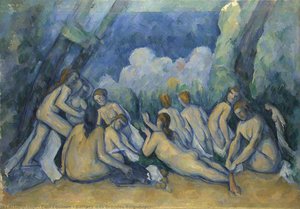
Велика басейни (Філадельфія)
Розмір репродукції
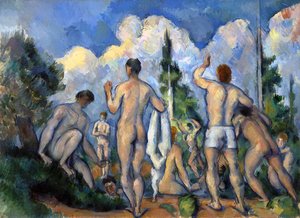
Paul Cézanne's *Large Bathers (Philadelphia)* isn’t merely a depiction of nude figures enjoying the water; it’s a profound statement about humanity’s relationship with nature, a pivotal bridge between the fleeting impressions of Impressionism and the revolutionary explorations of Cubism. Completed over seven years – from 1898 to 1905 – this monumental canvas transcends simple representation, inviting us into a world where form, space, and light intertwine in an exquisitely balanced composition. It’s a work that whispers of ancient myths, evokes a sense of timeless serenity, and challenges our very perception of reality.
The painting presents thirteen female figures nestled within a lush woodland setting, seemingly lost in quiet contemplation beside a body of water. Unlike the mythological narratives often associated with bathers, Cézanne’s women are archetypal – devoid of individualizing features, existing not *within* the landscape but as an integral part of it. They aren't characters in a story; they *are* nature itself. This deliberate choice elevates the scene to a realm of pure abstraction and symbolic resonance. The composition is masterfully structured around vertical tree trunks that act as framing elements, creating a sense of enclosure while simultaneously directing our gaze through layers of space. Cézanne intentionally flattens depth, rejecting traditional perspective in favor of a more two-dimensional approach – a bold move that anticipates the fragmented forms of Cubism and emphasizes the inherent beauty of the canvas surface.
Cézanne’s signature technique is powerfully evident throughout *Large Bathers*. He employs small, deliberate brushstrokes to build up planes of color, creating a remarkable sense of texture and underlying structure. These strokes aren't blended smoothly; instead, they retain their individual character, contributing to the painting’s dynamic energy. He reduces forms – the bodies of the women, the branches of the trees, the ripples in the water – to their essential geometric components: cylinders, cones, spheres. This simplification isn’t arbitrary; it's a deliberate attempt to distill reality down to its most fundamental elements, anticipating the deconstruction of form that would characterize Cubism. The palette is dominated by cool blues, greens, and grays—a palette evocative of twilight or early morning— punctuated by warmer ochres, browns, and flesh tones. Color isn’t used descriptively; rather, it's employed expressively, contributing to the painting’s flattened aesthetic and emphasizing formal relationships over realistic representation. The overall effect is one of luminous intensity and profound emotional depth.
*Large Bathers (Philadelphia)* emerged during a period of radical artistic experimentation in France – a time when established conventions were being challenged and new modes of expression were being explored. Cézanne’s work represents a crucial turning point, bridging the gap between Impressionism's focus on capturing fleeting moments of light and color and the more structural and analytical approach of Cubism. His exploration of form and space paved the way for future generations of artists to question traditional notions of representation. The painting’s influence can be seen in the works of Picasso, Matisse, and countless others who followed. It's a testament to Cézanne’s genius that he not only anticipated the future of art but also fundamentally altered its course. The unfinished quality of the piece adds another layer of intrigue, suggesting an ongoing process of artistic discovery – a deliberate choice by Cézanne to resist complete closure and invite continued contemplation.
Beyond its formal innovations, *Large Bathers (Philadelphia)* is rich in symbolism. The nude figures evoke classical ideals of beauty and virtue—a nod to the artistic traditions of antiquity. However, Cézanne’s treatment of the human form is far from idealized; his women are presented with a quiet dignity and an almost meditative stillness. The surrounding landscape – the trees, the water, the dappled light – reinforces this sense of harmony and connection between humanity and nature. The painting invites us to contemplate our place within the natural world, suggesting that true beauty lies not in superficial appearances but in the profound interconnectedness of all things. It’s a work that speaks to our deepest longings for peace, serenity, and a deeper understanding of ourselves and the universe around us.


1839 - 1906 , Франція

Explore the transformative era of Post-Impressionism. Discover how masters like Van Gogh moved beyond light to embrace emotion, structure, and vibrant color, redefining modern art history through expressive brushwork and symbolic depth.


Будьте в курсі останніх новин зі світу мистецтва, ексклюзивних пропозицій та ідей для декорування.
Розкажіть нам про свій проєкт, і наші експерти з мистецтва підготують для вас 3 персоналізовані пропозиції щодо творів мистецтва.
Дозвольте нам підібрати 3 варіанти спеціально для вас — безкоштовно!


 Переглянути в інтер'єрі
 Надіслати як листівку
 Поділитися
 Детальніше

 Завантажити
 Схожі експонати
 Рентгенівське дослідження
 Слайд-шоу
 Читати далі







 Скляний варіант доступний лише для розмірів до 110 см