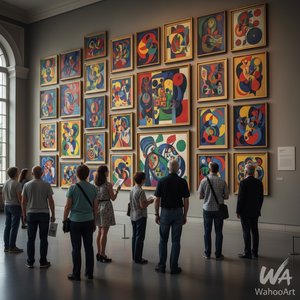
A Visionary of Form: The Life and Legacy of Trevor Bell
In the vibrant tapestry of twentieth-century British abstraction, few threads are as strikingly colored or structurally daring as those woven by Trevor Bell. Born in Leeds in 1930, Bell emerged from the industrial heart of England to become a transformative force within the prestigious St Ives School. His journey was one of profound metamorphosis, moving from the structured academic training of his youth toward a radical reimagining of what a painting could be. To encounter a Bell original is to step into a world where the boundaries of the frame dissolve, replaced by a rhythmic dance of geometry and light that continues to captivate the modern eye.
The trajectory of Bell’s career was irrevocably altered in 1955 when, drawn by the magnetic pull of the Cornish coast and encouraged by his contemporary Terry Frost, he relocated to Cornwall. This move was far more than a change in geography; it was an immersion into a crucible of creative innovation. Surrounded by the rugged landscapes and the pioneering spirits of artists like Peter Lanyon and Barbara Hepworth, Bell began to move away from representational echoes toward a pure exploration of Abstract Expressionism. The salt-sprayed light and undulating topography of St Ives provided the essential catalyst for his fascination with how color and shape could evoke the essence of nature without mimicking its literal form.
The Revolution of the Shaped Canvas
As Bell’s artistic consciousness deepened, he began to challenge the very architecture of the medium. He grew dissatisfied with the traditional rectangular window of the canvas, viewing it as a restrictive container that imposed an artificial limit on the energy of his compositions. This dissatisfaction birthed one of his most significant contributions to modern art: the shaped canvas. By manipulating the physical edges of his work, Bell allowed the painted forms to bleed into the surrounding space, creating an organic continuity between the artwork and its environment.
These experimental formats were not merely aesthetic whims but profound structural statements. Through these non-traditional boundaries, he achieved several artistic breakthroughs:
- Dynamic Interconnectivity: The edges of the canvas became active participants in the composition, guiding the viewer's eye through interlocking geometric segments.
- Spatial Expansion: His work broke the "fourth wall" of traditional painting, suggesting that the energy of the colors extended far beyond the physical fabric.
- Structural Harmony: The interplay between bold, saturated hues and meticulously calculated shapes created a sense of balanced tension, mirroring the natural rhythms of the Cornish landscape.
A Lasting Impression on British Abstraction
The historical significance of Trevor Bell lies in his ability to marry the visceral emotion of abstraction with a rigorous, almost architectural precision. While many of his contemporaries focused on the gestural spontaneity of action painting, Bell sought a more structured equilibrium. His work stands as a testament to a period when British art was bravely redefining itself on the global stage, moving away from pastoral traditions toward a sophisticated, international language of form.
Throughout his decades of experimentation, Bell remained a steadfast explorer of the relationship between color and perception. His legacy is preserved not just in museum collections, but in the very way we perceive the limits of the frame. He taught us that art need not be contained by borders, but can instead exist as an expansive, breathing entity. Today, his influence persists in the works of contemporary abstract artists who continue to push the boundaries of shape and space, forever indebted to the bold, geometric courage of this Leeds-born pioneer.