x

Ručně malovaná olejná barva na plátně ve vašem zvoleném rozměru i s rámem, vyrobená našimi umělci na zakázku. ( Koupit tisk Koupit obrázek)
Vyberte si z našich přednastavených velikostí, které odpovídají původním proporcím díla.

Můžete zadat vlastní rozměry pro konkrétní rám nebo prostor. Pokud se vámi vybraná velikost neshoduje s proporcemi původního obrazu, dílo buď ořízneme, nebo jej doplníme ručně malovanými prvky. Před zahájením výroby vám bude zaslán digitální náhled ke schválení.
Upozorňujeme, že náhled na obrazovce neodpovídá skutečnému ořezu ani rozšíření. Pouze digitální náhled přesně zobrazí finální kompozici.
Ačkoliv je možné zvolit vlastní velikost, pro zachování původních proporcí doporučujeme vybrat rozměr z předdefinovaného seznamu.
Celosvětová doprava () za 3–4 týdny namísto standardních 5 týdnů. (18 srpen). Bez kompromisů v kvalitě.


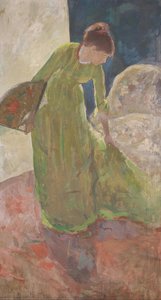
Maternity
Rozměry reprodukce

In the twilight of the nineteenth century, as the rigid structures of academic realism began to fracture under the weight of modernity, Darío de Regoyos y Valdés emerged as a transformative force in Spanish art. Born in the coastal serenity of Ribadesella, Asturias, in 1857, Regoyos was destined to bridge the gap between the traditionalist roots of his homeland and the radical, light-drenched innovations of the European avant-garde. His journey was not merely one of geographical movement but of profound stylistic evolution, as he transitioned from a disciplined student of classical technique to a pioneer who would introduce the vibrant languages of Impressionism and Neo-Impressionism to the Spanish consciousness.
His artistic foundation was laid in Madrid at the prestigious Real Academia de Bellas Artes de San Fernando, where he studied under the esteemed Carlos de Haes. While this period provided him with a rigorous command of form and composition, it was his departure for Brussels that would irrevocably alter his creative DNA. Immersed in the pulsating energy of the Belgian art scene, Regoyos became a vital participant in Les XX, a groundbreaking group of avant-garde artists dedicated to challenging established conventions. In the studios of Brussels, surrounded by luminaries such as Edmond Picard and the psychological depth of James Ensor, he began to dismantle the heavy shadows of academicism, replacing them with a fascination for the ephemeral qualities of light, atmosphere, and color.
The work of Regoyos is characterized by an extraordinary ability to capture the fleeting essence of a moment, a hallmark of the Impressionist movement. His travels through the Netherlands and Morocco served as vital catalysts for his development, providing him with a diverse palette of cultural textures and natural phenomena. In his landscapes, one can observe the influence of masters like Claude Monet and Camille Pissarro, yet Regoyos maintained a distinctively personal voice—one that could oscillate between the luminous, sun-dappled serenity of a coastal village and the more somber, poignant observations of Spanish life.
One of his most profound contributions to the art historical canon is his ability to weave social observation into his aesthetic explorations. While many of his contemporaries focused solely on the beauty of nature, Regoyos possessed a keen eye for the human condition. This is perhaps most strikingly realized in his "Black Spain" series, where he moved away from the romanticized, picturesque views of the Iberian Peninsula to document more visceral, often tragic, aspects of local traditions and customs. Through these works, he utilized the broken brushstrokes and vibrant color theories of Neo-Impressionism to lend a modern, almost documentary urgency to his subjects, creating a dialogue between the beauty of technique and the gravity of reality.
Though his radical approach was not met with widespread acclaim during his lifetime, the historical significance of Darío de Regoyos has grown exponentially in the decades since his death in 1913. He stands today as a crucial link in the chain of modern Spanish art, representing the moment when Spanish painting broke free from its provincial constraints to join the broader European dialogue. His legacy is preserved not only in the masterpieces held by institutions such as the Bilbao Fine Arts Museum and the Museu Nacional d'Art de Catalunya but also in the very spirit of innovation he championed.
To study Regoyos is to witness the birth of a modern sensibility. His life’s work remains a testament to the courage required to abandon the familiar for the sake of the new. Through his mastery of light, his embrace of the avant-garde, and his profound empathy for his subjects, he ensured that the evolution of Spanish painting would forever be marked by a more luminous, complex, and deeply human perspective.

1857 - 1913


Buďte na tahu s nejnovějšími novinkami ze světa umění, exkluzivními nabídkami a inspirativními nápady na dekoraci.
Sdělte nám více o svém projektu a naši odborníci na umění vám připraví 3 personalizované návrhy uměleckých děl.
Nechť pro vás vybereme 3 možnosti – zdarma!


 Náhled
 Sdílet
 Sdílet
 Podrobnosti o díle

 Stáhnout
 Podobné položky
 Rentgenové snímky
 Slideshow
 Zobrazit více




































 Skleněná varianta je dostupná pouze u rozměrů menších než 110 cm