


x

 Oil On CanvasWallArtExpressionism
 1954
1954 51.0 x 61.0 cm
 Kunstförderungssammlung
Handgemaltes Ölgemälde auf Leinwand in Ihrer Wunschgröße und mit Rahmen, auf Bestellung von unseren Künstlern angefertigt. ( Druck bestellen Bild kaufen)





























Wählen Sie aus unseren vordefinierten Formaten, die den ursprünglichen Proportionen des Kunstwerks entsprechen.

Sie können Ihre eigenen Maße eingeben, um einen bestimmten Rahmen oder Platz auszufüllen. Wenn die gewählte Größe nicht den Proportionen des Originalbildes entspricht, werden wir das Kunstwerk entweder beschneiden oder das Gemälde durch zusätzliche, handgemalte Elemente erweitern. Ein digitales Mockup wird Ihnen zur Genehmigung zugesandt, bevor die Produktion beginnt.
Bitte beachten Sie, dass die Bildschirmvorschau nicht die tatsächliche Beschneidung oder Erweiterung widerspiegelt. Nur das Mockup zeigt die endgültige Komposition exakt an.
Obwohl Sondermaße verfügbar sind, empfehlen wir, eine Größe aus der vordefinierten Liste zu wählen, um die ursprünglichen Proportionen beizubehalten.
Weltweiter Versand () in nur 3 bis 4 Wochen statt der üblichen 5 Wochen. (14 August). Keine Kompromisse bei der Qualität.


Two Musicians
Format der Reproduktion
Ceri Richards' "Two Musicians," painted in 1954, isn’t merely a depiction of two figures engaged in musical activity; it’s an immersive experience—a vibrant, emotionally charged exploration of sound, movement, and the very essence of artistic expression. This work, a cornerstone of Welsh modernism, transcends simple representation to become a powerful distillation of feeling, firmly rooted in Richards' deep connection to both music and the landscape of his native Wales. The painting immediately commands attention with its audacious use of color – a dominant palette of fiery oranges and reds that pulsates with an almost palpable energy. These aren’t gentle hues; they are bold, assertive strokes designed to evoke passion, intensity, and perhaps even a touch of drama.
Richards' stylistic choices firmly place “Two Musicians” within the realm of Expressionism and early Cubism, though he synthesizes these influences into something uniquely his own. The figures themselves are rendered with remarkable abstraction; their forms are simplified, almost geometric, yet retain enough recognizable human quality to suggest a narrative. Lines are thick and expressive, not meticulously outlining shapes but rather conveying movement and texture through the application of paint itself. This impasto technique—the building up of layers of pigment—creates a tactile surface, inviting the viewer to reach out and feel the energy contained within the canvas. The flattened perspective further contributes to this sense of immediacy, prioritizing emotional impact over strict adherence to realistic spatial representation.
Richards’ lifelong fascination with music served as a primary catalyst for his artistic vision. He wasn't simply painting musicians; he was attempting to capture the *feeling* of music—its rhythm, its flow, its emotional resonance. The swirling arabesque patterns that dominate the composition are directly inspired by musical notation, mirroring the intricate dance of notes on a page. The placement of the central figures, bathed in this vibrant light, suggests an intimate moment of shared experience, perhaps a duet or a conversation through music. This connection to Welsh culture is also evident; Richards’ upbringing in Dunvant, steeped in folklore and choral tradition, profoundly shaped his artistic sensibilities.
Further adding to the painting's complexity is the subtle inclusion of symbolic elements. The prominent pot, adorned with a dragon motif—a potent symbol in Welsh heraldry—appears to be an integral part of the scene, almost acting as a conduit for the music itself. Its placement behind the musicians suggests a connection between tradition, artistry, and the creative spirit. This layering of meaning elevates “Two Musicians” beyond a straightforward portrait, transforming it into a rich tapestry of cultural references and artistic intentions.
The painting’s execution is remarkably confident and assured. Richards masterfully employs color to create depth and dynamism, using warm hues to draw the eye towards the central figures while simultaneously establishing a sense of movement throughout the composition. The thick application of paint—the hallmark of his impasto technique—adds considerable texture and visual interest, inviting close examination. “Two Musicians” was created during a period of significant artistic experimentation in Britain, following the devastation of World War II. Richards’ work reflects this spirit of renewal and exploration, embracing abstraction and emotional expression as ways to grapple with the complexities of the modern world.
The painting's creation coincided with a renewed interest in Welsh identity and culture, fueled by figures like Dylan Thomas. Richards’ engagement with Thomas’ poetry—as evidenced by his later series “Homage to Dylan Thomas”—demonstrates a broader cultural dialogue taking place within Wales at the time. “Two Musicians” can be seen as part of this larger movement, reflecting a desire to celebrate Welsh heritage and artistic innovation.
Reproductions of “Two Musicians” offer a remarkable opportunity to bring Richards’ vibrant vision into your home or office. The painting's bold colors and dynamic composition will undoubtedly serve as a focal point, injecting energy and passion into any space. Consider framing the artwork in a way that complements its intensity—a dark wood frame would provide a striking contrast, while a lighter color scheme could allow the colors of the painting to truly shine. Beyond its aesthetic appeal, “Two Musicians” is a testament to Richards’ artistic genius—a powerful and evocative work that continues to resonate with viewers today.


1903 - 1971 , Vereinigte Staaten von Amerika
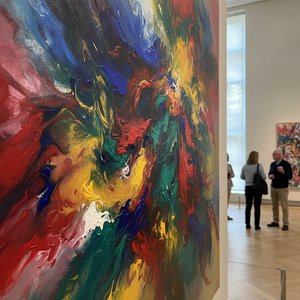
Explore the profound emotional depth of Lyrical Abstraction. Discover how masters like Raymond Parker used color and form to bridge Impressionism and Abstract Expressionism. Learn about this pivotal movement through our expert-led art history guide.

Explore the profound emotional depth of Color Field painting. Discover the history of mid-century abstraction, from Rothko to Newman, and learn how pure color transforms the viewer's experience through our expert art history guide.

Explore the profound history and emotional depth of Abstract Expressionism. From Jackson Pollock to Mark Rothko, master the nuances of the New York School through our expert art history guide. Discover museum-quality hand-painted reproductions for your collection.


Bleiben Sie über die neuesten Kunstnachrichten, exklusive Angebote und Dekorationsideen auf dem Laufenden.
Erzählen Sie uns von Ihrem Projekt, und unsere Kunstexperten erstellen für Sie drei personalisierte Kunstvorschläge.
Wir kuratieren 3 Optionen exklusiv für Sie – kostenlos!


 Vorschau anzeigen
 Versenden
 Teilen
 Details anzeigen

 Herunterladen
 Ähnliche Objekte
 Röntgenaufnahme
 Diashow
 Weiterlesen







 Die Glasoption ist nur für Größen unter 110 cm verfügbar.


