x

Handgemaltes Ölgemälde auf Leinwand in Ihrer Wunschgröße und mit Rahmen, auf Bestellung von unseren Künstlern angefertigt. ( Druck bestellen Bild kaufen)





























Wählen Sie aus unseren vordefinierten Formaten, die den ursprünglichen Proportionen des Kunstwerks entsprechen.

Sie können Ihre eigenen Maße eingeben, um einen bestimmten Rahmen oder Platz auszufüllen. Wenn die gewählte Größe nicht den Proportionen des Originalbildes entspricht, werden wir das Kunstwerk entweder beschneiden oder das Gemälde durch zusätzliche, handgemalte Elemente erweitern. Ein digitales Mockup wird Ihnen zur Genehmigung zugesandt, bevor die Produktion beginnt.
Bitte beachten Sie, dass die Bildschirmvorschau nicht die tatsächliche Beschneidung oder Erweiterung widerspiegelt. Nur das Mockup zeigt die endgültige Komposition exakt an.
Obwohl Sondermaße verfügbar sind, empfehlen wir, eine Größe aus der vordefinierten Liste zu wählen, um die ursprünglichen Proportionen beizubehalten.
Weltweiter Versand () in nur 3 bis 4 Wochen statt der üblichen 5 Wochen. (18 August). Keine Kompromisse bei der Qualität.


untitled (9919)
Format der Reproduktion
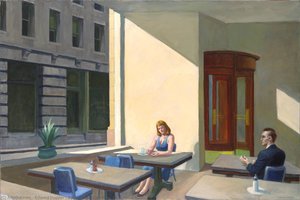
Edward Hopper's "Untitled (9919)," painted in 1942, isn’t merely a depiction of a vintage automobile and its occupant; it’s a distilled essence of American loneliness, a poignant snapshot of urban isolation rendered with remarkable precision and evocative light. The painting immediately draws the viewer into a scene of quiet contemplation, a moment suspended between the mundane and the melancholic. Hopper masterfully utilizes the geometry of the car's interior – the sharply defined dashboard, the prominent steering wheel, the angled windows – to create a sense of contained space, mirroring perhaps the internal landscape of the figure within.
The color palette is deliberately restrained, dominated by warm browns and yellows that suggest the aged leather and worn surfaces of the vehicle. These earthy tones are contrasted with the cool blues and greens of the exterior landscape, creating a subtle tension between the interior world of the driver and the anonymous city beyond. Hopper’s signature use of light – a diffused, almost artificial glow emanating from an unseen source – casts long shadows and highlights textures, lending the scene a palpable sense of depth and realism. It's not a vibrant, celebratory illumination; rather, it feels like the muted light of a late-night street, casting a contemplative mood.
Hopper was a pivotal figure in American Realism, moving beyond mere representation to capture the emotional and psychological complexities of everyday life. He wasn't interested in grand narratives or heroic figures; instead, he focused on the quiet moments, the unspoken anxieties, and the subtle gestures that define the human experience. His meticulous attention to detail – from the wrinkles around the driver’s eyes to the worn fabric of the seat – speaks volumes about his commitment to authenticity. Hopper's technique involved layering thin washes of paint, building up color gradually to create a luminous effect and capturing the nuances of light and shadow with astonishing accuracy.
Born in Nyack, New York, in 1882, Hopper’s early life instilled a deep appreciation for observation and detail. His artistic journey began with commercial illustration but quickly evolved into a profound exploration of American identity. His work often reflects the isolation and alienation prevalent in modern urban environments – themes that resonated deeply during the tumultuous years leading up to and including World War II. The painting’s composition, with its solitary figure seemingly lost in thought, powerfully embodies this sense of detachment.
The driver's posture—leaning slightly forward, absorbed in a book or document—suggests a retreat from the outside world, a desire for solitude. The open window offers a glimpse of a darkened landscape, hinting at an unseen city teeming with life yet inaccessible to the figure within. There’s a subtle tension between observation and detachment; the driver is present but not truly engaged. This ambiguity is central to the painting's enduring appeal.
"Untitled (9919)" isn’t simply a portrait of a man in a car; it’s a meditation on loneliness, contemplation, and the quiet rhythms of modern life. It invites viewers to contemplate their own experiences of isolation and the search for meaning in an increasingly complex world. Hopper's ability to capture such profound emotions with such understated elegance solidifies his place as one of America’s most enduring artists.

1931 - 1967 , Vereinigte Staaten von Amerika

Explore the profound history of American Regionalism. Discover how Grant Wood captured the heart of the Midwest through masterpieces like American Gothic. An expert guide to the movement, its cultural impact, and the enduring beauty of American Realism.

Explore the raw, evocative beauty of the Ashcan School. Discover how masters like Bellows and Glackens captured New York's urban soul through American Realism, and learn to bring this gritty, historical elegance into your modern art collection.


Bleiben Sie über die neuesten Kunstnachrichten, exklusive Angebote und Dekorationsideen auf dem Laufenden.
Erzählen Sie uns von Ihrem Projekt, und unsere Kunstexperten erstellen für Sie drei personalisierte Kunstvorschläge.
Wir kuratieren 3 Optionen exklusiv für Sie – kostenlos!


 Vorschau anzeigen
 Versenden
 Teilen
 Details anzeigen

 Herunterladen
 Ähnliche Objekte
 Röntgenaufnahme
 Diashow
 Weiterlesen







 Die Glasoption ist nur für Größen unter 110 cm verfügbar.