x

 Acryl auf LeinwandWandkunstNeoclassical Idealism
 1791
1791 66.0 x 101.0 cm
 Musée National du Château de Versailles
Handgemaltes Ölgemälde auf Leinwand in Ihrer Wunschgröße und mit Rahmen, auf Bestellung von unseren Künstlern angefertigt. ( Druck bestellen Bild kaufen)





























Wählen Sie aus unseren vordefinierten Formaten, die den ursprünglichen Proportionen des Kunstwerks entsprechen.

Sie können Ihre eigenen Maße eingeben, um einen bestimmten Rahmen oder Platz auszufüllen. Wenn die gewählte Größe nicht den Proportionen des Originalbildes entspricht, werden wir das Kunstwerk entweder beschneiden oder das Gemälde durch zusätzliche, handgemalte Elemente erweitern. Ein digitales Mockup wird Ihnen zur Genehmigung zugesandt, bevor die Produktion beginnt.
Bitte beachten Sie, dass die Bildschirmvorschau nicht die tatsächliche Beschneidung oder Erweiterung widerspiegelt. Nur das Mockup zeigt die endgültige Komposition exakt an.
Obwohl Sondermaße verfügbar sind, empfehlen wir, eine Größe aus der vordefinierten Liste zu wählen, um die ursprünglichen Proportionen beizubehalten.
Weltweiter Versand () in nur 3 bis 4 Wochen statt der üblichen 5 Wochen. (17 August). Keine Kompromisse bei der Qualität.


Das Eid der Tenniscourt
Format der Reproduktion
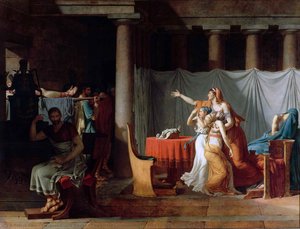
Jacques-Louis David’s “Der Eid der Tennis Court” (1791) is not merely a painting; it's a meticulously crafted tableau vivant, a frozen moment of profound political and social significance. This monumental work, measuring 66 x 101 cm, captures the pivotal event that ignited the French Revolution – the Tennis Court Oath. David, a master of Neoclassicism, deliberately eschews romanticism in favor of stark realism and an almost theatrical presentation, drawing viewers directly into the heart of this revolutionary moment.
The scene unfolds within a dimly lit room, dominated by a long table laden with legal documents and surrounded by chairs. At its center stands a group of men – lawyers, judges, and members of the Third Estate – their hands raised in solemn agreement, pledging to continue meeting until they had drafted a new constitution for France. The composition is rigorously structured; David employs a clear pyramidal arrangement, anchoring the scene with the central figures and culminating in the elevated gaze of the man at the forefront. This deliberate construction lends an air of authority and gravitas to the event, transforming it into a symbolic representation of civic duty and national unity.
David’s artistic choices are deeply rooted in the Neoclassical style, which was gaining prominence during this period. Rejecting the ornate curves and frivolous subjects of the Rococo era, Neoclassicism sought inspiration from the art and values of ancient Greece and Rome. This is evident in the painting's clear lines, balanced composition, and idealized figures. The men are depicted with a dignified severity, their faces etched with determination and purpose – embodying the virtues of reason, justice, and civic responsibility that were central to the revolutionary ideals.
The color palette is restrained, dominated by muted browns, grays, and ochres, creating an atmosphere of seriousness and solemnity. David’s masterful use of light and shadow further emphasizes the figures and their commitment. The subtle highlights on their hands, raised in oath, draw the viewer's eye directly to this gesture of unity and defiance.
Beyond the central event, “Der Eid der Tennis Court” is rich with symbolic details. The clock hanging prominently on the wall serves as a reminder of the passage of time and the urgency of the situation. The book lying open on one of the tables represents the law and the pursuit of justice – principles that were at the heart of the revolution. Even the wine glass, positioned towards the right side of the table, subtly hints at the sacrifices made in the name of liberty.
Notably, David deliberately includes women in the scene, though they are largely relegated to a secondary role. This reflects the complex social dynamics of the time – a period of great upheaval where traditional roles were being challenged and redefined. The inclusion of women subtly acknowledges their potential participation in shaping the future of France.
“Der Eid der Tennis Court” is more than just a historical record; it’s a powerful emotional statement. David masterfully captures the spirit of determination, courage, and unity that fueled the French Revolution. The painting evokes a sense of awe and respect for those who risked everything to fight for their ideals. Most-Famous-Paintings offers meticulously crafted hand-painted reproductions of this iconic artwork, allowing you to bring this pivotal moment in history into your home or office. Our reproductions faithfully capture David’s masterful technique and the painting's profound emotional impact, ensuring that this enduring masterpiece continues to inspire generations.


1748 - 1800 , Frankreich

Entdecken Sie das Leben und Werk von Jacques-Louis David, dem führenden Maler des Neoklassizismus! Erfahren Sie mehr über seine Rolle in der Französischen Revolution und sein bleibendes Vermächtnis für die Kunstgeschichte. Expertenwissen & detaillierte Analysen.

Explore the captivating world of Anne-Louis Girodet, a pivotal figure bridging Neoclassicism & Romanticism. Discover his masterpieces and unique artistic vision with Most-Famous-Paintings.

Explore the captivating world of Neoclassical portraiture! Discover the power & ideals behind masterpieces by David, Girodet & more. Expert analysis, custom reproductions & art appraisal at Most-Famous-Paintings.

Explore the revival of classical art with our deep dive into Neoclassicism! Discover key artists like Jacques-Louis David, Enlightenment influences & lasting impact on art history. Learn more now.

Explore the artistic brilliance of the Enlightenment era! Discover Rococo's elegance & Neoclassicism’s virtue with expert insights into 18th-century masterpieces. Learn about David, Kauffmann & more.


Bleiben Sie über die neuesten Kunstnachrichten, exklusive Angebote und Dekorationsideen auf dem Laufenden.
Erzählen Sie uns von Ihrem Projekt, und unsere Kunstexperten erstellen für Sie drei personalisierte Kunstvorschläge.
Wir kuratieren 3 Optionen exklusiv für Sie – kostenlos!


 Vorschau anzeigen
 Versenden
 Teilen
 Details anzeigen

 Herunterladen
 Ähnliche Objekte
 Röntgenaufnahme
 Diashow
 Weiterlesen







 Die Glasoption ist nur für Größen unter 110 cm verfügbar.