x

Handgemaltes Ölgemälde auf Leinwand in Ihrer Wunschgröße und mit Rahmen, auf Bestellung von unseren Künstlern angefertigt. ( Druck bestellen Bild kaufen)





























Wählen Sie aus unseren vordefinierten Formaten, die den ursprünglichen Proportionen des Kunstwerks entsprechen.

Sie können Ihre eigenen Maße eingeben, um einen bestimmten Rahmen oder Platz auszufüllen. Wenn die gewählte Größe nicht den Proportionen des Originalbildes entspricht, werden wir das Kunstwerk entweder beschneiden oder das Gemälde durch zusätzliche, handgemalte Elemente erweitern. Ein digitales Mockup wird Ihnen zur Genehmigung zugesandt, bevor die Produktion beginnt.
Bitte beachten Sie, dass die Bildschirmvorschau nicht die tatsächliche Beschneidung oder Erweiterung widerspiegelt. Nur das Mockup zeigt die endgültige Komposition exakt an.
Obwohl Sondermaße verfügbar sind, empfehlen wir, eine Größe aus der vordefinierten Liste zu wählen, um die ursprünglichen Proportionen beizubehalten.
Weltweiter Versand () in nur 3 bis 4 Wochen statt der üblichen 5 Wochen. (22 August). Keine Kompromisse bei der Qualität.


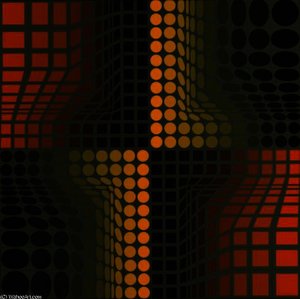
Dirac
Format der Reproduktion
Victor Vasarely's "Dirac" is not merely a painting; it’s an invitation into a realm of pure visual sensation, a testament to the burgeoning field of Op Art and the revolutionary ideas of kinetic art. Executed in a strikingly simple yet profoundly complex manner, this work embodies Vasarely’s lifelong obsession with exploring how our eyes perceive depth, movement, and order through geometric abstraction. The image itself – a vibrant yellow circle dominating a rich purple background punctuated by smaller circles – immediately draws the viewer into its captivating dance of light and form. It's a piece that demands attention, not through representational imagery, but through the sheer power of its meticulously crafted visual language.
Born in 1906 in Pécs, Croatia – then part of Austria-Hungary – Károly Vaszary, as he was initially known, embarked on a career trajectory that defied conventional artistic expectations. His early studies in medicine were abruptly abandoned in favor of visual expression, a decision profoundly shaped by his time at the Podolini-Volkmann Academy and, crucially, Sándor Bortnyik’s “Műhely” workshop. This environment, steeped in the principles of Bauhaus functional design and geometric abstraction, provided the fertile ground for Vasarely's groundbreaking style to take root. The influence is palpable here; the deliberate arrangement of circles, echoing the modular designs championed by the Bauhaus, speaks directly to this historical context. Vasarely wasn’t simply creating abstract shapes; he was actively investigating the science of perception, a field increasingly influenced by developments in physics and psychology.
The technique employed in "Dirac" is deceptively simple yet remarkably sophisticated. Vasarely utilized precise layering and color blocking to create an illusion of depth and movement – a hallmark of Op Art. The bold yellow circle, radiating outwards, appears to vibrate with energy, while the purple background provides a grounding contrast, enhancing the sense of spatial recession. The smaller circles scattered throughout the composition aren’t merely decorative elements; they contribute to the overall visual complexity, mimicking the patterns observed in natural phenomena like ripples on water or the movement of light. The title itself, referencing the renowned physicist Paul Dirac, subtly elevates the work beyond pure aesthetics, suggesting a connection between artistic exploration and scientific inquiry – a core tenet of Vasarely’s practice.
"Dirac" transcends its purely geometric form to evoke a powerful emotional response. The vibrant colors and dynamic composition generate a sense of excitement, disorientation, and ultimately, wonder. It's a piece that challenges the viewer to actively engage with the artwork, questioning their own perceptions and assumptions about space and time. Vasarely’s work represents a pivotal moment in 20th-century art, anticipating developments in digital art and interactive installations. A hand-painted reproduction of "Dirac" offers an unparalleled opportunity to experience this seminal work firsthand, bringing its captivating visual language into your home or studio – a bold statement of style and intellectual curiosity.
Victor Vasarely (geboren Károly Vaszary) war eine zentrale Figur in der Entwicklung der Op Art und kinetischen Kunst. Seine Arbeit versuchte, die traditionelle Malerei zu überwinden, indem er optische Illusionen erforschte und dynamische visuelle Erfahrungen schuf. Geboren in Pécs, damals Teil Österreich-Ungarns (heute Kroatien), umfassten seine frühen Jahre ein Medizinstudium an der Eötvös Loránd Universität in Budapest, bevor er sich ganz der Kunst widmete.
Vasarelys Beitrag zur Kunstgeschichte ist vielschichtig. Er ging über traditionelle Maltechniken hinaus, um Werke zu schaffen, die die Wahrnehmung des Betrachters aktiv einbeziehen. Sein systematischer Ansatz forderte konventionelle Vorstellungen künstlerischer Kreativität heraus und ebnete den Weg für computergenerierte Kunst und digitales Design. Indem er Reproduzierbarkeit und kommerzielle Anwendungen annahm, verschwamm Vasarely die Grenzen zwischen bildender Kunst und Populärkultur und hinterließ einen bleibenden Eindruck in beiden Bereichen.

1906 - 1997 , Kroatien

Explore the profound impact of Minimalism and Geometric Abstraction. From Mondrian to Malevich, discover how stripping art to its essential forms revolutionized modern aesthetics through our expert-led historical guide.

Explore the science of Op Art through the lens of masters like Victor Vasarely. Discover how geometric abstraction uses optical illusions to create movement and delve into the neuroaesthetics of perception with our expert art history guide.

Master the complexities of Geometric Abstraction. Our expert guide explores the evolution from Cubist deconstruction to Bauhaus precision, decoding the power of shape and form. Perfect for art students seeking deep historical context and academic insight into modern masterpieces.


Bleiben Sie über die neuesten Kunstnachrichten, exklusive Angebote und Dekorationsideen auf dem Laufenden.
Erzählen Sie uns von Ihrem Projekt, und unsere Kunstexperten erstellen für Sie drei personalisierte Kunstvorschläge.
Wir kuratieren 3 Optionen exklusiv für Sie – kostenlos!


 Vorschau anzeigen
 Versenden
 Teilen
 Details anzeigen

 Herunterladen
 Ähnliche Objekte
 Röntgenaufnahme
 Diashow

 Weiterlesen







 Die Glasoption ist nur für Größen unter 110 cm verfügbar.