x

Handgemaltes Ölgemälde auf Leinwand in Ihrer Wunschgröße und mit Rahmen, auf Bestellung von unseren Künstlern angefertigt. ( Druck bestellen Bild kaufen)





























Wählen Sie aus unseren vordefinierten Formaten, die den ursprünglichen Proportionen des Kunstwerks entsprechen.

Sie können Ihre eigenen Maße eingeben, um einen bestimmten Rahmen oder Platz auszufüllen. Wenn die gewählte Größe nicht den Proportionen des Originalbildes entspricht, werden wir das Kunstwerk entweder beschneiden oder das Gemälde durch zusätzliche, handgemalte Elemente erweitern. Ein digitales Mockup wird Ihnen zur Genehmigung zugesandt, bevor die Produktion beginnt.
Bitte beachten Sie, dass die Bildschirmvorschau nicht die tatsächliche Beschneidung oder Erweiterung widerspiegelt. Nur das Mockup zeigt die endgültige Komposition exakt an.
Obwohl Sondermaße verfügbar sind, empfehlen wir, eine Größe aus der vordefinierten Liste zu wählen, um die ursprünglichen Proportionen beizubehalten.
Weltweiter Versand () in nur 3 bis 4 Wochen statt der üblichen 5 Wochen. (21 August). Keine Kompromisse bei der Qualität.


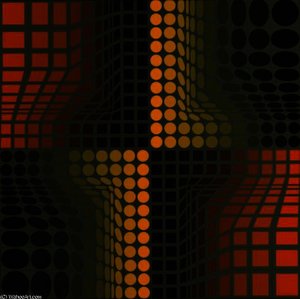
Felemash
Format der Reproduktion
Victor Vasarely's "Felemash" is more than just a painting; it’s an invitation into the heart of Op Art, a visual exploration of perception itself. This striking work, dominated by bold blues and pristine whites, exemplifies Vasarely’s pioneering approach to abstract art – one rooted in geometry, movement, and the very way our eyes interpret form. The image presents a meticulously crafted composition centered around concentric circles, each subtly varying in size, creating an illusion of depth and dynamism that draws the viewer into its captivating embrace.
Born Károly Vaszary in 1906 in Pécs, Croatia – then part of Austria-Hungary – Vasarely’s artistic trajectory was initially far removed from the canvas. His early studies in medicine hinted at a conventional path, but a profound fascination with visual expression led him to abandon his medical aspirations in 1927. This pivotal decision propelled him towards a lifelong investigation into the principles governing human perception. Crucially, Vasarely’s artistic development was profoundly shaped by his time within Sándor Bortnyik’s “Műhely” workshop, an institution deeply influenced by the Bauhaus movement. It was here that he absorbed the core tenets of functional design and geometric abstraction – concepts that would ultimately define his revolutionary style.
"Felemash" showcases Vasarely’s mastery of precise execution, a hallmark of his Op Art technique. The painting is created through meticulous layering of acrylic paint, often applied with airbrushes to achieve incredibly smooth gradients and sharp edges. This painstaking process allows for the creation of an illusion of movement and depth – the circles appear to vibrate and shift within the viewer’s eye. Vasarely's deliberate use of contrasting colors amplifies this effect, creating a dynamic tension that is both visually stimulating and intellectually engaging. The circular motifs themselves are not merely decorative; they represent fundamental geometric forms, explored through optical illusion to challenge our understanding of space and time.
While Vasarely’s work deliberately avoids overt symbolism, the repetition of circles evokes a sense of infinity, order, and dynamism. The composition can be interpreted as representing the underlying structure of the universe – a visual manifestation of mathematical principles at play. The painting's impact is profoundly emotional; it generates a feeling of excitement, wonder, and perhaps even slight disorientation, mirroring the way our brains process complex visual information. “Felemash” invites contemplation on the nature of perception and the beauty inherent in abstract forms. It’s a piece that rewards repeated viewing, revealing new nuances with each encounter.
Victor Vasarely (geboren Károly Vaszary) war eine zentrale Figur in der Entwicklung der Op Art und kinetischen Kunst. Seine Arbeit versuchte, die traditionelle Malerei zu überwinden, indem er optische Illusionen erforschte und dynamische visuelle Erfahrungen schuf. Geboren in Pécs, damals Teil Österreich-Ungarns (heute Kroatien), umfassten seine frühen Jahre ein Medizinstudium an der Eötvös Loránd Universität in Budapest, bevor er sich ganz der Kunst widmete.
Vasarelys Beitrag zur Kunstgeschichte ist vielschichtig. Er ging über traditionelle Maltechniken hinaus, um Werke zu schaffen, die die Wahrnehmung des Betrachters aktiv einbeziehen. Sein systematischer Ansatz forderte konventionelle Vorstellungen künstlerischer Kreativität heraus und ebnete den Weg für computergenerierte Kunst und digitales Design. Indem er Reproduzierbarkeit und kommerzielle Anwendungen annahm, verschwamm Vasarely die Grenzen zwischen bildender Kunst und Populärkultur und hinterließ einen bleibenden Eindruck in beiden Bereichen.

1906 - 1997 , Kroatien

Explore the science of Op Art through the lens of masters like Victor Vasarely. Discover how geometric abstraction uses optical illusions to create movement and delve into the neuroaesthetics of perception with our expert art history guide.

Explore the profound impact of Minimalism and Geometric Abstraction. From Mondrian to Malevich, discover how stripping art to its essential forms revolutionized modern aesthetics through our expert-led historical guide.

Master the complexities of Geometric Abstraction. Our expert guide explores the evolution from Cubist deconstruction to Bauhaus precision, decoding the power of shape and form. Perfect for art students seeking deep historical context and academic insight into modern masterpieces.


Bleiben Sie über die neuesten Kunstnachrichten, exklusive Angebote und Dekorationsideen auf dem Laufenden.
Erzählen Sie uns von Ihrem Projekt, und unsere Kunstexperten erstellen für Sie drei personalisierte Kunstvorschläge.
Wir kuratieren 3 Optionen exklusiv für Sie – kostenlos!


 Vorschau anzeigen
 Versenden
 Teilen
 Details anzeigen

 Herunterladen
 Ähnliche Objekte
 Röntgenaufnahme
 Diashow

 Weiterlesen







 Die Glasoption ist nur für Größen unter 110 cm verfügbar.