x

Giclée- oder Leinwanddruck in Museumsqualität mit schneller Produktion und flexiblen Veredelungsoptionen. ( Handgemalte Reproduktion bestellen Bild kaufen)





























Wählen Sie aus unseren vordefinierten Formaten, die den ursprünglichen Proportionen des Kunstwerks entsprechen.

Sie können Ihre eigenen Maße eingeben, um ein bestimmtes Format oder einen speziellen Platz einzupassen. Wenn das von Ihnen gewählte Format nicht den Proportionen des Originalbildes entspricht, werden wir das Kunstwerk entweder beschneiden oder das Bild mit einem gespiegelten oder einfarbigen Rand erweitern. Ein digitaler Entwurf wird Ihnen zur Genehmigung zugesandt, bevor die Produktion beginnt.
Bitte beachten Sie, dass die Vorschau auf dem Bildschirm nicht den tatsächlichen Zuschnitt oder die Erweiterung widerspiegelt. Nur der Entwurf zeigt die endgültige Komposition präzise an.
Obwohl Sondermaße verfügbar sind, empfehlen wir die Auswahl eines Maßes aus der vordefinierten Liste, um die ursprünglichen Proportionen zu bewahren.
Weltweiter Versand () innerhalb von 2 Wochen statt der üblichen 4/5 Wochen. (21 August)


Terz
Format der Reproduktion
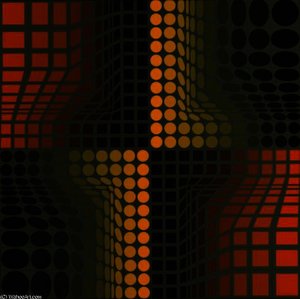
Victor Vasarely's "Terz" is more than just a painting; it’s an invitation into the very fabric of perception, a testament to the revolutionary impact of Op Art and the burgeoning fascination with geometric abstraction in the mid-20th century. This captivating work, rendered in a striking interplay of blue and white, immediately draws the viewer into its meticulously constructed world – a miniature universe contained within a seemingly simple arrangement of squares.
Born Károly Vaszary in 1906 in Pécs, Croatia (then part of Austria-Hungary), Vasarely’s artistic trajectory was initially rooted in the scientific. His early studies in medicine at Eötvös Loránd University hinted at a logical, analytical mind – a perspective that would later become central to his groundbreaking approach to art. However, abandoning the path of healing for painting in 1927 marked a profound shift, fueled by an intense desire to explore how the eye perceives and interprets visual information. This pursuit led him to the influential Podolini-Volkmann Academy and, crucially, Sándor Bortnyik’s “Műhely” workshop, where he absorbed the principles of functional design and geometric abstraction championed by the Bauhaus movement – a movement that prioritized clarity, functionality, and an understanding of optical illusions.
"Terz" exemplifies the core tenets of Op Art, a style pioneered by Vasarely and his contemporaries. This artistic movement sought to create optical illusions through precise arrangements of color and shape, manipulating the viewer’s perception of depth, movement, and space. The painting's seemingly static composition is anything but; the carefully calibrated squares generate an illusion of continuous motion, drawing the eye across the canvas in a mesmerizing dance. Vasarely wasn't simply depicting shapes; he was actively engaging with the science of visual perception, demonstrating how our brains construct reality based on sensory input.
The execution of "Terz" is characterized by an almost obsessive attention to detail. The numerous small squares are arranged in a circular fashion, creating a sense of continuity and echoing the principles of modular design. This deliberate construction isn't haphazard; it’s a carefully calculated harmony – a visual equation designed to exploit the brain’s natural tendency to seek patterns and order. Vasarely’s mastery lies in his ability to harness this inherent human response, transforming a simple geometric arrangement into a powerfully evocative image. The use of contrasting colors further amplifies the illusion, enhancing the sense of depth and movement.
"Terz," like much of Vasarely’s work, transcends mere visual representation to explore fundamental questions about reality itself. The geometric forms can be interpreted as representing the building blocks of the universe – a reflection of Vasarely's fascination with mathematics, physics, and the underlying order of existence. The painting evokes a sense of calm contemplation, inviting viewers to lose themselves in its intricate patterns and contemplate the nature of perception. It’s a piece that rewards repeated viewing, revealing new nuances and complexities with each encounter.
Victor Vasarely (geboren Károly Vaszary) war eine zentrale Figur in der Entwicklung der Op Art und kinetischen Kunst. Seine Arbeit versuchte, die traditionelle Malerei zu überwinden, indem er optische Illusionen erforschte und dynamische visuelle Erfahrungen schuf. Geboren in Pécs, damals Teil Österreich-Ungarns (heute Kroatien), umfassten seine frühen Jahre ein Medizinstudium an der Eötvös Loránd Universität in Budapest, bevor er sich ganz der Kunst widmete.
Vasarelys Beitrag zur Kunstgeschichte ist vielschichtig. Er ging über traditionelle Maltechniken hinaus, um Werke zu schaffen, die die Wahrnehmung des Betrachters aktiv einbeziehen. Sein systematischer Ansatz forderte konventionelle Vorstellungen künstlerischer Kreativität heraus und ebnete den Weg für computergenerierte Kunst und digitales Design. Indem er Reproduzierbarkeit und kommerzielle Anwendungen annahm, verschwamm Vasarely die Grenzen zwischen bildender Kunst und Populärkultur und hinterließ einen bleibenden Eindruck in beiden Bereichen.

1906 - 1997 , Kroatien

Explore the science of Op Art through the lens of masters like Victor Vasarely. Discover how geometric abstraction uses optical illusions to create movement and delve into the neuroaesthetics of perception with our expert art history guide.

Explore the profound impact of Minimalism and Geometric Abstraction. From Mondrian to Malevich, discover how stripping art to its essential forms revolutionized modern aesthetics through our expert-led historical guide.


Bleiben Sie über die neuesten Kunstnachrichten, exklusive Angebote und Dekorationsideen auf dem Laufenden.
Erzählen Sie uns von Ihrem Projekt, und unsere Kunstexperten erstellen für Sie drei personalisierte Kunstvorschläge.
Wir kuratieren 3 Optionen exklusiv für Sie – kostenlos!


 Vorschau anzeigen
 Versenden
 Teilen
 Details anzeigen

 Herunterladen
 Ähnliche Objekte
 Röntgenaufnahme
 Diashow

 Weiterlesen







 Die Glasoption ist nur für Größen unter 110 cm verfügbar.