


x

 Acrylic On CanvasWallArtTurkish Modernism
 1966
1966 5.0 x 27.0 cm
 Sakıp Sabancı Museum
Museum-quality giclée or canvas print with fast production and flexible finish options. ( Buy Hand Made Painting Buy Image)





























Pick from our preset sizes that match the artwork's original proportions.

You may enter your own dimensions to fit a specific frame or space. If your selected size does not match the original image's proportions, we will either crop the artwork or extend the image with a mirrored or solid-fill edge. A digital mockup will be sent for your approval before production begins.
Please note that the on-screen preview does not reflect the actual cropping or extension. Only the mockup will accurately show the final composition.
While custom sizes are available, we recommend selecting a dimension from the predefined list to preserve the original proportions.
Worldwide Delivery () in 2 weeks instead of standard 4/5 weeks. (18 August)


Untitled
Reproduction Size
Abidin Dino (1913-1993) stands as one of Turkey's most influential artists, a figure who seamlessly blended Eastern traditions with the burgeoning currents of European modernism. His oeuvre spanned decades and consistently demonstrated an unwavering dedication to artistic exploration—a commitment that culminated in works like “Untitled,” a captivating collage created in 1966 that offers a glimpse into Dino’s distinctive vision during a pivotal moment in Turkish art history.
The collage itself is deceptively simple at first glance. Composed of nine distinct images – predominantly photographs and drawings – it eschews traditional compositional rules, prioritizing instead an organic arrangement that draws the eye across its expanse. Each piece contributes to a larger narrative about Dino’s artistic journey and his engagement with the broader cultural landscape of the time.
Dino's style is characterized by a remarkable versatility, reflecting his exposure to various artistic movements. While rooted in Anatolian folk art traditions—evident in subtle textural qualities within some of the images—he simultaneously absorbed influences from Surrealism and Constructivism. This duality manifests itself in fragmented forms, bold color palettes (primarily muted blues and ochres), and an experimental approach to printmaking. Dino skillfully utilized techniques like photogravure and etching, demonstrating a mastery of traditional methods alongside his willingness to embrace innovative approaches.
"Untitled" emerged during the formative years of “The D Group,” a collective of Turkish artists who championed abstraction and challenged prevailing artistic conventions. Dino’s involvement with this influential group signaled a deliberate rejection of representational art, prioritizing instead exploration of form and emotion. The D Group sought to forge a distinctly Turkish aesthetic—one that transcended Western stylistic trends while acknowledging the profound impact of European modernism.
Beyond its formal qualities, “Untitled” resonates with deeper symbolic layers. Dino’s images depict figures engaged in contemplation, landscapes imbued with melancholic beauty, and abstract patterns that evoke feelings of serenity and disorientation. These elements collectively convey a sense of introspection—a preoccupation with the human condition and an awareness of the complexities inherent in artistic expression. The collage invites viewers to contemplate themes of memory, identity, and the relationship between art and reality.
“Untitled” remains a testament to Dino’s artistic genius—a work that embodies both his personal vision and the spirit of Turkish modernism. Its enduring appeal lies in its ability to captivate audiences with its understated elegance, its evocative imagery, and its profound emotional depth. Reproductions of this piece offer collectors and interior designers alike an opportunity to experience firsthand the transformative power of Dino’s artistic legacy.

Abidin Dino (1913-1993) was a pivotal Turkish artist whose work spanned several decades and reflected both his homeland’s rich cultural heritage and the influences of European modernism. His journey as an artist was marked by innovation, social commentary, and a deep commitment to artistic expression.
Born on March 23, 1913, in Istanbul, Turkey, Abidin Dino came from an art-loving family. This early exposure fostered his passion for drawing and painting. His grandfather, Abidin Pasha Dino, was an Albanian Ottoman diplomat, adding a unique cultural dimension to his lineage. He spent parts of his childhood in Geneva and France, experiencing different artistic environments before returning to Istanbul in 1925.
Dino’s formal education was briefly interrupted when he left Robert College to dedicate himself fully to art. He quickly began publishing cartoons and articles, establishing himself as a rising talent. In 1933, alongside other innovative painters, he co-founded the “D Group”, a collective that challenged conventional artistic norms in Turkey. The D Group’s exhibitions were groundbreaking for their time.
A significant turning point came when Dino was invited by Soviet director Sergei Yutkevich to work at the Lenfil Studios in Leningrad (now Saint Petersburg) in 1933. This experience, encouraged by Atatürk himself, exposed him to new artistic techniques and perspectives. He worked as a scenery designer and assistant director, even directing his own film, “Miners,” in Moscow, Kyiv, and Odesa.
Dino spent considerable time in Paris, first from 1937-1939 and then settling there permanently in 1952. He encountered leading figures of the Parisian art world, including Gertrude Stein, Tristan Tzara, and Pablo Picasso. This period was crucial for his artistic development, allowing him to absorb new influences and refine his style.
Abidin Dino’s artistic style is characterized by:
His work frequently explored themes of:
Throughout his career, Abidin Dino achieved significant recognition:
Dino continued to create art and engage with the artistic community until his death on December 7, 1993, in Villejuif Hospital, Paris. His body was returned to Istanbul for burial in Aşiyan Cemetery.
Abidin Dino’s legacy extends beyond his individual artworks. He played a vital role in bridging Turkish and European art scenes, influencing subsequent generations of artists with his innovative style and commitment to social commentary. His work remains a testament to the power of art to reflect and shape our understanding of the world.

1913 - 1993 , Turkey
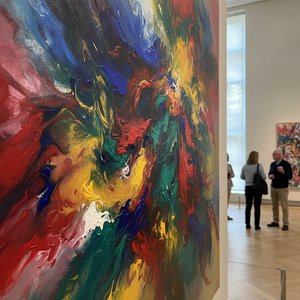
Explore the profound emotional depth of Lyrical Abstraction. Discover how masters like Raymond Parker used color and form to bridge Impressionism and Abstract Expressionism. Learn about this pivotal movement through our expert-led art history guide.

Discover the profound emotional depth and investment potential of contemporary abstraction. Our expert guide explores how texture, movement, and form create timeless value for discerning art collectors and sophisticated interiors.
Master the nuances of abstract art with our expert guide. Explore the profound emotional depth of non-objective forms, from Abstract Expressionism to Color Field painting, and learn how to curate impactful, sophisticated masterpieces for your private collection.


Stay updated with the latest art news, exclusive offers, and decoration ideas.
Tell us about your project and our art experts will provide you with 3 personalized art suggestions.
Let Us Curate 3 Options Just for You - Free!


 Preview
 Send
Send Share
Share
 Details

 Download
 Similars
 X-Ray
X-Ray Diaporama
 Read More







 Glass option is only available in size under 110 CM


