x

Museum-quality giclée or canvas print with fast production and flexible finish options. ( Switch to hand made Painting Switch to Image)
Pick from our preset sizes that match the artwork's original proportions.

You may enter your own dimensions to fit a specific frame or space. If your selected size does not match the original image's proportions, we will either crop the artwork or extend the image with a mirrored or solid-fill edge. A digital mockup will be sent for your approval before production begins.
Please note that the on-screen preview does not reflect the actual cropping or extension. Only the mockup will accurately show the final composition.
While custom sizes are available, we recommend selecting a dimension from the predefined list to preserve the original proportions.
Worldwide Delivery () in 2 weeks instead of standard 4/5 weeks. (11 August)


A Night At The Opera
Reproduction Size

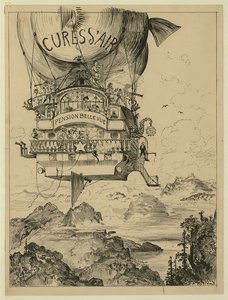
In the twilight of the nineteenth century, as the gears of the Industrial Revolution began to turn with an almost feverish intensity, one artist looked beyond the soot and steam to glimpse a future charged with electricity and wonder. Albert Robida was not merely an illustrator or a novelist; he was a temporal voyager, a man whose pen traced the outlines of a century yet to be born. Born in the historic town of Compiègne in 1848, Robida possessed a rare intellectual duality, blending the meticulous precision of a trained notary with the boundless, satirical imagination of a true storyteller. His early years, steeped in classical literature and fine arts, provided the foundation for a career that would eventually bridge the gap between the gritty realism of his era and the fantastical possibilities of science fiction.
Robida’s ascent within the vibrant Parisian art scene was fueled by his remarkable ability to capture the pulse of social change. Beginning his professional journey in 1866 with the Journal Amusant, he quickly distinguished himself through a sharp, observant eye for caricature. He did not merely draw people; he drew the very spirit of an age caught between tradition and progress. As the co-founder and editor of the satirical magazine La Caricature, he wielded his illustrations as both a mirror and a weapon, offering biting commentary on political shifts and the burgeoning anxieties of a society facing rapid technological advancement. His work during this period was characterized by an extraordinary level of detail, utilizing intricate hatching techniques that gave his compositions a tactile, breathing quality.
While his satirical sketches earned him contemporary fame, it was Robida’s profound literary and visual trilogy—comprising works such as Le Vingtième Siècle—that secured his place in the pantheon of visionary creators. In these works, Robida moved far beyond the models of his predecessors like Gustave Doré or Honoré Daumier. He constructed a "pantomimed exposition" of the future, where the air itself seemed vibrant with the hum of new inventions. His illustrations for these narratives were not merely accompaniments to text but were essential components of a larger, cohesive mythology. He envisioned a world of aerostats, telephonic communication, and mechanized wonders, often imbuing these technological marvels with a sense of everyday normalcy that made his predictions feel hauntingly plausible.
The technical mastery Robida brought to his speculative landscapes was nothing short of extraordinary. His process involved:
As the twentieth century dawned, Robida’s influence began to ripple through the burgeoning genre of science fiction. His ability to blend dystopia with satire allowed him to explore the darker side of progress—the potential for mechanized warfare and social fragmentation—while never losing the sense of whimsical wonder that defined his aesthetic. Even as his mainstream fame waned following the devastation of World War I, his impact remained etched in the DNA of visual storytelling. He paved the way for future illustrators who would seek to visualize the impossible, serving as a vital link between the romanticized past and the technological future.
Today, we look back at Robida not just as a chronicler of his time, but as an architect of our collective imagination. His work remains a testament to the power of art to transcend its era, reminding us that the most profound way to understand our present is to dare to dream of what lies beyond the horizon. Through his etchings and novels, Albert Robida continues to invite us into a world where the boundaries between reality and fantasy are perpetually blurred by the light of human ingenuity.

1848 - 1926 , France


Stay updated with the latest art news, exclusive offers, and decoration ideas.
Tell us about your project and our art experts will provide you with 3 personalized art suggestions.
Let Us Curate 3 Options Just for You - Free!


 Preview
 Send
Send Share
Share
 Details

 Download
 Similars
 X-Ray
X-Ray Diaporama
 Read More




































 Glass option is only available in size under 110 CM