Wishlist Shopping Cart Cart
Buy print Buy printBuy Image Buy Image SendSend
DetailsDetails Add to favorites Add to favorites DownloadDownload SimilarsSimilars X-RayX-Ray DiaporamaDiaporama

Landscape

Experience Romantic Orientalist watercolors by Alexandre Gabriel Decamps, capturing exotic 1840s landscapes with luminous detail; discover this masterpiece today.

Explore Alexandre Gabriel Decamps (1803-1860), the pioneer of Orientalism! Discover his vibrant depictions of exotic life, biblical scenes & humorous genre art. Find masterpieces on Most-Famous-Paintings!

Hand Made Oil Reproduction

Hand-painted oil on canvas in your size and frame, made to order by our artists.

P118B $10
P118H $10
P118W $10
P438Z $10
P508JH $12
P508YH $12
P805H $10
P805Z $10
P919BZ $10
P919G $10
P919XJ $10
P959ZH $10
P968JZ $12
W106C $8
W218G $10
W218JH $8
W218Y $10
W307PJ $10
W316G $10
W316PJ $8
W316Y $10
W398PJ $8
W4111J $10
W500HY $15
W500JH $15
W692G $12
W849H $8
W940BG $15
W953PJ $8

Standard
custom
CM
INCH

Pick from our preset sizes that match the artwork's original proportions.

width
height

You may enter your own dimensions to fit a specific frame or space. If your selected size does not match the original image's proportions, we will either crop the artwork or extend the painting with additional hand-painted elements. A digital mockup will be sent for your approval before production begins.
Please note that the on-screen preview does not reflect the actual cropping or extension. Only the mockup will accurately show the final composition.
While custom sizes are available, we recommend selecting a dimension from the predefined list to preserve the original proportions.

Examples of what can be changed: Replace face with customer photo; Add pet (e.g., replace cat with dog); Include hidden message in background; Change background landscape or elements.
After order, Most-Famous-Paintings.com team will email client for instructions and provide a mockup preview

Worldwide Delivery () in 3/4 weeks instead of standard 5 weeks. (18 July). No compromise on quality.

why_choose_icon
Free Worldwide Express Shipping
why_choose_icon
High-Quality Linen Canvas
why_choose_icon
Full Shipping Insurance
why_choose_icon
Customs Tax Refund Guarantee
why_choose_icon
True Color Matching Guarantee
why_choose_icon
60-Day Return Policy (Defects Only)
why_choose_icon
100% Money-Back Guarantee
why_choose_icon
Bulk Discount Offer

Total Price

-

reproduction

Landscape

Reproduction Medium

Reproduction Size

-

Total Price

-

Quick Facts

  • Location: Metropolitan Museum of Art
  • Year: 1840
  • Artist: Alexandre Gabriel Decamps
  • Subject or theme: Mountain scenery
  • Title: Landscape
  • Influences: Romanticism
  • Movement: Romanticism

Art Quiz

There is only one correct answer for each question.

Question 1:
What artistic movement is Alexandre Gabriel Decamps’ ‘Landscape’ primarily associated with?
Question 2:
Where can viewers find this painting?
Question 3:
Approximately when was ‘Landscape’ created?
Question 4:
The painting depicts a scene featuring what prominent element?
Question 5:
What stylistic characteristic distinguishes Decamps’ work from other artists of his time?

Artwork Description

Alexandre Gabriel Decamps: Capturing Exotic Sensations Through Romantic Watercolor

Alexandre Gabriel Decamps (1803 – 1860) stands as an intriguing figure in the annals of French art history, a painter who dared to venture beyond the confines of academic tradition and embraced the burgeoning fascination with the Orient that characterized the Romantic era. Unlike his contemporaries preoccupied with grand historical narratives or idealized landscapes, Decamps possessed a singular vision—one rooted in meticulous observation and infused with a palpable emotional resonance that distinguishes him as a pioneer of Orientalist painting.

His artistic trajectory began amidst the intellectual fervor of Paris during the mid-19th century, where discussions surrounding Eastern cultures fueled imaginative explorations. Decamps wasn’t merely documenting distant lands; he sought to convey their atmosphere and spirit—the vibrant colors, exotic flora, and captivating rituals that captivated European sensibilities. This approach aligns perfectly with the Romantic movement's emphasis on subjective experience and emotional intensity.

  • Style: Romanticism – Decamps’ canvases embody the core tenets of Romanticism, prioritizing emotion over reason and celebrating the sublime beauty of nature alongside depictions of Eastern cultures.
  • Technique: Watercolor – Primarily utilizing watercolor paint on paper, Decamps achieved remarkable luminosity and textural detail. His technique involved layering washes of color to build up depth and create atmospheric effects that transported viewers to faraway locales.
  • Subject Matter: Orientalist Landscapes – Decamps’ oeuvre is dominated by landscapes inspired by Egypt, Morocco, Persia, and Syria. These scenes are rendered with painstaking accuracy, capturing the grandeur of mountainsides, bustling marketplaces, and serene mosques.

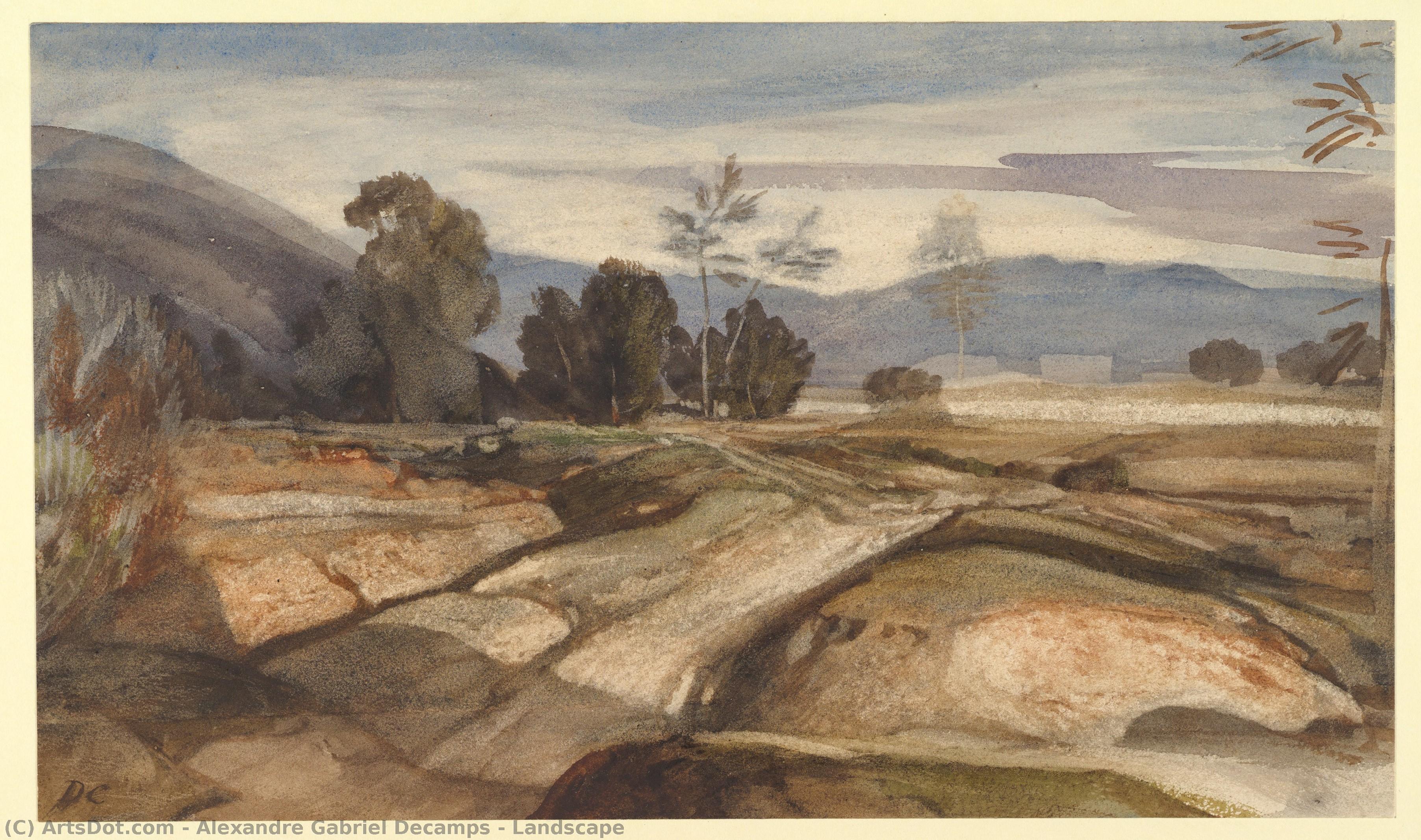
“Landscape,” created in 1840, exemplifies this distinctive style. The painting portrays a rocky hillside adorned with trees—a motif frequently employed by Romantic artists to symbolize resilience and spiritual contemplation. Decamps’ masterful brushwork captures the interplay of light and shadow, conveying not just visual information but also an emotional sense of wonder and solitude. Notably displayed at The Metropolitan Museum of Art in New York City, this artwork serves as a poignant reminder of Decamps' ability to translate sensory experience into enduring artistic expression.

Beyond its aesthetic qualities, “Landscape” speaks to the broader cultural currents of its time. It reflects the Romantic fascination with the exotic—a desire to escape the constraints of bourgeois society and immerse oneself in experiences that stirred the imagination. Decamps’ depiction of a mountainous terrain imbued with vegetation is symbolic of overcoming obstacles and achieving spiritual enlightenment – themes central to Romantic thought.

The painting's muted palette contributes significantly to its emotional impact, fostering a contemplative mood that invites viewers to contemplate the beauty and grandeur of the natural world. Decamps skillfully utilizes watercolor’s transparency to create an ethereal quality, enhancing the sense of distance and conveying the sublime—a concept championed by Romantic philosophers like Edmund Burke.

  • Historical Context: The painting emerged during a period marked by intense intellectual debate regarding the role of emotion in understanding the universe.
  • Symbolism: The trees represent resilience, while the mountain symbolizes overcoming challenges and achieving spiritual enlightenment.

Alexandre Gabriel Decamps’ “Landscape” remains an exceptional achievement—a testament to his artistic vision and a captivating illustration of Romantic painting's enduring legacy.


Artist Biography

A Pioneer of Orientalist Visions: The Life and Art of Alexandre Gabriel Decamps

Alexandre Gabriel Decamps, a name resonating with the vibrant hues of exotic landscapes and the dramatic flair of Romanticism, emerged as a pivotal figure in 19th-century French painting. Born in Paris on March 3, 1803, his artistic journey was one of bold innovation, challenging academic conventions and forging a path toward what would become known as Orientalism. While contemporaries like Delacroix and Ingres also held prominent positions within the French art world, Decamps distinguished himself through an intensely personal style—a blend of meticulous observation, dramatic composition, and a captivating narrative quality that drew viewers into worlds both familiar and utterly foreign. His early recognition as a talented artist foreshadowed a career marked by critical acclaim, culminating in the grand or council medal at the Paris Exhibition of 1855, a testament to his exceptional skill and unique vision. Beyond the canvas, Decamps was a man deeply connected to nature, finding solace and inspiration in the countryside surrounding Paris, where he indulged his passion for animals and field sports—a fondness that would subtly permeate much of his artistic output.

From Scripture to the Sahara: The Evolution of an Artistic Style

Decamps’ artistic development was characterized by a willingness to explore diverse subjects and techniques. Initially drawn to historical and biblical scenes, he quickly distinguished himself by portraying these narratives with an unprecedented level of realism—grounding them in authentic local settings rather than relying on idealized or conventional representations. This commitment to verisimilitude stemmed from his travels to the East, experiences that profoundly impacted his artistic sensibilities. He didn’t merely depict what he saw; he conveyed a feeling for the atmosphere, the light, and the very essence of these distant lands. Joseph Sold by His Brethren, for example, is not simply an illustration of a biblical story but a vivid portrayal of a specific time and place, imbued with emotional depth and psychological insight. This approach extended to his larger historical works like The Defeat of the Cimbri, where he masterfully captured the chaos and brutality of battle, showcasing his ability to handle large-scale compositions with dynamic energy. However, it was his depictions of Oriental life that truly set him apart. He revealed everyday scenes—markets, schools, domestic interiors—with a fidelity that initially puzzled critics accustomed to more romanticized or stereotypical representations.

The Father of Orientalism and His Lasting Influence

Decamps is rightfully considered the founding father of Orientalism in French painting. Before him, depictions of the East were often filtered through a lens of fantasy and exoticism. He presented a different vision—one rooted in direct observation and genuine curiosity. His 1831 Salon exhibition marked a turning point, introducing Parisian audiences to an unvarnished glimpse of life in North Africa and the Middle East. This groundbreaking approach resonated with artists and writers alike, inspiring a wave of Orientalist works that would dominate much of 19th-century art. His style—characterized by bold brushstrokes, striking contrasts of light and shadow, and a palpable sense of atmosphere—became a reference point for generations of painters, photographers, and authors. Maxime du Camp famously dubbed him the “Christopher Columbus of the Orient,” recognizing his pioneering role in opening up this new artistic territory. The Albanian Dancer, with its vibrant colors and energetic composition, exemplifies his ability to capture the spirit of a culture while maintaining a distinctly French aesthetic sensibility. Even satirical works like The Monkey Connoisseurs, a playful jab at the conservative jury of the Académie des Beaux-Arts, demonstrate his willingness to challenge established norms and embrace a more independent artistic vision.

A Tragic End and an Enduring Legacy

Tragically, Decamps’ life was cut short on August 22, 1860, at the age of 57, following a hunting accident near Fontainebleau. His untimely death robbed the art world of a truly innovative talent, but his legacy continues to endure through his captivating paintings and their enduring appeal. Today, masterpieces like Incendie d'un village italien, with its dramatic depiction of conflict and masterful use of impasto, and A Bedouin and a Camel Resting in a Desert, showcasing the textures and tranquility of desert life, are celebrated for their artistic merit and historical significance. His works can be found in prestigious institutions such as the Musée du Louvre in Paris, ensuring that his vision continues to inspire and captivate audiences worldwide. Platforms like Most-Famous-Paintings.com play a vital role in preserving and disseminating his art, offering high-quality reproductions that allow admirers to experience the beauty and power of Decamps’ paintings firsthand. His influence extends beyond the realm of painting, shaping perceptions of the East and leaving an indelible mark on the cultural landscape of 19th-century Europe.

Exploring Decamps' World: Notable Works

  • CHIENS BRIFAUTS: A charming Orientalist scene showcasing dogs in a vibrant setting.
  • LA COUR DE FERME: A captivating 19th-century painting blending French Romanticism with historical detail.
  • L’ÉCOLE TURQUE: A lively depiction of a Turkish school, capturing the energy and atmosphere of daily life.
  • PAYSAGE TURC: A serene landscape exploring realism and romanticism in a French setting.
Alexandre Gabriel Decamps

Alexandre Gabriel Decamps

1803 - 1860 , France

Quick Facts

  • Artistic Movement Or Style: Orientalism, Romanticism
  • Artists Or Movements Influenced By This Artist:
    • Delacroix
    • Théophile Gautier
  • Date Of Birth: March 3, 1803
  • Date Of Death: August 22, 1860
  • Full Name: Alexandre Gabriel Decamps
  • Nationality: French
  • Notable Artworks:
    • The Defeat of the Cimbri
    • Joseph Sold by His Brethren
    • The Monkey Connoisseurs
    • The Albanian Dancer
    • Incendie d'un village italien
    • A Bedouin and a Camel Resting
    • PAYSAGE TURC
  • Place Of Birth: Paris, France
Explore artworks organized by themes, styles, and characteristics.