x


 PaintingNeoclassicism
 1777Early Modern
 120.0 x 120.0 cm
 National Trust
Hand-painted oil on canvas in your size and frame, made to order by our artists.





























Pick from our preset sizes that match the artwork's original proportions.

You may enter your own dimensions to fit a specific frame or space. If your selected size does not match the original image's proportions, we will either crop the artwork or extend the painting with additional hand-painted elements. A digital mockup will be sent for your approval before production begins.
Please note that the on-screen preview does not reflect the actual cropping or extension. Only the mockup will accurately show the final composition.
While custom sizes are available, we recommend selecting a dimension from the predefined list to preserve the original proportions.
Worldwide Delivery () in 3/4 weeks instead of standard 5 weeks. (18 July). No compromise on quality.


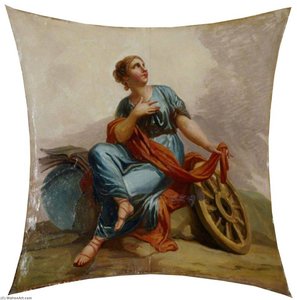
The Four Continents Europe
Reproduction Size
To gaze upon Antonio Zucchi's "The Four Continents Europe" is to step directly into the vibrant intellectual currents of the late eighteenth century. This remarkable round artwork transcends mere cartography; it functions as a grand allegory, a visual encyclopedia celebrating humanity’s reach and diversity at the cusp of modern global understanding. The composition itself, circular in form, suggests completeness and eternal cycles—a perfect microcosm reflecting the burgeoning interconnectedness of the world during Zucchi's time.
The scene is richly populated with figures representing various peoples from different lands, each group thoughtfully arranged upon their symbolic continent. One can almost hear the murmur of conversation and the rustle of exotic garments. The inclusion of specific details, such as the elephant near the bottom right corner or the bowl resting between two men on one section, anchors this grand vision in tangible reality while simultaneously elevating it to the realm of mythic representation.
Antonio Zucchi, working in the spirit of Enlightenment-era decorative arts, employed allegory as a primary narrative tool. The figures are not simply placed; they embody ideals—be it knowledge symbolized by the man holding a staff, or domestic harmony suggested by couples gathered together. Observe the careful grouping: on one segment, two men and a woman sit in quiet contemplation; adjacent to them, another pair stands poised for conversation. This masterful arrangement guides the viewer's eye across the narrative arc of global civilization.
The technique employed speaks to Zucchi’s skill as a decorative painter. While the overall effect is one of vibrant storytelling, the execution suggests careful attention to costume and posture, hallmarks of academic painting traditions that sought to educate as much as they sought to decorate. The richness of the implied color palette—even in reproduction—speaks to the depth of pigment used to bring these diverse cultures to life.
Painted in 1777, this piece captures a moment when European curiosity had expanded into an unprecedented global awareness. It is a product of the Enlightenment’s thirst for knowledge and classification. Before modern photography and instantaneous travel, such large-scale paintings served as vital educational pieces, summarizing vast geographical and anthropological data for wealthy patrons who desired both beauty and erudition in their homes. Owning a reproduction of this work connects one's space to the grand salons and libraries of the late Georgian era.
It speaks to an age fascinated by taxonomy—the desire to categorize, understand, and master the world’s peoples and places. It is a sophisticated piece of cultural commentary disguised as decorative art.
For the discerning collector or interior designer, "The Four Continents Europe" offers more than just decoration; it offers conversation. Imagine this artwork gracing a formal drawing-room or a library, its circular form acting as a unifying centerpiece for an elaborate space. The narrative depth allows it to complement various styles, from Neoclassical elegance to richly appointed traditional interiors. A high-quality reproduction allows you to harness the intellectual weight and visual splendor of Zucchi’s original vision without the constraints of museum acquisition.
It is a piece that invites study, contemplation, and admiration—a permanent testament to humanity's shared journey across the globe.


1726 - 1795

Journey through 18th century art! Explore 10 iconic paintings – from Rococo elegance to Neoclassical grandeur. Discover Fragonard, David & more. Find museum-quality reproductions and elevate your home decor on Most-Famous-Paintings.com.

Journey through 25 iconic artworks at the Metropolitan Museum of Art! Explore Van Gogh, Monet, Rembrandt & more. Discover art history, inspiring stories, and museum-quality reproductions to elevate your home decor. Explore the full collection on Most-Famous-Paintings.com.
Explore 25 iconic artworks from Washington DC's National Gallery of Art! Discover masterpieces by Cézanne, Matisse & Picasso. Find museum-quality art reproductions and elevate your home decor with timeless paintings. Explore the full collection online at Most-Famous-Paintings.com.
Journey through 25 iconic James Abbott McNeill Whistler paintings! Explore his masterpieces of Aestheticism, from 'Nocturne in Black and Gold' to captivating portraits. Find museum-quality art reproductions & elevate your home decor with Most-Famous-Paintings.com. Discover the full collection online.
Journey through 18th & 19th century art! Explore iconic masterpieces by Monet, Van Gogh & more. Discover the stories behind these timeless paintings and find museum-quality reproductions for your home at Most-Famous-Paintings.com.


Stay updated with the latest art news, exclusive offers, and decoration ideas.
Tell us about your project and our art experts will provide you with 3 personalized art suggestions.
Let Us Curate 3 Options Just for You - Free!


 Buy print
 Send
Send Share
Share
 Details

 Download
 Similars
 X-Ray
X-Ray Diaporama
 Read More







 Glass option is only available in size under 110 CM