x

 Acrylic On CanvasWallArtModern Sculpture
 1971
1971 81.0 x 58.0 cm
 The Hepworth Wakefield
Hand-painted oil on canvas in your size and frame, made to order by our artists. ( Buy Print Buy Image)





























Pick from our preset sizes that match the artwork's original proportions.

You may enter your own dimensions to fit a specific frame or space. If your selected size does not match the original image's proportions, we will either crop the artwork or extend the painting with additional hand-painted elements. A digital mockup will be sent for your approval before production begins.
Please note that the on-screen preview does not reflect the actual cropping or extension. Only the mockup will accurately show the final composition.
While custom sizes are available, we recommend selecting a dimension from the predefined list to preserve the original proportions.
Worldwide Delivery () in 3/4 weeks instead of standard 5 weeks. (20 August). No compromise on quality.


Desert Forms
Reproduction Size
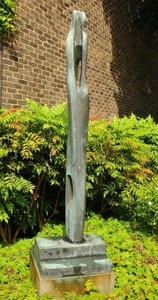
Dame Barbara Hepworth (1903–1975) stands as an icon of British modernism, particularly the sculptural movement that emerged in the mid-20th century. Her work transcends mere representation; it delves into fundamental geometric forms—circles and squares—to convey profound emotional resonance and philosophical contemplation. “Desert Forms,” created in 1971, exemplifies Hepworth’s unwavering commitment to abstraction and her masterful manipulation of material and space.
The artwork itself is a striking monochrome piece executed in bronze. Hepworth meticulously crafted two white circles—one larger than the other—upon a textured yellow background. This seemingly simple composition belies its complexity, reflecting Hepworth’s fascination with exploring the relationship between solid form and negative space. The subtle variations in surface texture contribute to an ethereal quality, mimicking the undulating contours of desert dunes.
Hepworth's approach to sculpture was deeply rooted in her belief that forms should communicate directly with the viewer’s subconscious mind. Influenced by Surrealism and Expressionism, she sought to liberate art from descriptive accuracy, prioritizing instead the conveyance of feeling and intuition. Her method involved carving away material from a block of stone—a process she termed “subtraction”—allowing the inherent form of the stone to guide her artistic vision.
“Desert Forms” speaks powerfully to themes of stillness, contemplation, and resilience. The circular shapes evoke notions of wholeness and cyclical time, mirroring the natural rhythms of the desert landscape. Simultaneously, the textured surface suggests an underlying dynamism—a hidden energy that contrasts with the apparent serenity of the piece. It’s a testament to Hepworth's ability to distill complex ideas into elegant visual forms.
The artwork resides within Tate Britain’s Prints and Drawings Room, offering visitors the opportunity to experience Hepworth’s artistic legacy firsthand. Its enduring appeal lies in its timeless beauty and its capacity to provoke introspection—a reflection of Hepworth's profound engagement with the human condition and her unwavering pursuit of artistic innovation.


1903 - 1975 , United Kingdom

Explore the profound impact of Minimalism and Geometric Abstraction. From Mondrian to Malevich, discover how stripping art to its essential forms revolutionized modern aesthetics through our expert-led historical guide.

Explore the profound history of sculpture, from classical realism to modern abstraction. Discover the mastery of form, texture, and medium through an expert art-historical lens designed for discerning collectors and enthusiasts.


Stay updated with the latest art news, exclusive offers, and decoration ideas.
Tell us about your project and our art experts will provide you with 3 personalized art suggestions.
Let Us Curate 3 Options Just for You - Free!


 Preview
 Send
Send Share
Share
 Details

 Download
 Similars
 X-Ray
X-Ray Diaporama
 Read More







 Glass option is only available in size under 110 CM