x


Hand-painted oil on canvas in your size and frame, made to order by our artists.





























Pick from our preset sizes that match the artwork's original proportions.

You may enter your own dimensions to fit a specific frame or space. If your selected size does not match the original image's proportions, we will either crop the artwork or extend the painting with additional hand-painted elements. A digital mockup will be sent for your approval before production begins.
Please note that the on-screen preview does not reflect the actual cropping or extension. Only the mockup will accurately show the final composition.
While custom sizes are available, we recommend selecting a dimension from the predefined list to preserve the original proportions.
Worldwide Delivery () in 3/4 weeks instead of standard 5 weeks. (18 July). No compromise on quality.


Proof for
Reproduction Size
Barbara Hepworth's "Proof for 'Landscape Sculpture' Ascher scarf design," created in 1947, isn’t merely a decorative print; it’s a distilled essence of the artist’s profound engagement with form and space. Born in Wakefield, Yorkshire, Hepworth’s journey into abstraction began amidst the burgeoning artistic movements of the early 20th century, influenced by her time in Italy and her close relationships with figures like Ben Nicholson. This particular work represents a pivotal moment – a bridge between her sculptural explorations and a more accessible visual language. The design itself feels almost embryonic, a preliminary sketch for a larger concept, yet it possesses an undeniable maturity and a captivating internal logic. It’s as if Hepworth is inviting us to witness the birth of an idea, a geometric meditation on the relationship between solid form and negative space.
At first glance, the composition appears deceptively simple: a network of interlocking triangles and circles arranged within a central circular void. However, closer inspection reveals a complex system of relationships. The triangles aren’t randomly placed; they seem to be striving for equilibrium, pushing against each other in a dynamic tension. They evoke the fractured planes of a landscape viewed through shifting light, mirroring Hepworth's own sculptural explorations of natural forms – rocks, water, and earth. The circles, acting as anchors, provide stability and suggest the cyclical nature of existence. The deliberate absence of a definitive ‘foreground’ or ‘background’ further enhances this sense of spatial ambiguity, inviting the viewer to actively participate in constructing their own interpretation.
Symbolism Note:Hepworth was deeply influenced by Surrealist ideas and sought to capture the subconscious through her art. The fragmented forms can be interpreted as representing the brokenness of experience, while the circular void suggests a yearning for wholeness or perhaps an acceptance of incompleteness.
Understanding “Proof for ‘Landscape Sculpture’ Ascher scarf design” requires acknowledging Barbara Hepworth's broader artistic context. She was a key figure in the Unit One movement, alongside Ben Nicholson and Paul Nash, which aimed to synthesize Surrealist and abstract principles within British art. Her sculptural work, characterized by its clean lines, biomorphic forms, and exploration of negative space, profoundly influenced her printmaking. The design’s geometric precision reflects this commitment to reductive abstraction – stripping away extraneous detail to reveal the essential form. Her sculptures often sought to capture a sense of movement and dynamism, qualities that are subtly echoed in the arrangement of shapes within the print.
Despite its intellectual rigor, “Proof for ‘Landscape Sculpture’ Ascher scarf design” possesses a remarkable emotional resonance. The muted colors and carefully considered composition evoke a sense of quiet contemplation – an invitation to slow down and observe the subtle beauty of form. It's not a work that demands immediate attention; rather, it rewards patient viewing with a growing appreciation for its intricate details and underlying harmony. The design’s inherent ambiguity allows it to resonate differently with each viewer, making it a timeless piece that continues to provoke thought and inspire reflection. Its understated elegance makes it an ideal addition to any space seeking a touch of sophisticated serenity.


1903 - 1975 , United Kingdom

Journey through 25 iconic artworks at the Metropolitan Museum of Art! Explore Van Gogh, Monet, Rembrandt & more. Discover art history, inspiring stories, and museum-quality reproductions to elevate your home decor. Explore the full collection on Most-Famous-Paintings.com.
Journey through Wassily Kandinsky's 25 most iconic abstract paintings. Explore his revolutionary use of color, form & spiritual expressionism. Find museum-quality Kandinsky reproductions and elevate your home decor with Most-Famous-Paintings.com. Discover all masterpieces on Most-Famous-Paintings.com!

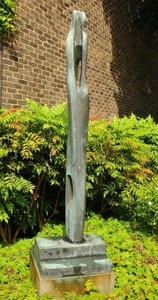
Explore the profound world of Barbara Hepworth's sculpture. Discover her artistic evolution, iconic forms, and lasting influence on modern art. A guide for collectors & enthusiasts.

Journey through art history with our Top 10 bronze sculptures! Explore masterpieces by Rodin, Michelangelo & more. Discover stories behind iconic statues and find museum-quality reproductions for your home decor at Most-Famous-Paintings.com.
Explore 10 defining masterpieces of Geometric Abstraction! Discover Kandinsky, Mondrian & Malevich’s iconic works. Find museum-quality art reproductions and curated decor ideas to elevate your home at Most-Famous-Paintings.com.


Stay updated with the latest art news, exclusive offers, and decoration ideas.
Tell us about your project and our art experts will provide you with 3 personalized art suggestions.
Let Us Curate 3 Options Just for You - Free!


 Buy print
 Send
Send Share
Share
 Details

 Download
 Similars
 X-Ray
X-Ray Diaporama


 Read More







 Glass option is only available in size under 110 CM