


x

Hand-painted oil on canvas in your size and frame, made to order by our artists.
Pick from our preset sizes that match the artwork's original proportions.

You may enter your own dimensions to fit a specific frame or space. If your selected size does not match the original image's proportions, we will either crop the artwork or extend the painting with additional hand-painted elements. A digital mockup will be sent for your approval before production begins.
Please note that the on-screen preview does not reflect the actual cropping or extension. Only the mockup will accurately show the final composition.
While custom sizes are available, we recommend selecting a dimension from the predefined list to preserve the original proportions.
Worldwide Delivery () in 3/4 weeks instead of standard 5 weeks. (18 July). No compromise on quality.


Triptych
Reproduction Size
To stand before this magnificent triptych is to step directly into the hushed, sacred atmosphere of a late Gothic chapel. This work, dating from 1460, is not merely a painting; it is a devotional portal, crafted with painstaking reverence for the divine narrative. The structure itself—the three hinged panels—invites an intimate viewing experience, suggesting that the viewer must physically open the piece to reveal its full spiritual scope. At its heart lies the central panel, where the Virgin Mary cradles the infant Jesus Christ, surrounded by celestial attendants and saints whose gazes seem to follow the eye across centuries of faith.
The technical brilliance evident in this piece speaks volumes about the skill of its creator. Executed in tempera on wood panels, the medium lends a characteristic luminosity and permanence to the colors. One can almost feel the subtle texture of the aged wood beneath the vibrant pigments. Observe the meticulous rendering of the drapery; the folds of the garments are not simply painted but seem to possess weight and life, catching the light as if they were woven from silk and prayer. The attention paid to every detail, from the delicate wings of the surrounding angels to the rich embroidery on the saints' vestments, speaks to an era where art was considered a form of sacred labor.
The narrative complexity is breathtaking. On the left wing, St. John the Baptist stands in contemplative repose, his traditional attire and the presence of the lamb serving as potent symbols of innocence and prophecy. The right panel offers a contrasting scene, perhaps within the cool embrace of a cloister, where another saint engages in deep study from a manuscript, suggesting the enduring power of scripture and contemplation. These flanking scenes do not merely decorate; they frame the central mystery—the Incarnation—with supporting pillars of Christian virtue: prophecy, devotion, and wisdom. The pointed Gothic arches framing each section further anchor the piece within an architectural vocabulary that speaks of heavenly aspiration.
This triptych belongs to a period when religious art served as both high art and essential teaching tool for the faithful. It captures the profound piety characteristic of the late Gothic era, a time deeply invested in personal spiritual experience. While the artist's hand may have been guided by the traditions of masters like Bartolomeo Vivarini, the emotional resonance is universal. For the modern collector or designer, owning such a reproduction offers more than mere decoration; it provides an immediate connection to the deep currents of European spirituality and artisanal excellence.

The name Fra Angelico – Guido di Pietro – conjures an image of a serene, contemplative figure, and indeed, the Dominican friar who bore this title was one of the most profoundly spiritual artists of the Italian Renaissance. Born around 1395 in the Mugello region of Tuscany, his life intertwined seamlessly with his art, creating a body of work that continues to resonate with its ethereal beauty and deeply felt piety. Unlike many of his contemporaries who sought patronage from wealthy merchant families or powerful courts, Angelico’s primary allegiance lay within the walls of San Domenico in Fiesole, where he served as a monk for nearly forty years. This unique context profoundly shaped his artistic vision, imbuing every brushstroke with a sense of devotion and a yearning for the divine.
Angelico's early training remains somewhat shrouded in mystery, though it’s widely believed that he apprenticed under Lorenzo Monaco, a prominent Florentine painter known for his refined style and meticulous attention to detail. However, Angelico quickly surpassed his master, developing a distinctive approach characterized by a remarkable ability to render natural forms with an almost photographic realism while simultaneously elevating them to a realm of spiritual significance. This synthesis is particularly evident in the fragments recovered from the Liber Sacrae Familiares, a choirbook commissioned for San Domenico, which offer tantalizing glimpses into his artistic process and stylistic evolution.
Fra Angelico’s artistic innovations were deeply rooted in a burgeoning interest in scientific observation and mathematical principles. He was keenly aware of the developments in linear perspective, pioneered by Filippo Brunelleschi, and skillfully employed this technique to create a sense of spatial depth and realism within his paintings. However, unlike many of his contemporaries who prioritized technical accuracy above all else, Angelico used perspective not merely as a means of achieving visual illusion but as a tool for guiding the viewer’s gaze towards the spiritual center of each scene.
Furthermore, Angelico demonstrated an exceptional ability to render natural forms with astonishing precision. His meticulous attention to detail—the delicate folds of drapery, the intricate patterns of foliage, and the subtle nuances of human expression—contributed significantly to the lifelike quality of his paintings. This commitment to realism was not simply a matter of artistic skill; it reflected Angelico’s deep reverence for God's creation and his desire to capture its beauty and wonder within his art.
It is crucial to understand that Fra Angelico’s life as a Dominican friar profoundly shaped the nature of his artistic practice. The monastic routine—characterized by prayer, contemplation, and manual labor—provided him with a framework for disciplined creativity and instilled in him a deep sense of humility and service. His paintings were not created for personal glory or material gain but as expressions of his faith and as aids to spiritual devotion.
The simplicity and austerity of the monastic environment are reflected in Angelico’s artistic style, which is marked by its clarity, restraint, and profound sense of peace. He eschewed elaborate ornamentation and dramatic gestures, focusing instead on conveying a quiet reverence for God's grace and the beauty of his creation. His works are often described as “spiritual,” reflecting the monk’s devotion to his faith.
Fra Angelico’s influence on subsequent generations of artists was immense. His innovative use of perspective, his meticulous attention to detail, and his profound spiritual sensibility helped to shape the course of Renaissance painting. Artists such as Masaccio, Botticelli, and Raphael all drew inspiration from Angelico's work, incorporating elements of his style into their own compositions.
Today, Fra Angelico’s paintings are treasured for their beauty, their historical significance, and their enduring spiritual power. His legacy extends far beyond the confines of the art world, reminding us of the transformative potential of faith and the profound connection between art and spirituality. The works he created continue to inspire awe and contemplation, offering a glimpse into the heart of a man who sought to capture the divine in every brushstroke.

1440 - 1499 , Italy

Explore the spiritual intensity & architectural innovation of Gothic art! Discover the symbolism behind cathedrals, stained glass & master artists like Giotto and Monet. A deep dive into medieval history & artistic expression.

Explore the exquisite beauty & spiritual depth of International Gothic art. Discover key artists like Simone Martini & Pol de Limbourg, its origins, symbolism, and lasting influence on European painting. Expert insights at Most-Famous-Paintings.
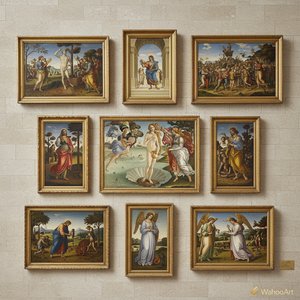
Journey through the Early Renaissance! Explore 10 iconic paintings by Botticelli, Leonardo da Vinci & Michelangelo. Discover their stories, techniques & lasting impact. Find museum-quality art reproductions and elevate your home decor with .

Journey into the Early Netherlandish Renaissance! Explore 10 iconic paintings by Jan van Eyck, Rogier van der Weyden & more. Discover stunning detail, symbolism, and oil painting techniques. Find museum-quality art reproductions for your home at Most-Famous-Paintings.com.

Transform cherished photos into museum-quality oil paintings with . Expert artists & bespoke art commissions for discerning collectors. Create a lasting legacy.


Stay updated with the latest art news, exclusive offers, and decoration ideas.
Tell us about your project and our art experts will provide you with 3 personalized art suggestions.
Let Us Curate 3 Options Just for You - Free!


 Buy print
 Send
Send Share
Share
 Details

 Download
 Similars
 X-Ray
X-Ray Diaporama


 Read More




































 Glass option is only available in size under 110 CM


