x

Museum-quality giclée or canvas print with fast production and flexible finish options. ( Buy Hand Made Painting Buy Image)





























Pick from our preset sizes that match the artwork's original proportions.

You may enter your own dimensions to fit a specific frame or space. If your selected size does not match the original image's proportions, we will either crop the artwork or extend the image with a mirrored or solid-fill edge. A digital mockup will be sent for your approval before production begins.
Please note that the on-screen preview does not reflect the actual cropping or extension. Only the mockup will accurately show the final composition.
While custom sizes are available, we recommend selecting a dimension from the predefined list to preserve the original proportions.
Worldwide Delivery () in 2 weeks instead of standard 4/5 weeks. (15 August)


the city
Reproduction Size
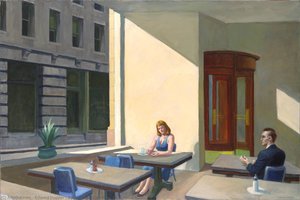
The City, painted by Edward Hopper in 1927, is a striking black and white depiction of early 20th-century American urban life. This artwork isn't merely a representation of buildings and streets; it’s an evocative exploration of solitude within the bustling metropolis.
The painting presents a typical city street, dominated by imposing structures that stretch upwards. Numerous windows suggest countless lives unfolding behind closed doors, yet remain largely anonymous and unknowable. Hopper populates the scene with a few pedestrians – figures absorbed in their own worlds, walking with heads down or lost in thought. A casually leaning bicycle and a stoic fire hydrant punctuate the streetscape, while a clock subtly emphasizes the relentless passage of time.
The City exemplifies Hopper’s signature style – American Realism imbued with profound emotional depth. His masterful use of stark black and white creates a dramatic, almost cinematic effect. The absence of color intensifies the sense of isolation and quiet contemplation. Hopper's precise rendering of architectural details—windows, clocks, fire hydrants—demonstrates meticulous observation. He wasn’t simply recording what he saw; he was distilling it to its essence, revealing psychological truths about modern urban existence.
Created during a period of rapid urbanization and social change in the United States, The City reflects a growing sense of alienation within burgeoning metropolises. Hopper was influenced by writers like Ralph Waldo Emerson, whose transcendentalist ideals explored individualism and introspection. He also drew inspiration from French Impressionists such as Manet and Degas, particularly their ability to capture fleeting moments of modern life with honesty.
The painting’s power lies in its subtle symbolism. The towering buildings represent the overwhelming scale of urban life, while the solitary figures embody a sense of anonymity and disconnection. The clock serves as a constant reminder of time's relentless march, adding to the feeling of transience and perhaps even anxiety. The City evokes nostalgia for a bygone era but also acknowledges the inherent loneliness that can accompany modern existence. It’s a work that invites quiet contemplation on the human condition.
This striking artwork would be a captivating addition to various interior settings:
To best showcase The City, consider displaying it in a well-lit space with ample wall area. A simple, neutral frame will enhance its impact without distracting from Hopper’s masterful composition. Its monochromatic palette makes it exceptionally versatile for pairing with various color schemes.
To gain a deeper understanding of Hopper’s artistic vision, explore other works that share similar themes of urban life and isolation, such as Office in a Small City, City Roofs, August in the City, and Approaching the City. These pieces offer further insight into his unique perspective on American modernity.

1931 - 1967 , United States of America

Explore the profound artistry of black and white photography. From the chemistry of gelatin silver to the chiaroscuro of the Old Masters, discover how monochrome captures the eternal essence of light, form, and emotion for the discerning art collector.


Stay updated with the latest art news, exclusive offers, and decoration ideas.
Tell us about your project and our art experts will provide you with 3 personalized art suggestions.
Let Us Curate 3 Options Just for You - Free!


 Preview
 Send
Send Share
Share
 Details

 Download
 Similars
 X-Ray
X-Ray Diaporama

 Read More







 Glass option is only available in size under 110 CM