x
 1938
1938 30.0 x 23.0 cm
Museum-quality giclée or canvas print with fast production and flexible finish options. ( Buy Hand Made Painting Buy Image)
Pick from our preset sizes that match the artwork's original proportions.

You may enter your own dimensions to fit a specific frame or space. If your selected size does not match the original image's proportions, we will either crop the artwork or extend the image with a mirrored or solid-fill edge. A digital mockup will be sent for your approval before production begins.
Please note that the on-screen preview does not reflect the actual cropping or extension. Only the mockup will accurately show the final composition.
While custom sizes are available, we recommend selecting a dimension from the predefined list to preserve the original proportions.
Worldwide Delivery () in 2 weeks instead of standard 4/5 weeks. (14 August)


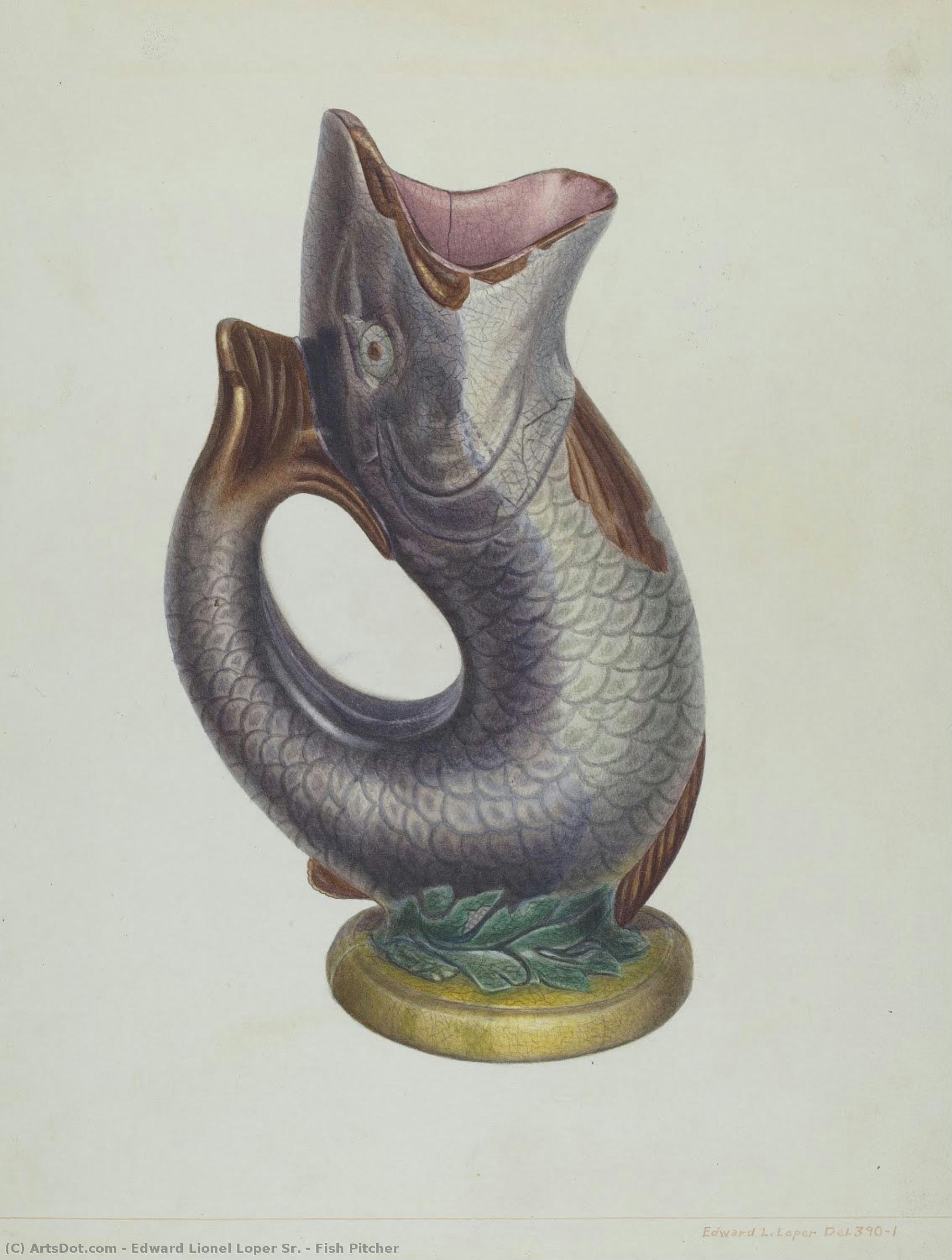
Fish Pitcher
Reproduction Size

Born Bertrand Redon in Bordeaux, France, on April 20, 1840, Odilon Redon’s life was a testament to the power of sustained artistic vision. His early years were marked by a conventional education, including studies at the École des Beaux-Arts in Paris, yet it was through self-directed exploration and a profound engagement with printmaking and drawing that he forged his unique path – one dedicated to exploring the hidden landscapes of the subconscious mind.
Redon’s artistic journey began with charcoal sketches, capturing the stark realities of everyday life. However, it was in the late 1870s that he discovered the captivating world of printmaking, a medium that allowed him to experiment with textures, tones, and multiple layers of imagery. These early “noirs,” as they became known, were intensely personal works—dreamlike visions populated by strange creatures, distorted figures, and unsettling landscapes. They represented a departure from academic realism, embracing instead the expressive potential of line and shadow.
The influence of Symbolism was crucial to Redon’s development. He found resonance in the movement's exploration of subjective experience, psychological states, and the mystical realm. His work began to incorporate elements of fantasy, mythology, and folklore, drawing inspiration from medieval tapestries, Japanese woodblock prints, and the works of Edgar Allan Poe. This fascination with the macabre and the uncanny would become a defining characteristic of his oeuvre.
As he matured as an artist, Redon’s palette shifted from the predominantly black and white of his early prints to include vibrant colors—particularly blues, greens, and reds—which he employed in pastel and oil paintings. These later works retained the dreamlike quality of his earlier pieces but were imbued with a heightened sense of color and luminosity. He began to depict scenes of rural life, fantastical creatures, and portraits that seemed to capture fleeting moments of emotion or memory. His subject matter often evoked a sense of melancholy and nostalgia, reflecting his own introspective nature.
Redon’s legacy extends far beyond the confines of the Symbolist movement. His pioneering exploration of the subconscious, his masterful use of line and color, and his ability to create images that are both unsettling and beautiful have influenced generations of artists—including Surrealists like Salvador Dalí and Max Ernst. He remains a singular figure in art history, celebrated for his unique vision and his profound engagement with the mysteries of the human psyche.
Born in Philadelphia, Pennsylvania, on September 21, 1844, Thomas Eakins was a pivotal figure in the development of American art. Unlike many of his contemporaries who sought to emulate European artistic traditions, Eakins relentlessly pursued a style that was both realistic and deeply expressive, capturing the dynamism and complexity of everyday life.
Eakins’ early training at the Pennsylvania Academy of the Fine Arts provided him with a solid foundation in traditional techniques. However, he quickly grew dissatisfied with the rigid academic approach and began to experiment with new ways of representing the human figure. He supplemented his formal education by attending anatomy lectures at Jefferson Medical College, an experience that profoundly influenced his understanding of the body’s structure and movement.
Eakins' artistic career was marked by a relentless pursuit of truth—a commitment to portraying subjects with unflinching honesty and psychological insight. He eschewed idealized representations in favor of capturing the raw energy and emotional intensity of his chosen subjects. His paintings often featured athletes, musicians, doctors, and other figures engaged in their daily activities – boxing matches, rowing competitions, medical examinations, and musical performances.
Eakins’ most famous work, *The Gross Clinic* (1875), exemplifies his innovative approach to painting. The large-scale canvas depicts a scene from Jefferson Medical College, capturing the clinical atmosphere with remarkable detail and psychological acuity. The painting's unconventional composition—with figures arranged in a dynamic diagonal—and its unflinching portrayal of human anatomy challenged conventional artistic norms.
Despite his critical acclaim, Eakins faced considerable resistance during his lifetime due to his unorthodox teaching methods at the Pennsylvania Academy of the Fine Arts. His insistence on emphasizing anatomical accuracy and psychological realism clashed with the prevailing attitudes of the art establishment. As a result, he was forced to resign from his position in 1886.
Thomas Eakins died on January 29, 1916, leaving behind a remarkable body of work that continues to be celebrated for its realism, psychological depth, and innovative approach to painting. His influence can be seen in the works of later American artists who sought to capture the essence of American life with honesty and conviction.
Born Bertrand Redon on April 20, 1840, in Bordeaux, France, Odilon Redon’s artistic journey was one of profound introspection and a relentless pursuit of the hidden realms of the imagination. From his early days as a charcoal artist to his later explorations of color and texture, Redon consistently sought to translate the complexities of the human psyche onto canvas.
Redon's initial training at the École des Beaux-Arts in Paris provided him with a foundation in traditional techniques, but he quickly abandoned academic conventions in favor of a more personal and expressive style. His early works—the “noirs”—were characterized by their stark contrasts, intricate lines, and haunting imagery. These monochrome prints explored themes of mortality, isolation, and the subconscious.
The influence of Symbolism was pivotal to Redon’s artistic development. He embraced the movement's emphasis on subjective experience, psychological states, and the mystical realm. His work began to incorporate elements of fantasy, mythology, and folklore, drawing inspiration from medieval tapestries, Japanese woodblock prints, and the works of Edgar Allan Poe.
As he matured as an artist, Redon’s palette expanded beyond black and white, incorporating vibrant colors—particularly blues, greens, and reds—which he employed in pastel and oil paintings. These later works retained the dreamlike quality of his earlier pieces but were imbued with a heightened sense of color and luminosity. He depicted scenes of rural life, fantastical creatures, and portraits that seemed to capture fleeting moments of emotion or memory.
Redon’s legacy extends far beyond the confines of the Symbolist movement. His pioneering exploration of the subconscious, his masterful use of line and color, and his ability to create images that are both unsettling and beautiful have influenced generations of artists—including Surrealists like Salvador Dalí and Max Ernst. He remains a singular figure in art history, celebrated for his unique vision and his profound engagement with the mysteries of the human psyche.
Born on November 15, 1887, in Forsyth, Georgia, Georgia O'Keeffe was a pioneering American modernist painter whose work profoundly shaped our understanding of the American landscape. Her career spanned nearly seven decades, during which she developed a distinctive style characterized by bold colors, simplified forms, and an intimate connection to the natural world.
O’Keeffe’s early artistic training included studies at the Chicago Art Institute and the New York School of Art. However, it was her move to Santa Fe, New Mexico, in 1940 that proved transformative. The stark beauty of the Southwest—its vast deserts, towering mesas, and dramatic skies—became the primary subject of her work.
O’Keeffe's paintings of flowers are among her most iconic works. She approached these subjects with an almost obsessive attention to detail, magnifying their forms and rendering them in vibrant colors. Her flower paintings—such as *Red Poppy* (1926) and *Georgia O’Keeffe and Jack Frost* (1945)—are often interpreted as metaphors for female sexuality and resilience.
Beyond her floral studies, O'Keeffe also painted landscapes, cityscapes, and portraits. Her paintings of the New Mexico landscape—including mesas, canyons, and mountains—capture the grandeur and solitude of the region. She was particularly drawn to the stark beauty of the desert, which she described as “as beautiful as anything.”
Throughout her career, O’Keeffe faced challenges as a female artist in a male-dominated art world. Despite these obstacles, she persevered and achieved international recognition for her unique vision and artistic talent. She died on March 6, 1986, leaving behind a legacy of groundbreaking paintings that continue to inspire artists and viewers alike.

1916 - 2011 , United States of America


Stay updated with the latest art news, exclusive offers, and decoration ideas.
Tell us about your project and our art experts will provide you with 3 personalized art suggestions.
Let Us Curate 3 Options Just for You - Free!


 Preview
 Send
Send Share
Share
 Details

 Download
 Similars
 X-Ray
X-Ray Diaporama
 Read More




































 Glass option is only available in size under 110 CM