


x

Museum-quality giclée or canvas print with fast production and flexible finish options. ( Buy Hand Made Painting Buy Image)





























Pick from our preset sizes that match the artwork's original proportions.

You may enter your own dimensions to fit a specific frame or space. If your selected size does not match the original image's proportions, we will either crop the artwork or extend the image with a mirrored or solid-fill edge. A digital mockup will be sent for your approval before production begins.
Please note that the on-screen preview does not reflect the actual cropping or extension. Only the mockup will accurately show the final composition.
While custom sizes are available, we recommend selecting a dimension from the predefined list to preserve the original proportions.
Worldwide Delivery () in 2 weeks instead of standard 4/5 weeks. (21 August)


untitled (5171)
Reproduction Size
In the quiet, shadowed corridors of art history, few works possess the haunting, spectral allure of Untitled (5170). This striking monochrome portrait by the master Doménikos Theotokópoulos, known eternally as El Greco, invites the viewer into a realm where the boundaries between the physical and the spiritual begin to dissolve. At first glance, the painting presents two figures standing shoulder to shoulder, their forms rendered in a sophisticated palette of greys and deep blacks. There is an undeniable gravity to their presence; they stand as silent sentinenes against a muted, textured wall, their gaze fixed upon something unseen by the spectator. Whether they are contemplating a sacred text or lost in a moment of profound religious devotion, their stillness commands a contemplative silence that resonates long after one turns away.
The composition is masterfully balanced, utilizing the stark contrast of light and shadow to sculpt the figures from the darkness. One man, marked by the wisdom of a well-groomed beard, stands alongside his companion, whose smoother features suggest a different stage of life or perhaps a different station within their mysterious order. Their attire—heavy, flowing robes reminiscent of ancient togas—hints at a connection to the classical world or a high-ranking religious brotherhood. This sense of historical weight is further enhanced by the subtle presence of a chair tucked near the edge of the frame, a small domestic detail that grounds these ethereal beings in a tangible, albeit somber, reality.
To understand the technical brilliance of this piece, one must look to the unique artistic lineage of El Greco himself. Born in Crete under Venetian rule, the artist was a bridge between worlds. This painting serves as a breathtaking synthesis of his Byzantine heritage and the burgeoning Baroque movement. From his early training, he retained a profound respect for the symbolic clarity and meticulous detail found in Eastern iconography. However, he infused this tradition with a dramatic, almost restless energy. Through the masterful application of sfumato, El Greco softens the edges of reality, allowing the contours of the figures to bleed subtly into the background. This technique creates an atmospheric, dreamlike quality that is essential to the painting's emotional impact.
The artist’s signature use of elongated proportions—a hallmark of his mature style—is present here in a more restrained, monochromatic form. These stretched silhouettes do not merely serve a stylistic purpose; they act as visual metaphors for spiritual elevation, pulling the viewer's eye upward and away from the mundane. For the collector or interior designer, this technique offers a unique way to introduce movement and verticality into a space. The interplay of light across the folds of the robes creates a rhythmic texture that provides depth to any wall, making it an ideal centerpiece for rooms designed for reflection, study, or sophisticated conversation.
Beyond its technical merits, Untitled (5170) carries a profound emotional weight. It is a work that thrives on ambiguity, making it a timeless addition to any curated collection. The painting does not provide easy answers; instead, it poses questions about identity, faith, and the passage of time. This sense of mystery is precisely what makes El Greco’s work so enduringly relevant in contemporary interior design. In an era of visual noise, the monochromatic serenity of this portrait offers a sanctuary of calm.
Integrating a high-quality reproduction of such a masterpiece allows one to bring the historical gravity of 16th-century Toledo into a modern setting. Whether placed in a minimalist gallery-style living room or a richly textured library, the painting acts as an anchor of sophistication. It is more than mere decoration; it is an invitation to engage with the ghosts of the past and to find beauty in the shadows. For those seeking to adorn their homes with art that inspires deep thought and aesthetic reverence, this work by El Greco remains an incomparable choice.
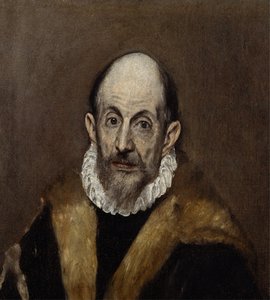
1541 - 1614 , Greece
Explore the dramatic transition from High Renaissance harmony to Mannerist tension. Discover how masters like El Greco redefined art through distortion and spiritual intensity. An expert guide for art enthusiasts seeking deep historical context and museum-quality inspiration.

Explore the profound elegance of Baroque Classicism. Discover how 17th-century masters synthesized dramatic emotion with classical order through the lens of the Counter-Reformation and the works of legends like Carlo Maratta and Andrea Sacchi.

Explore the dramatic power of Baroque art through an expert guide to light, shadow, and emotion. Discover how the Counter-Reformation shaped 17th-century masterpieces and learn about the profound techniques used by the Old Masters to inspire awe.

Explore the dramatic evolution from Mannerist distortion to Baroque grandeur. Discover how light, shadow, and emotion redefined art history through a masterclass in technical mastery and religious fervor.

Explore the profound differences between Baroque drama and Rococo elegance. Our expert guide delves into art history, chiaroscuro, and the evolution of European masterpieces for collectors and enthusiasts seeking deep historical context.


Stay updated with the latest art news, exclusive offers, and decoration ideas.
Tell us about your project and our art experts will provide you with 3 personalized art suggestions.
Let Us Curate 3 Options Just for You - Free!


 Preview
 Send
Send Share
Share
 Details

 Download
 Similars
 X-Ray
X-Ray Diaporama

 Read More







 Glass option is only available in size under 110 CM


