x

 80.0 x 66.0 cm
 Accademia di San Luca
Museum-quality giclée or canvas print with fast production and flexible finish options. ( Buy Hand Made Painting Buy Image)
Pick from our preset sizes that match the artwork's original proportions.

You may enter your own dimensions to fit a specific frame or space. If your selected size does not match the original image's proportions, we will either crop the artwork or extend the image with a mirrored or solid-fill edge. A digital mockup will be sent for your approval before production begins.
Please note that the on-screen preview does not reflect the actual cropping or extension. Only the mockup will accurately show the final composition.
While custom sizes are available, we recommend selecting a dimension from the predefined list to preserve the original proportions.
Worldwide Delivery () in 2 weeks instead of standard 4/5 weeks. (15 August)


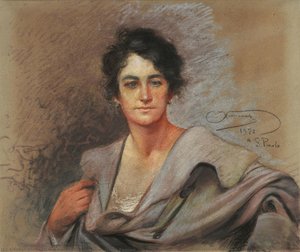
Self-portrait
Reproduction Size

Born on April 11, 1855, in the sun-drenched city of Palermo, Ettore Ximenes emerged from a lineage that blended aristocratic grace with profound intellectual curiosity. As the son of Antonio Ximenes and the noble Giulia Tolentino, his early years were steeped in the cultural richness of Sicily. While his initial academic inclinations leaned toward the written word and literature, a transformative fascination with the tactile reality of stone and clay soon redirected his destiny. This shift led him to the prestigious Palermo Academy of Fine Arts, where he began the rigorous process of mastering anatomical precision and the delicate nuances of light and shadow through carving.
The trajectory of Ximenlyes’ artistry was further refined by his travels and the mentorship of masters in Naples. Following 1872, his studies at the Naples Academy of Fine Arts brought him into the orbit of legendary figures such as Vincenzo Gemito, Domenico Morelli, and Stanislao Lista. These encounters were pivotal, instilling in him a stylistic foundation rooted in classical ideals and the grandeur of antiquity. By synthesizing these influences, Ximenes developed a unique approach to the Neo-Renaissance style—a method that allowed him to mirror the monumental scale of the past while infusing his subjects with an unmistakable, emotive human depth.
Ximenes’ work is characterized by a breathtaking command over diverse materials, from the ethereal translucency of polished marble to the enduring strength of bronze. His technique was never merely about technical perfection; it was about capturing the very soul of his subjects. Whether he was modeling clay or carving intricate stone details, his focus remained on textural nuance and anatomical truth. This dedication allowed him to explore themes ranging from civic virtue to religious devotion with equal fervor.
His repertoire included works that spoke to both the personal and the political, often utilizing subtle symbolic gestures to convey complex narratives:
As his career progressed, Ximenes’ reputation transcended the borders of Italy, earning him international notoriety and a place among the great monumental sculptors of the turn of the century. His ability to weave Italian identity into the urban fabric of foreign cities became one of his most significant historical contributions. In the Americas, his hand shaped the landscape of memory; he was responsible for the Monument to the Independence of Brazil in São Paulo, a work that stands as a testament to his monumental scale and ambition.
His influence even reached the bustling streets of New York City, where he was commissioned to create sculptures honoring Italian icons such as Giovanni da Verrazzano and Dante Alighieri. These monuments served not only as artistic achievements but as cultural anchors for the Italian diaspora, celebrating a shared heritage through the permanence of stone. Through his tireless pursuit of beauty and his ability to monumentalize history, Ettore Ximenes left behind a legacy that continues to resonate, bridging the gap between the classical traditions of the Renaissance and the burgeoning realism of the modern era.

1855 - 1926 , Italy


Stay updated with the latest art news, exclusive offers, and decoration ideas.
Tell us about your project and our art experts will provide you with 3 personalized art suggestions.
Let Us Curate 3 Options Just for You - Free!


 Preview
 Send
Send Share
Share
 Details

 Download
 Similars
 X-Ray
X-Ray Diaporama
 Read More




































 Glass option is only available in size under 110 CM