x

Hand-painted oil on canvas in your size and frame, made to order by our artists.





























Pick from our preset sizes that match the artwork's original proportions.

You may enter your own dimensions to fit a specific frame or space. If your selected size does not match the original image's proportions, we will either crop the artwork or extend the painting with additional hand-painted elements. A digital mockup will be sent for your approval before production begins.
Please note that the on-screen preview does not reflect the actual cropping or extension. Only the mockup will accurately show the final composition.
While custom sizes are available, we recommend selecting a dimension from the predefined list to preserve the original proportions.
Worldwide Delivery () in 3/4 weeks instead of standard 5 weeks. (18 July). No compromise on quality.


Vairumati
Reproduction Size
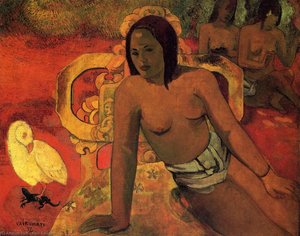
Paul Gauguin’s Vairumati, a vibrant tableau painted in 1892 during his transformative years in Tahiti, is far more than a simple portrait. It's an immersion into the heart of Polynesian culture, a potent blend of earthly sensuality and spiritual symbolism, and a testament to Gauguin’s revolutionary approach to color and form. Initially housed within the prestigious Musée d'Orsay in Paris, this painting immediately captivates with its audacious palette and the arresting presence of its central figure – a woman seated gracefully on a chair, her breasts exposed, yet radiating an undeniable dignity and allure.
The scene unfolds against a backdrop of loosely rendered figures, some similarly adorned in states of undress, creating a sense of communal intimacy within this exotic locale. A striking detail—a small bird perched delicately upon the chair—adds a layer of harmonious juxtaposition, suggesting a connection between the human form and the natural world, a recurring motif throughout Gauguin’s Tahitian works. This deliberate arrangement isn't merely decorative; it speaks to the artist’s deep fascination with the interconnectedness of life, mirroring his desire to capture the essence of Polynesian spirituality through visual representation.
Gauguin’s style in Vairumati firmly establishes him as a pivotal figure within the Post-Impressionist movement. Rejecting the fleeting effects of light favored by his Impressionist predecessors, Gauguin embraced bold, saturated colors—cerulean blues, fiery oranges, and deep greens—to express emotion and symbolic meaning rather than simply documenting reality. His technique is characterized by “Synthetism,” a deliberate flattening of forms and an emphasis on strong, graphic lines, departing from the traditional illusionistic approach of academic painting. This simplification allows him to focus on the essential qualities of his subjects, imbuing them with a raw, almost primal energy.
The influence of Synthetism is particularly evident in the painting’s composition; the figures are not meticulously rendered but rather suggested through blocks of color and simplified shapes. This approach, combined with Gauguin's use of tempera on canvas—a medium known for its vibrant hues and quick drying time—contributes to the painting’s immediate impact and enduring appeal. It’s a deliberate departure from the polished surfaces and delicate brushwork typical of earlier European art.
Vairumati is inextricably linked to Gauguin's exploration of Polynesian culture during his time in Tahiti. The painting’s title, “Vairumati tei oa,” translates to "Her name was Vairaumati," referencing a figure from Tahitian mythology—a goddess associated with fertility and the origins of humanity. This connection imbues the portrait with layers of symbolic significance, elevating it beyond a simple depiction of a woman into a representation of Polynesian spirituality and ancestral heritage.
Gauguin’s portrayal of nudity in Vairumati is not intended to be overtly erotic but rather serves as a powerful symbol of connection to the earth and the natural world. It reflects his belief that by stripping away Western conventions, he could gain access to a more authentic understanding of Polynesian life. The painting can also be interpreted as an exploration of identity—Gauguin’s own search for belonging amidst a culture vastly different from his native France.
Vairumati stands as a cornerstone of Gauguin's Tahitian period, a time when he radically redefined the boundaries of art. His bold experimentation with color, form, and subject matter paved the way for future generations of artists—including Picasso and Matisse—and continues to inspire contemporary creatives today. The painting’s enduring power lies not only in its visual beauty but also in its profound exploration of cultural exchange, spirituality, and the human condition. For those seeking a tangible connection to this remarkable masterpiece, Most-Famous-Paintings offers meticulously crafted oil painting reproductions that faithfully capture the vibrancy and emotional depth of Gauguin's vision. Explore the magic of Vairumati and immerse yourself in the captivating world of Paul Gauguin.


1848 - 1903 , France
Journey through 25 iconic artworks by Paul Cézanne – a master of Impressionism and Post-Impressionism. Explore his landscapes, still lifes, and the stories behind these timeless masterpieces. Discover museum-quality reproductions & curated decor at Most-Famous-Paintings.com.

Journey through Paul Klee's 25 most iconic paintings & prints. Explore his abstract style, Bauhaus influence, and vibrant color palettes. Find museum-quality art reproductions & decor ideas at Most-Famous-Paintings.com. Discover all masterpieces online.

Journey through 25 iconic artworks at the Metropolitan Museum of Art! Explore Van Gogh, Monet, Rembrandt & more. Discover art history, inspiring stories, and museum-quality reproductions to elevate your home decor. Explore the full collection on Most-Famous-Paintings.com.
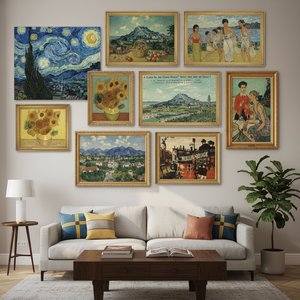
Journey through Post-Impressionism's 10 defining masterpieces – Van Gogh, Monet & more. Explore iconic paintings, art history & find museum-quality reproductions for your home at . Discover all masterpieces online!

Journey through 25 iconic artworks at the Detroit Institute of Arts! Explore Van Gogh, Monet, Rembrandt & more. Discover art history, stunning techniques & find museum-quality reproductions to elevate your home decor on Most-Famous-Paintings.com.


Stay updated with the latest art news, exclusive offers, and decoration ideas.
Tell us about your project and our art experts will provide you with 3 personalized art suggestions.
Let Us Curate 3 Options Just for You - Free!


 Buy print
 Send
Send Share
Share
 Details

 Download
 Similars
 X-Ray
X-Ray Diaporama


 Read More







 Glass option is only available in size under 110 CM