x


 Acrylic On PaperSymbolism, Parallelism
 190319th Century
 47.0 x 31.0 cm
 National Gallery of Bosnia and Herzegovina
Hand-painted oil on canvas in your size and frame, made to order by our artists.





























Pick from our preset sizes that match the artwork's original proportions.

You may enter your own dimensions to fit a specific frame or space. If your selected size does not match the original image's proportions, we will either crop the artwork or extend the painting with additional hand-painted elements. A digital mockup will be sent for your approval before production begins.
Please note that the on-screen preview does not reflect the actual cropping or extension. Only the mockup will accurately show the final composition.
While custom sizes are available, we recommend selecting a dimension from the predefined list to preserve the original proportions.
Worldwide Delivery () in 3/4 weeks instead of standard 5 weeks. (18 July). No compromise on quality.


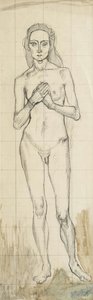
Figure study
Reproduction Size
Ferdinand Hodler's 1903 “Figure Study,” a deceptively simple pencil drawing, offers far more than just three figures posed before an unseen viewer. Measuring a modest 47 x 31 cm, this work is a poignant distillation of the artist’s signature style – a delicate balance between observation and profound emotional resonance. The image depicts three women standing in close proximity, their postures suggesting a shared moment of contemplation or perhaps a silent exchange. While seemingly straightforward, the drawing is imbued with the hallmarks of Symbolism, a movement that sought to express inner states rather than merely represent external reality.
Hodler’s technique is characterized by its remarkable restraint and subtle shifts in tone. The lines are fluid and graceful, avoiding harsh outlines or dramatic contrasts. He employs a muted palette – predominantly shades of grey and brown – creating an atmosphere of quiet introspection. Notice the careful rendering of the figures' torsos and legs, executed with a delicate precision that belies the overall softness of the piece. The inclusion of a grid pattern within the drawing itself hints at its origins as a preparatory study, likely used to meticulously map out proportions and ensure compositional harmony – a testament to Hodler’s methodical approach despite his embrace of intuitive artistic expression.
Hodler's life was profoundly shaped by early tragedy. The untimely deaths of his father and two brothers before he reached adolescence left an indelible mark on his psyche, a theme that frequently surfaced in his art. This sense of loss isn’t overtly depicted here, but rather manifests as a pervasive melancholy and a deep awareness of the transient nature of beauty and existence. The women's averted gazes and slightly downward postures contribute to this feeling of quiet sadness, suggesting a shared experience of contemplation or perhaps a subtle acknowledgement of mortality. Hodler was deeply interested in exploring universal themes – love, loss, spirituality – and sought to capture these emotions through symbolic representation rather than literal depiction.
Hodler is most famously associated with his development of what he termed "parallelism" – a technique that involved depicting multiple viewpoints of a single subject simultaneously. While not immediately apparent in this particular study, the underlying principle is present: each figure is presented as if viewed from slightly different angles, creating a sense of depth and movement within the static image. This approach aimed to capture the essence of a subject by representing it through various perspectives, mirroring the way we perceive reality through our own shifting viewpoints. The drawing’s composition invites the viewer to step into this multi-faceted perspective, fostering a deeper connection with the figures and their unspoken narratives.
“Figure Study” stands as a compelling example of Hodler's ability to convey profound emotion through deceptively simple forms. It’s a work that invites quiet contemplation and rewards repeated viewing, revealing new nuances with each encounter. Hodler’s influence extended beyond Switzerland, impacting artists like Albin Egger-Lienz and Cuno Amiet, who embraced his exploration of symbolism and landscape. Today, Most-Famous-Paintings offers meticulously crafted hand-painted reproductions of this evocative drawing, allowing you to bring Hodler's poignant vision into your home or studio. Explore the full depth of Hodler’s artistic world through our collection – a journey into the heart of Symbolist expression.


1853 - 1918 , Switzerland

Delve into the haunting world of Francis Bacon with Most-Famous-Paintings. Explore 25 iconic paintings, from his visceral portraits to powerful triptychs. Discover the stories behind these masterpieces & find museum-quality art reproductions for your home. Explore the full collection online!
Journey through Leonardo da Vinci's genius with our curated selection of 25 iconic artworks. Explore the stories behind Mona Lisa, The Last Supper & more Renaissance masterpieces. Find museum-quality art reproductions for your home at Most-Famous-Paintings.com.

Explore the captivating world of graphite drawing! Discover its rich history, master essential techniques like chiaroscuro, and learn how artists evoke emotion through this timeless medium. Expert insights for art enthusiasts.

Explore the captivating world of Ferdinand Hodler, Swiss Symbolist painter renowned for his evocative landscapes & pioneering 'parallelism'. Discover his life, key works, and lasting influence on art history. Own a hand-painted reproduction today!
Explore the anatomical mastery of George B. Bridgman & his revolutionary figure drawing techniques. Discover how his methods transformed art instruction and continue to inspire artists today. Learn more at Most-Famous-Paintings.


Stay updated with the latest art news, exclusive offers, and decoration ideas.
Tell us about your project and our art experts will provide you with 3 personalized art suggestions.
Let Us Curate 3 Options Just for You - Free!


 Buy print
 Send
Send Share
Share
 Details

 Download
 Similars
 X-Ray
X-Ray Diaporama
 Read More







 Glass option is only available in size under 110 CM