


x

 Oil On CanvasWallArtGerman Expressionism
 1913
1913 60.0 x 80.0 cm
Hand-painted oil on canvas in your size and frame, made to order by our artists. ( Buy Print Buy Image)





























Pick from our preset sizes that match the artwork's original proportions.

You may enter your own dimensions to fit a specific frame or space. If your selected size does not match the original image's proportions, we will either crop the artwork or extend the painting with additional hand-painted elements. A digital mockup will be sent for your approval before production begins.
Please note that the on-screen preview does not reflect the actual cropping or extension. Only the mockup will accurately show the final composition.
While custom sizes are available, we recommend selecting a dimension from the predefined list to preserve the original proportions.
Worldwide Delivery () in 3/4 weeks instead of standard 5 weeks. (16 August). No compromise on quality.


Long Yellow Horse
Reproduction Size
Franz Marc's *Long Yellow Horse*, painted in 1913, isn’t merely a depiction of an animal; it’s a profound meditation on the relationship between humanity and nature, faith and instinct. This arresting canvas, currently residing at the Nassau County Museum of Art in Roslyn Harbor, pulsates with a raw emotionality that speaks to the core of Expressionist philosophy – a desire to convey inner experience rather than simply represent external reality. The painting immediately commands attention through its scale: measuring 60 x 80 centimeters, it’s an immersive work designed to draw the viewer into its world.
At first glance, the composition appears straightforward—a solitary yellow horse dominates the frame, set against a muted background of earthy tones and punctuated by the suggestion of human figures. However, closer inspection reveals a carefully constructed interplay of forms and colors. Marc’s masterful use of Cubist principles – fracturing shapes and simplifying forms – isn't about dissecting reality; it’s about distilling its essence. The horse itself is rendered with angularity and abstraction, its body broken down into geometric planes that simultaneously suggest movement and stillness. This deliberate distortion invites us to consider the animal not as a fixed object, but as a living embodiment of primal energy.
Marc's signature use of color is utterly central to *Long Yellow Horse*. The dominant yellow isn’t a cheerful, sunny hue; it’s a rich, almost bruised ochre—a color associated with the earth, decay, and even sacrifice. This deliberate choice imbues the horse with a sense of vulnerability and spiritual weight. The surrounding browns and greens further ground the image, creating a visual dialogue between the animal's vibrant presence and the natural world from which it emerges. The application of paint is equally significant; Marc employs thick, impasto strokes, building up layers of color to create texture and depth. This tactile quality invites us to reach out and touch the canvas, fostering a sense of intimacy with the artwork.
Technically, the painting utilizes oil on canvas, a medium that allows for both luminous color saturation and textural complexity – qualities perfectly suited to Marc’s expressive vision. The brushwork is loose and gestural, conveying a feeling of immediacy and spontaneity. It's as if Marc was attempting to capture not just the appearance of the horse, but its very spirit.
To understand *Long Yellow Horse*, it’s crucial to consider Franz Marc’s broader artistic and philosophical context. Born in Munich in 1880, Marc was deeply influenced by his early exposure to religious thought, a legacy that continued to inform his work throughout his career. He co-founded the influential journal *Der Blaue Reiter* (The Blue Rider), a group of artists who sought to explore spirituality through art. Marc believed that animals possessed a purity and innocence unattainable by humans, representing a connection to a more fundamental reality.
The figures in the background – a man and a woman – are deliberately ambiguous, almost spectral. They aren’t actively engaged with the horse; instead, they seem to observe it from a distance, perhaps contemplating its significance. The dog near the horse further reinforces this theme of observation and connection. Some art historians interpret these figures as representing humanity's yearning for spiritual understanding, mirroring the horse’s own quest for meaning within the natural world.
*Long Yellow Horse* transcends its specific subject matter to become a powerful symbol of the human condition. It speaks to our innate connection with nature, our spiritual longings, and our capacity for both wonder and vulnerability. The painting’s emotional impact is profound—it evokes feelings of awe, melancholy, and perhaps even a touch of unease. It's a work that invites repeated viewing, revealing new layers of meaning with each encounter. For those seeking an artwork that embodies the spirit of modernism while retaining a deeply human resonance, *Long Yellow Horse* remains a compelling and unforgettable masterpiece.

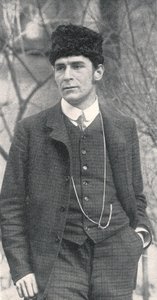
1880 - 1916 , Germany

Explore the revolutionary world of Cubism. Discover how masters Pablo Picasso and Georges Braque dismantled reality through geometric abstraction to redefine modern art history.


Stay updated with the latest art news, exclusive offers, and decoration ideas.
Tell us about your project and our art experts will provide you with 3 personalized art suggestions.
Let Us Curate 3 Options Just for You - Free!


 Preview
 Send
Send Share
Share
 Details

 Download
 Similars
 X-Ray
X-Ray Diaporama
 Read More







 Glass option is only available in size under 110 CM


