Wishlist Shopping Cart Cart
Buy print Buy printBuy Image Buy Image SendSend
DetailsDetails Add to favorites Add to favorites DownloadDownload SimilarsSimilars X-RayX-Ray DiaporamaDiaporama

Study of the Human Figure, Anterior View, from 'A Comparative Anatomical Exposition of the Structure of the Human Body with that of a Tiger and a Common Fowl'

Explore George Stubbs's groundbreaking anatomical study 'Study of the Human Figure,' showcasing meticulous detail and scientific realism—a masterpiece of Romanticism capturing human anatomy alongside animal forms.

George Stubbs (1724-1806): Celebrated English painter renowned for his anatomical accuracy & masterful depictions of horses. Pioneer of Romanticism, famous for 'Whistlejacket'. Explore his equine art & legacy.

Hand Made Oil Reproduction

Hand-painted oil on canvas in your size and frame, made to order by our artists.

P118B $10
P118H $10
P118W $10
P438Z $10
P508JH $12
P508YH $12
P805H $10
P805Z $10
P919BZ $10
P919G $10
P919XJ $10
P959ZH $10
P968JZ $12
W106C $8
W218G $10
W218JH $8
W218Y $10
W307PJ $10
W316G $10
W316PJ $8
W316Y $10
W398PJ $8
W4111J $10
W500HY $15
W500JH $15
W692G $12
W849H $8
W940BG $15
W953PJ $8

Standard
custom
CM
INCH

Pick from our preset sizes that match the artwork's original proportions.

width
height

You may enter your own dimensions to fit a specific frame or space. If your selected size does not match the original image's proportions, we will either crop the artwork or extend the painting with additional hand-painted elements. A digital mockup will be sent for your approval before production begins.
Please note that the on-screen preview does not reflect the actual cropping or extension. Only the mockup will accurately show the final composition.
While custom sizes are available, we recommend selecting a dimension from the predefined list to preserve the original proportions.

Examples of what can be changed: Replace face with customer photo; Add pet (e.g., replace cat with dog); Include hidden message in background; Change background landscape or elements.
After order, Most-Famous-Paintings.com team will email client for instructions and provide a mockup preview

Worldwide Delivery () in 3/4 weeks instead of standard 5 weeks. (18 July). No compromise on quality.

why_choose_icon
Free Worldwide Express Shipping
why_choose_icon
High-Quality Linen Canvas
why_choose_icon
Full Shipping Insurance
why_choose_icon
Customs Tax Refund Guarantee
why_choose_icon
True Color Matching Guarantee
why_choose_icon
60-Day Return Policy (Defects Only)
why_choose_icon
100% Money-Back Guarantee
why_choose_icon
Bulk Discount Offer

Total Price

-

reproduction

Study of the Human Figure, Anterior View, from 'A Comparative Anatomical Exposition of the Structure of the Human Body with that of a Tiger and a Common Fowl'

Reproduction Medium

Reproduction Size

-

Total Price

-

Quick Facts

  • Medium: Drawing (Graphite & Ink)
  • Movement: Romanticism
  • Artistic style: Scientific Realism
  • Title: Study of the Human Figure, Anterior View, from 'A Comparative Anatomical Exposition of the Structure of the Human Body with that of a Tiger and a Common Fowl'
  • Subject or theme: Human Anatomy
  • Artist: George Stubbs
  • Influences: Enlightenment

Art Quiz

There is only one correct answer for each question.

Question 1:
What artistic movement is George Stubbs’s ‘Study of the Human Figure, Anterior View, from ‘A Comparative Anatomical Exposition of the Structure of the Human Body with that of a Tiger and a Common Fowl’” attributed to?
Question 2:
The artwork primarily focuses on:
Question 3:
What technique is prominently used in the depiction of muscles and bones?
Question 4:
Approximately when was George Stubbs’s ‘Study of the Human Figure, Anterior View, from ‘A Comparative Anatomical Exposition of the Structure of the Human Body with that of a Tiger and a Common Fowl’” created?
Question 5:
What was Stubbs’s main motivation for undertaking extensive anatomical dissections?

Artwork Description

Study of the Human Figure, Anterior View, from ‘A Comparative Anatomical Exposition of the Structure of the Human Body with that of a Tiger and a Common Fowl’

George Stubbs's "Study of the Human Figure, Anterior View," executed around 1795-1806, stands as an unparalleled testament to Enlightenment anatomical illustration—a fusion of scientific rigor and artistic brilliance that continues to captivate viewers today. More than just a depiction of musculature and bone structure, this drawing embodies Stubbs’s profound fascination with the natural world and his unwavering commitment to capturing its essence through meticulous observation and precise rendering. ### Historical Context & Artistic Movement Born in Liverpool in 1724, George Stubbs emerged from obscurity as an autodidact—a self-taught artist who honed his skills independently, drawing inspiration from masters like Joshua Reynolds and Thomas Gainsborough. His early life remains sparsely documented, primarily gleaned from the recollections of Hamlet Winstanley, reflecting a period when artistic reputations were often built on anecdotal accounts rather than formal biographies. Stubbs’s trajectory toward renown began with an apprenticeship under Samuel Coats at York Minster, where he gained invaluable experience in depicting monumental architecture and religious subjects—skills that would later inform his ambitious undertaking: “A Comparative Anatomical Exposition of the Structure of the Human Body with That of a Tiger and a Common Fowl.” This project signaled Stubbs’s embrace of Romanticism, a movement characterized by an emphasis on emotion, imagination, and subjective experience—a dramatic departure from the neoclassical ideals that dominated much of the preceding century. The tiger skeleton, meticulously studied alongside the human form, became emblematic of this burgeoning artistic sensibility. ### Technique & Artistic Detail Stubbs’s mastery lay in his unparalleled ability to translate anatomical knowledge into visual artistry. He undertook extensive dissections—a daring practice for his time—primarily at York County Hospital under the tutelage of surgeon Charles Atkinson, immersing himself in the study of animal anatomy and furthering his understanding of human musculature. The resulting drawing exemplifies Stubbs’s distinctive technique: a masterful blend of hatching, cross-hatching, and shading that builds up tonal values with astonishing accuracy. Lines are deployed strategically to delineate muscles, bones, and skin contours—each stroke imbued with deliberate control and precision. The artist skillfully utilizes textures through variations in line density, creating an illusion of volume and depth that transcends mere representation. Notably, the drawing’s muted grayscale palette—ranging from pale whites to deep blacks—serves not only to convey anatomical information but also to evoke a sense of solemn contemplation. ### Symbolism & Emotional Resonance Beyond its scientific merit, “Study of the Human Figure” resonates with deeper symbolic significance. Stubbs's fascination with the tiger—a creature perceived as both formidable and sublime—reflects Romantic ideals of confronting primal forces and exploring the boundaries between humanity and nature. The pose of the nude male figure is deliberately understated, prioritizing anatomical accuracy over dramatic gesture—a conscious decision to honor the scientific pursuit while simultaneously conveying a profound respect for human form. The drawing’s quiet stillness invites viewers to contemplate the complexities of existence and to appreciate the beauty inherent in observation—a testament to Stubbs's enduring legacy as one of Britain’s greatest artists and anatomists. ### Legacy & Reproduction Value Today, “Study of the Human Figure” hangs prominently at Yale Center for British Art, a beacon of Enlightenment artistry and scientific inquiry. Its influence extends far beyond its immediate context, inspiring generations of artists to strive for anatomical precision while embracing expressive artistic vision. Reproductions of this iconic drawing offer collectors and interior designers alike an opportunity to experience Stubbs’s unparalleled skill—a chance to bring home a masterpiece that embodies the spirit of Romanticism and celebrates the enduring power of observation.

Artist Biography

early life and training

george stubbs, a renowned english painter, was born on august 25, 1724, in liverpool, united kingdom. his early life was marked by a sparse record of his activities until the age of 35, with most information sourced from ozias humphry's memoirs, based on conversations with stubbs in 1794. stubbs began his artistic journey at the age of 15, initially working under his father, a currier or leather-dresser. he later approached hamlet winstanley, a lancashire painter and engraver, for a brief apprenticeship. this short stint allowed him to study the collection at knowsley hall.

artistic development and notable works

stubbs's passion for anatomy led him to move to york in 1744, where he studied under surgeon charles atkinson at york county hospital. one of his earliest surviving works is a set of illustrations for john burton's textbook on midwifery, published in 1751. in 1756, stubbs rented a farmhouse in lincolnshire and spent 18 months dissecting horses, assisted by his common-law wife, mary spencer. this led to the publication of the anatomy of the horse in 1766, with original drawings now housed at the royal academy. stubbs's work was soon recognized by leading aristocratic patrons, including the 3rd duke of richmond, who commissioned three large pictures in 1759. this marked the beginning of his successful career, with works produced for several dukes and lords, culminating in the purchase of a house in marylebone, london.

legacy and notable paintings

stubbs's most famous work, whistlejacket, a painting of a prancing horse commissioned by the 2nd marquess of rockingham, is now housed at the national gallery in london. this and two other paintings for rockingham break with convention, featuring plain backgrounds.
  • whistlejacket, a thoroughbred race horse rising on his hind legs, showcases stubbs's unparalleled skill in capturing the essence of horses.
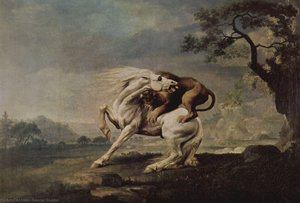
  • stubbs's series of paintings on a lion attacking a horse are early examples of the romantic movement, demonstrating his influence on 18th-century art.
stubbs's legacy as an equine artist remains unmatched, with his works continuing to inspire and awe art enthusiasts worldwide.
George Stubbs

George Stubbs

1724 - 1806 , United Kingdom

Quick Facts

  • Artistic Movement Or Style: Romanticism, Equine Art
  • Artists Or Movements Influenced By This Artist: ['Joshua Reynolds']
  • Artists Who Influenced This Artist: ['Hamlet Winstanley']
  • Date Of Birth: August 25, 1724
  • Date Of Death: July 10, 1806
  • Full Name: George Stubbs
  • Nationality: British
  • Notable Artworks:
    • Whistlejacket
    • Lion & Horse
    • A Lion and Tiger
  • Place Of Birth: Liverpool, UK
Explore artworks organized by themes, styles, and characteristics.