x

Hand-painted oil on canvas in your size and frame, made to order by our artists. ( Buy Print Buy Image)
Pick from our preset sizes that match the artwork's original proportions.

You may enter your own dimensions to fit a specific frame or space. If your selected size does not match the original image's proportions, we will either crop the artwork or extend the painting with additional hand-painted elements. A digital mockup will be sent for your approval before production begins.
Please note that the on-screen preview does not reflect the actual cropping or extension. Only the mockup will accurately show the final composition.
While custom sizes are available, we recommend selecting a dimension from the predefined list to preserve the original proportions.
Worldwide Delivery () in 3/4 weeks instead of standard 5 weeks. (19 August). No compromise on quality.


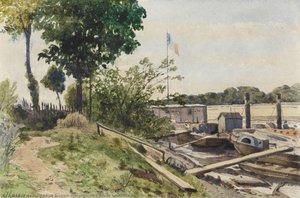
Moonlight
Reproduction Size

Born on June 28, 1819, in Valenciennes, France, Henri-Joseph Harpignies initially faced parental expectations to pursue a business career. However, his passion for art proved too strong to ignore. Of Belgian origin, his family’s initial plans were set aside as he dedicated himself to becoming an artist. At the age of twenty-seven, he formally began his artistic training in Paris, entering the atelier of Jean Achard. This foundational period focused on developing solid draughtsmanship skills – a crucial element that would remain central to Harpignies’ work.
After two years under Achard's tutelage, Harpignies embarked on a pivotal journey to Italy in 1848. This experience profoundly shaped his artistic vision. Upon his return in 1850, he became acquainted with the leading figures of the Barbizon School, including Jean-Baptiste-Camille Corot. The Barbizon painters’ emphasis on direct observation of nature and their realistic portrayal of rural life deeply resonated with Harpignies. In 1860, he further cemented his artistic connection with Corot through a collaborative trip back to Italy.
Harpignies’ style is characterized by its serene and idyllic depictions of the French countryside. He masterfully captured the subtle nuances of light and atmosphere, creating landscapes that evoke a sense of tranquility and harmony. His technique involved careful observation combined with a refined understanding of composition. While influenced by the Barbizon School's realism, Harpignies developed his own distinct voice, often incorporating a poetic sensibility into his work.
Harpignies’ artistic legacy extends beyond his own paintings. He was a dedicated teacher, imparting his knowledge and skills to numerous students, including Émile Appay (1876-1935) and James Wilson Morrice (1865-1924). His influence can be seen in the development of French landscape painting throughout the late 19th and early 20th centuries. He helped to solidify the Barbizon School’s impact on subsequent generations of artists.
Henri-Joseph Harpignies occupies an important place in the history of French landscape painting. His work reflects a deep appreciation for nature and a commitment to capturing its beauty with honesty and sensitivity. He died in 1916, leaving behind a rich artistic legacy that continues to inspire and captivate audiences today. His paintings are held in prominent museum collections, including the Musée des Beaux-Arts Valence, ensuring his enduring recognition as a master of landscape art.

1819 - 1916 , France


Stay updated with the latest art news, exclusive offers, and decoration ideas.
Tell us about your project and our art experts will provide you with 3 personalized art suggestions.
Let Us Curate 3 Options Just for You - Free!


 Preview
 Send
Send Share
Share
 Details

 Download
 Similars
 X-Ray
X-Ray Diaporama
 Read More




































 Glass option is only available in size under 110 CM