x

Museum-quality giclée or canvas print with fast production and flexible finish options. ( Buy Hand Made Painting Buy Image)





























Pick from our preset sizes that match the artwork's original proportions.

You may enter your own dimensions to fit a specific frame or space. If your selected size does not match the original image's proportions, we will either crop the artwork or extend the image with a mirrored or solid-fill edge. A digital mockup will be sent for your approval before production begins.
Please note that the on-screen preview does not reflect the actual cropping or extension. Only the mockup will accurately show the final composition.
While custom sizes are available, we recommend selecting a dimension from the predefined list to preserve the original proportions.
Worldwide Delivery () in 2 weeks instead of standard 4/5 weeks. (20 August)


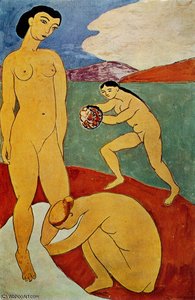
Three Sisters (Triptych - Right part)
Reproduction Size
Henri Matisse’s “Three Sisters” stands as a testament to the artist's masterful command of color and his unwavering belief in its expressive power. Painted circa 1906-7, this vibrant triptych embodies the culmination of Matisse’s explorations into Fauvist principles—a movement that championed bold, non-naturalistic hues as a means of conveying emotion rather than representing reality.
The painting depicts three women seated together in what appears to be a dimly lit interior. The composition is strikingly simple yet profoundly impactful; Matisse eschews detailed rendering in favor of flattened planes of color—primarily shades of ochre, crimson, and lemon yellow—that dominate the canvas. These hues aren’t merely decorative; they pulsate with energy and imbue the scene with an atmosphere of warmth and intimacy.
Matisse's technique is characterized by loose brushstrokes and a deliberate disregard for traditional perspective. He applies paint thickly, creating textured surfaces that capture the interplay of light and shadow. The artist’s focus isn’t on capturing precise anatomical details but rather on conveying the essence of human presence—the subtle gestures and expressions of the women communicate a sense of quiet contemplation and connection.
Historically, “Three Sisters” reflects Matisse's engagement with Symbolism and Impressionism, movements that sought to capture subjective experience. However, it firmly establishes Matisse as a pioneer of Fauvism, marking a decisive break from academic conventions. The bold color palette aligns perfectly with the movement’s ethos—a rejection of mimetic representation in favor of artistic intuition.
Beyond its formal qualities, “Three Sisters” resonates emotionally with viewers. The luminous colors evoke feelings of serenity and comfort, while the stylized figures invite contemplation on themes of femininity, companionship, and domestic tranquility. It's a painting that speaks to the human desire for beauty and connection—a timeless masterpiece that continues to inspire admiration for its artistic innovation and expressive depth.


1869 - 1954 , France

Explore the vibrant revolution of Fauvism. Discover how masters like Henri Matisse liberated color from reality to express pure emotion. An expert guide into the 'Wild Beasts' of modern art history for collectors and enthusiasts.


Stay updated with the latest art news, exclusive offers, and decoration ideas.
Tell us about your project and our art experts will provide you with 3 personalized art suggestions.
Let Us Curate 3 Options Just for You - Free!


 Preview
 Send
Send Share
Share
 Details

 Download
 Similars
 X-Ray
X-Ray Diaporama
 Read More







 Glass option is only available in size under 110 CM