x


Museum-quality giclée or canvas print with fast production and flexible finish options. ( Switch to hand made Painting Switch to Image)





























Pick from our preset sizes that match the artwork's original proportions.

You may enter your own dimensions to fit a specific frame or space. If your selected size does not match the original image's proportions, we will either crop the artwork or extend the image with a mirrored or solid-fill edge. A digital mockup will be sent for your approval before production begins.
Please note that the on-screen preview does not reflect the actual cropping or extension. Only the mockup will accurately show the final composition.
While custom sizes are available, we recommend selecting a dimension from the predefined list to preserve the original proportions.
Worldwide Delivery () in 2 weeks instead of standard 4/5 weeks. (29 July)


untitled (5681)
Reproduction Size
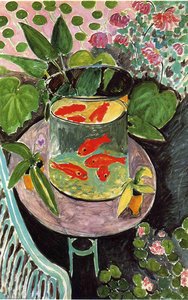
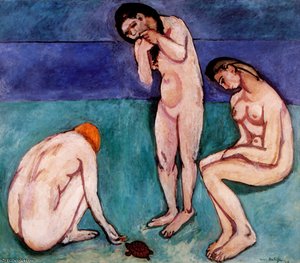
This striking untitled work by Henri Matisse, designated as ‘5681’, presents a compelling and emotionally resonant scene that deviates from his typically bright and optimistic palette. It's a fascinating example of the artist exploring darker psychological territories within a still life framework.
The composition centers around a reclining nude female figure, positioned on a stone bench. This classical motif is immediately juxtaposed with decidedly modern elements: a boldly striped jar teeming with vibrant orange goldfish and a lush bouquet of yellow and pink flowers contained within a purple vase. The arrangement isn’t harmonious in the traditional sense; rather, it feels deliberately unbalanced. The eye is drawn to the stark contrast between the luminous fish and blossoms against the deep, almost oppressive background of purple-grey. This deliberate imbalance contributes significantly to the artwork's overall mood.
While Matisse is celebrated as a founder of Fauvism – known for its explosive color – ‘5681’ reveals an intriguing exploration of Expressionistic tendencies. The forms are distorted, the perspective flattened, and the brushstrokes are thick and gestural. The visible impasto technique—the heavy application of paint—creates a rich texture that adds depth and physicality to the canvas. Lines aren’t used for precise definition but rather as energetic marks conveying movement and emotion. Shapes are simplified and abstracted, moving away from realistic representation towards an evocation of feeling.
The symbolism within this piece is layered and open to interpretation. The goldfish, traditionally associated with fleeting beauty or captive desires, could represent a sense of longing or entrapment. The flowers, while vibrant, are contained – perhaps suggesting constrained joy or the ephemeral nature of life. The nude figure, rendered in somber tones, evokes vulnerability and isolation. The overall effect is one of melancholy and introspection, a departure from Matisse’s more celebratory works.
Born in 1869, Henri Matisse initially trained in law before dedicating himself to art. He absorbed influences from classical masters like Chardin, Poussin and Watteau, building a strong foundation in traditional techniques. However, he quickly evolved beyond these roots, becoming a pivotal figure in the development of modern art. While ‘5681’ doesn't immediately scream “Fauvism,” it demonstrates Matisse’s willingness to experiment with form and color to express inner states – a key characteristic of his artistic journey. This work suggests a period of exploration beyond pure chromatic exuberance, delving into more complex emotional landscapes.
‘Untitled (5681)’ is not merely a visually arresting image; it’s an emotionally charged experience. The artwork evokes feelings of contemplation, vulnerability, and perhaps even a touch of unease. Its dark palette and expressive brushwork make it a powerful statement piece. In an interior design context, this work would lend itself well to spaces seeking depth and sophistication. It could serve as a focal point in a living room or study, adding a layer of intellectual intrigue and artistic gravitas. The contrasting colors – the orange fish and yellow flowers – provide subtle accents that can be echoed in surrounding décor.


1869 - 1954 , France

Commission a breathtaking hyperrealistic still life painting with Most-Famous-Paintings. Preserve cherished culinary moments as timeless heirlooms. Museum-quality craftsmanship, personalized service & a lasting legacy for your home.

Explore the rich history of still life painting & the symbolism of fruit across art movements. Discover masterpieces from Caravaggio to Cézanne with Most-Famous-Paintings – expert guidance & museum-quality reproductions.
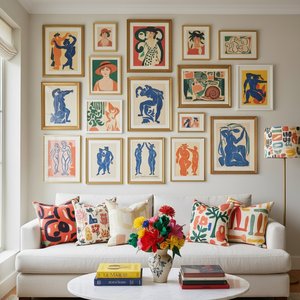
Journey through Henri Matisse's 25 most iconic paintings! Explore Fauvism, vibrant colors & the stories behind masterpieces like 'The Dance'. Find museum-quality art reproductions and curated decor ideas to elevate your space. Discover all masterpieces on Most-Famous-Paintings.com.

Explore the captivating world of Severin Roesen, a major American still life painter influenced by Dutch masters. Discover his lush compositions and the symbolism within his art – a window into 19th-century America.

Explore the rich history of still life painting with Most-Famous-Paintings. Discover Dutch Masters, decode vanitas symbolism & learn about collecting timeless art. Expert insights and museum-quality reproductions.


Stay updated with the latest art news, exclusive offers, and decoration ideas.
Tell us about your project and our art experts will provide you with 3 personalized art suggestions.
Let Us Curate 3 Options Just for You - Free!


 Preview
 Send
Send Share
Share
 Details

 Download
 Similars
 X-Ray
X-Ray Diaporama
 Read More







 Glass option is only available in size under 110 CM