


x

Hand-painted oil on canvas in your size and frame, made to order by our artists. ( Buy Print Buy Image)





























Pick from our preset sizes that match the artwork's original proportions.

You may enter your own dimensions to fit a specific frame or space. If your selected size does not match the original image's proportions, we will either crop the artwork or extend the painting with additional hand-painted elements. A digital mockup will be sent for your approval before production begins.
Please note that the on-screen preview does not reflect the actual cropping or extension. Only the mockup will accurately show the final composition.
While custom sizes are available, we recommend selecting a dimension from the predefined list to preserve the original proportions.
Worldwide Delivery () in 3/4 weeks instead of standard 5 weeks. (18 August). No compromise on quality.


Acanthostega
Reproduction Size
Jane Kim's "Acanthostega" isn’t merely a depiction of a fish; it’s an evocative portal into the distant past, a frozen moment in the evolutionary drama that birthed our own terrestrial existence. The painting, rendered with meticulous detail and a restrained palette of blacks, whites, and subtle grays, captures a creature – Acanthostega gunnari – that lived approximately 365 million years ago during the Famennian age of the Late Devonian period. This remarkable specimen represents one of the earliest known tetrapods, those elusive ancestors from which all land vertebrates ultimately descended. Kim’s work transcends simple representation, instead offering a profound meditation on transition and the slow, incremental steps that led to our dominance on land.
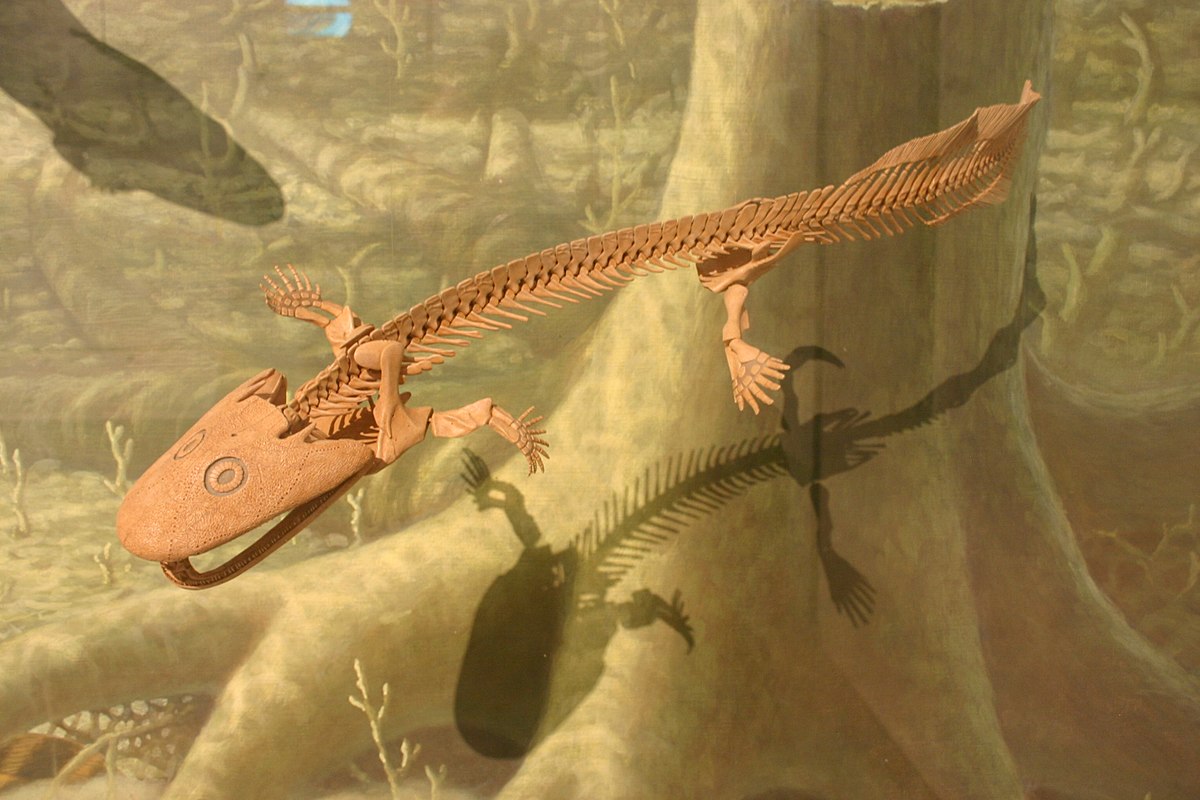
The painting meticulously portrays Acanthostega’s unique anatomy, a fascinating blend of fish-like and amphibian characteristics. Notice the elongated body, reminiscent of a lobe-finned fish, yet coupled with eight digits on each hand – a crucial evolutionary step towards limb development. The webbing connecting these digits suggests an adaptation for paddling through shallow waters, likely inhabiting weed-choked swamps teeming with life. Jennifer Clack’s extensive research into this species reveals that Acanthostega wasn't a fully terrestrial animal; its shoulder structure and limited ability to bend its elbows indicate it primarily inhabited aquatic environments. The painting subtly conveys this duality – a creature poised on the brink of land, yet firmly rooted in the water.
Kim’s artistic choices are informed by paleontological understanding. She doesn't shy away from depicting the fish-like features—the prominent gills, the streamlined form—but simultaneously highlights the nascent limb structure, hinting at the potential for future locomotion. This delicate balance between familiarity and transformation is central to the artwork’s power.
Beyond its anatomical accuracy, “Acanthostega” resonates with symbolic weight. The prominent crown adorning the fish's head – a motif frequently employed by Kim – represents not just royalty but also potential and nascent power. It’s a visual metaphor for the evolutionary leap from aquatic to terrestrial life, suggesting that even in this ancient creature, the seeds of future dominance were already being sown. The careful rendering of the scales and fins evokes a sense of vulnerability and fragility, while the crown subtly asserts an inherent strength – a promise of what was yet to come.
Jane Kim's work, as exemplified by “Acanthostega,” is a testament to her skill and dedication. Her meticulous attention to detail, combined with a deep understanding of paleontology and artistic expression, results in images that are both scientifically accurate and emotionally resonant. Most-Famous-Paintings offers high-quality reproductions of this captivating piece, allowing art lovers to bring this pivotal moment in evolutionary history into their homes or offices. Each reproduction is crafted with the same care and precision as the original, ensuring a faithful representation of Kim’s artistic vision – a silent witness to the dawn of limbs and the unfolding story of life on Earth.

Born in Harlem, New York City in 1960, Jean-Michel Basquiat’s life was a whirlwind of artistic experimentation, social commentary, and tragically premature death. His journey from the streets of Manhattan to international acclaim is a testament to his raw talent, relentless drive, and the potent confluence of influences that shaped his distinctive visual language. Basquiat's work wasn’t simply about painting; it was an urgent dialogue with American society, grappling with issues of race, class, power, and identity within the vibrant, often chaotic landscape of 1980s New York.
Early influences were deeply rooted in his surroundings. Growing up in a predominantly Black neighborhood, Basquiat witnessed firsthand the inequalities and struggles faced by marginalized communities. This experience fueled a critical perspective that permeated his art. He was also profoundly impacted by graffiti culture – a world of vibrant tags, elaborate murals, and rebellious expression – which he initially engaged with through the duo SAMO (pronounced “samo”), alongside Al Diaz. Together they created enigmatic epigrams, often addressing social issues and challenging established norms, plastered across Lower East Side walls. This early collaboration provided him with invaluable experience in street art techniques and a crucial understanding of how to communicate directly with a public audience.
By the early 1980s, Basquiat’s individual style began to emerge, distinct from SAMO's collaborative approach. He transitioned from anonymous graffiti tags to large-scale paintings that explored themes of race, poverty, and cultural identity with a newfound intensity. His work quickly gained attention within the New York art scene, aligning him with the burgeoning neo-expressionist movement – characterized by its rejection of minimalist abstraction and embrace of subjective experience and emotional expression.
A pivotal moment arrived in 1982 when Basquiat exhibited at the prestigious Whitney Museum of American Art’s annual exhibition, “Documenta,” a remarkable achievement for a young Black artist. This recognition catapulted him to international fame, alongside artists like David Salle and Elizabeth Murray. His work was immediately lauded for its raw energy, confrontational imagery, and powerful social commentary. He quickly became one of the youngest artists ever to exhibit at the Whitney Biennial in 1983, further solidifying his position as a major force in contemporary art.
Basquiat’s artistic style was instantly recognizable. He employed a distinctive combination of text and image, often layering words and symbols onto canvases filled with fragmented figures, skulls, crowns (a symbol of royalty and power), and other recurring motifs. His paintings were not simply decorative; they were dense with meaning, demanding close scrutiny and inviting multiple interpretations.
Despite his rapid rise to fame, Basquiat's life was tragically cut short at the age of 27 in August 1988 due to a heroin overdose. His untimely death shocked the art world and left behind a body of work that continues to resonate with audiences today.
Today, Jean-Michel Basquiat’s paintings command some of the highest prices on the art market, reflecting his enduring influence and the critical importance of his artistic vision. His work serves as a powerful reminder of the struggles faced by marginalized communities, the complexities of identity, and the urgent need for social justice. He remains an icon of 20th-century art – a voice that continues to challenge us to confront uncomfortable truths and imagine a more equitable world.
For deeper insights into Basquiat’s life and work, consider exploring these resources:

1981 - , United States of America

Explore the profound history of drawing techniques, from Dürer's precision to the alchemy of graphite. Discover how masters use line, weight, and contour to capture the human spirit in this expert guide to art history and technical mastery.

Explore the profound history and technical mastery of charcoal art. From prehistoric origins to Renaissance chiaroscuro, learn the essential additive and subtractive techniques used by masters to capture light, shadow, and raw emotional depth in monochrome fine art.

Explore the profound mastery of graphite pencil art. From the historical alchemy of carbon to advanced chiaroscuro techniques, learn to navigate grades and shadows like a master. Discover the precision and depth that define the world's most iconic drawings.


Stay updated with the latest art news, exclusive offers, and decoration ideas.
Tell us about your project and our art experts will provide you with 3 personalized art suggestions.
Let Us Curate 3 Options Just for You - Free!


 Preview
 Send
Send Share
Share
 Details

 Download
 Similars
 X-Ray
X-Ray Diaporama


 Read More







 Glass option is only available in size under 110 CM


