Wishlist Shopping Cart Cart
Buy print Buy printBuy Image Buy Image SendSend
DetailsDetails Add to favorites Add to favorites DownloadDownload SimilarsSimilars X-RayX-Ray DiaporamaDiaporama

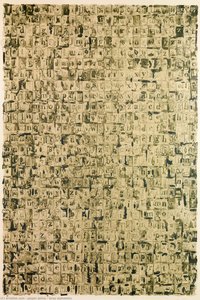
Between the Clock and the Bed

Explore 'Between the Clock and the Bed' by Jasper Johns – an abstract masterpiece blending geometric lines with subtle color accents to convey disruption and complexity, rooted in Expressionist techniques.

Discover Jasper Johns (b. 1930), a pioneer of Pop & Abstract Expressionism! Explore iconic works like 'Flag,' maps, & targets – redefining modern art.

Hand Made Oil Reproduction

Hand-painted oil on canvas in your size and frame, made to order by our artists.

Standard
custom
CM
INCH

Pick from our preset sizes that match the artwork's original proportions.

width
height

You may enter your own dimensions to fit a specific frame or space. If your selected size does not match the original image's proportions, we will either crop the artwork or extend the painting with additional hand-painted elements. A digital mockup will be sent for your approval before production begins.
Please note that the on-screen preview does not reflect the actual cropping or extension. Only the mockup will accurately show the final composition.
While custom sizes are available, we recommend selecting a dimension from the predefined list to preserve the original proportions.

Examples of what can be changed: Replace face with customer photo; Add pet (e.g., replace cat with dog); Include hidden message in background; Change background landscape or elements.
After order, Most-Famous-Paintings.com team will email client for instructions and provide a mockup preview

Worldwide Delivery () in 3/4 weeks instead of standard 5 weeks. (18 July). No compromise on quality.

why_choose_icon
Free Worldwide Express Shipping
why_choose_icon
High-Quality Linen Canvas
why_choose_icon
Full Shipping Insurance
why_choose_icon
Customs Tax Refund Guarantee
why_choose_icon
True Color Matching Guarantee
why_choose_icon
60-Day Return Policy (Defects Only)
why_choose_icon
100% Money-Back Guarantee
why_choose_icon
Bulk Discount Offer

Total Price

-

reproduction

Between the Clock and the Bed

Reproduction Medium

Reproduction Size

-

Total Price

-

Quick Facts

  • Artist: Jasper Johns
  • Title: Between the Clock and the Bed
  • Influences: Minimalism
  • Artistic style: Neo-Expressionist
  • Notable elements or techniques: Layered paint application; Masking technique
  • Movement: Abstract Expressionism

Artwork Description

Between the Clock and the Bed

The artwork presents a captivating exploration of fragmented form and restrained color, embodying the spirit of Abstract Expressionism while hinting at the influence of Neo-Expressionism. Created by Jasper Johns—a titan amongst American artists—this piece delves into themes of disorientation and contemplation, inviting viewers to wrestle with notions of order versus chaos within a deceptively simple visual language. Historical Context: Emerging in the wake of World War II, Johns’s artistic trajectory coincided with a significant shift away from the emotionally charged canvases of Abstract Expressionists like Pollock and Rothko. Simultaneously, Pop Art was gaining momentum, challenging conventions by incorporating imagery drawn from popular culture—a juxtaposition that reflects the anxieties and uncertainties of the postwar era. Johns consciously resisted overt representationalism, prioritizing instead the exploration of psychological states and conceptual ideas through meticulously crafted visual elements. His experiences during the Korean War instilled a profound awareness of geopolitical tensions and contributed to his preoccupation with symbols and repetition as vehicles for conveying meaning beyond literal depiction. Style & Technique: The painting’s aesthetic leans heavily into Abstract Expressionism's core tenets—namely, spontaneous gesture and emotional intensity—though Johns tempers this impulse with a deliberate control over composition and execution. Unlike the sprawling canvases of his predecessors, “Between the Clock and the Bed” adopts a strikingly reductive approach, focusing on a dense network of intersecting lines rendered in shades of gray and white. The technique appears to involve layering multiple coats of paint, possibly utilizing masking techniques to achieve the intricate textural surface that characterizes the piece. This meticulous process underscores Johns’s commitment to precision alongside expressive freedom—a hallmark of Neo-Expressionism's resurgence in the late 1970s and early 1980s. Composition & Color Palette: The artwork’s visual dynamism stems from its asymmetrical arrangement, where lines converge and diverge across the canvas without establishing a dominant focal point. This deliberate lack of hierarchy encourages viewers to engage actively with the image, allowing their gaze to wander freely amidst the interwoven patterns. The color palette is deliberately muted—primarily grayscale—creating an atmosphere of quiet contemplation. Subtle hints of yellow, red, and blue punctuate the monochrome expanse, adding visual warmth and complexity without disrupting the overall tonal harmony. These accents serve not merely as decorative elements but rather as conduits for conveying emotional resonance. Symbolism & Emotional Impact: The fragmented lines themselves function as potent symbols—representing both disruption and containment. They evoke a sense of unease yet simultaneously suggest an underlying structure, mirroring the complexities inherent in human experience. The juxtaposition of “clock” and “bed”—objects associated with time and rest—further amplifies this thematic tension. Johns’s masterful manipulation of form and color invites viewers to confront questions about perception, memory, and the elusive nature of reality. Ultimately, "Between the Clock and the Bed" resonates with a profound stillness, prompting reflection on the boundaries between consciousness and subconsciousness. Materials Used: Likely oil paint on canvas, demonstrating meticulous layering and textural manipulation—a testament to Johns’s dedication to craftmanship and his ability to distill complex ideas into visually arresting compositions.

Artist Biography

A Life Painted in Symbols: The World of Jasper Johns

Jasper Johns emerged as a pivotal figure in the landscape of American art, bridging the emotive intensity of Abstract Expressionism with the burgeoning Pop Art movement that would soon redefine artistic boundaries. Born in Augusta, Georgia, in 1930, his early life was marked by a sense of displacement following his parents’ divorce, an experience that perhaps subtly informed his later explorations of identity and belonging within the context of American iconography. His formative years unfolded across various schools before he briefly attended the University of South Carolina, but it wasn't until his move to New York City in 1949 that Johns truly began to forge his artistic path. A period of service during the Korean War further shaped his perspective, exposing him to a world far removed from the burgeoning art scene he was eager to embrace upon his return.

Breaking with Abstraction: The Dawn of a New Visual Language

The post-war American art world was dominated by Abstract Expressionism—a style characterized by spontaneous gesture and deeply personal emotional expression. While initially influenced by this movement, Johns felt compelled to move beyond its purely non-representational approach. He sought a new visual language, one that incorporated recognizable imagery not as illustrations but as vehicles for deeper contemplation. This wasn’t simply about *depicting* the world; it was about questioning how we perceive and interpret symbols within it. Key influences guided his departure: Marcel Duchamp's radical readymades challenged conventional notions of art-making, while the emphasis on materiality in Abstract Expressionism informed Johns’ early techniques. However, it was the everyday objects and potent symbols of American culture—flags, targets, maps, numbers—that truly became central to his artistic vocabulary. He wasn’t interested in escaping representation; he wanted to dissect it, layer it with meaning, and ultimately reveal its inherent ambiguities.

Iconic Images: Flags, Targets, and the Language of Symbols

Johns' breakthrough works arrived in the mid-1950s, instantly establishing him as a force to be reckoned with. His paintings of flags, most notably *Flag* (1954–55), were not patriotic declarations but rather investigations into the very nature of representation. Rendered in a semi-abstract style, using encaustic—pigment mixed with hot wax—and collage techniques, these flags weren’t simply images; they were textured surfaces laden with symbolic weight. The target series, beginning in 1958, further explored this fascination with recognizable forms, questioning perception and meaning through the seemingly straightforward image of a bullseye. *Map* (1961), with its fragmented and layered depictions of the United States, delved into themes of geography, identity, and the complexities of national representation. Works like *False Start* (1959) demonstrated his experimentation with language and visual codes, creating complex compositions that challenged viewers to decipher their underlying meanings. Even *White Flag* (1955), a seemingly simple monochrome canvas, prompted profound questions about absence, surrender, and the very act of seeing.

A Legacy of Influence: Paving the Way for Pop Art and Beyond

Jasper Johns’ impact on the trajectory of modern art is undeniable. He played a crucial role in the transition from Abstract Expressionism to Pop Art, challenging the prevailing aesthetic norms and opening up new avenues for artistic exploration. By embracing recognizable imagery, he paved the way for artists like Andy Warhol and Roy Lichtenstein, who would further blur the lines between high art and popular culture. His close collaboration with Robert Rauschenberg was also profoundly influential, fostering a spirit of experimentation and pushing the boundaries of artistic practice. Johns’ work continues to resonate today, inspiring generations of artists to question assumptions, challenge conventions, and explore the power of symbols in shaping our understanding of the world. He remains an active artist, constantly evolving his approach and solidifying his position as one of the most important figures in 20th and 21st-century art.

Recognition and Enduring Impact

Throughout his illustrious career, Jasper Johns has received numerous accolades, including a Golden Lion at the Venice Biennale in 1988, the National Medal of Arts in 1990, and the Presidential Medal of Freedom in 2011. His works are held in major museum collections worldwide—the Museum of Modern Art, the Whitney Museum of American Art, the Metropolitan Museum of Art in New York, and Tate Modern in London, to name just a few. He has been the subject of countless exhibitions, cementing his status as a master of modern art. Beyond his paintings, Johns’ contributions extend to sculpture and printmaking, demonstrating his versatility and unwavering commitment to artistic innovation. His enduring legacy lies not only in the iconic images he created but also in the profound questions he raised about the nature of representation, symbolism, and the very essence of what it means to be an artist in a rapidly changing world.
Jasper Johns

Jasper Johns

1930 - , United States of America

Quick Facts

  • Artistic Movement Or Style: Pop Art, Abstract Expressionism
  • Artists Or Movements Influenced By This Artist:
    • Andy Warhol
    • Roy Lichtenstein
  • Artists Who Influenced This Artist: ['Marcel Duchamp']
  • Date Of Birth: May 15, 1930
  • Full Name: Jasper Johns
  • Nationality: American
  • Notable Artworks:
    • Flag
    • Target
    • Map
    • White Flag
  • Place Of Birth: Augusta, USA
Explore artworks organized by themes, styles, and characteristics.