x


Hand-painted oil on canvas in your size and frame, made to order by our artists.





























Pick from our preset sizes that match the artwork's original proportions.

You may enter your own dimensions to fit a specific frame or space. If your selected size does not match the original image's proportions, we will either crop the artwork or extend the painting with additional hand-painted elements. A digital mockup will be sent for your approval before production begins.
Please note that the on-screen preview does not reflect the actual cropping or extension. Only the mockup will accurately show the final composition.
While custom sizes are available, we recommend selecting a dimension from the predefined list to preserve the original proportions.
Worldwide Delivery () in 3/4 weeks instead of standard 5 weeks. (18 July). No compromise on quality.


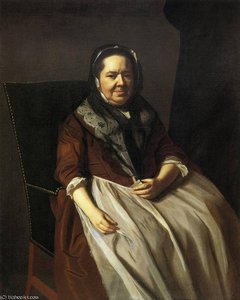
Mrs John Winthrop
Reproduction Size
John Singleton Copley’s “Mrs. John Winthrop” – painted in 1773, just before his departure for England – is more than a simple likeness; it's a meticulously crafted window into the world of colonial Boston society and the burgeoning ideals of American identity. The portrait captures Hannah Winthrop (née Fayerweather), wife of the prominent Harvard professor and mathematician, John Winthrop, in an atmosphere of quiet elegance and understated wealth. Copley’s skill lies not just in his ability to render the textures of silk and lace with astonishing detail – observe the delicate folds of her blue gown, the intricate embroidery of the white collar, or the subtle sheen of the apple in her hand – but also in conveying a sense of inner composure and dignified bearing. The painting speaks volumes about the social standing and intellectual pursuits of its subject, reflecting a period defined by both prosperity and profound political uncertainty.
Copley’s style in “Mrs. John Winthrop” is firmly rooted in the Neoclassical tradition, yet infused with a distinctly American sensibility. He employs a technique known as ‘finished realism,’ prioritizing meticulous detail and polished surfaces – a hallmark of his Boston studio practice. Note the sharp contrasts between light and shadow, expertly used to sculpt the forms of Hannah’s face and hands, drawing the viewer's eye to her expressive gaze. The composition is carefully balanced, with the parrot perched on her hand acting as a focal point, subtly hinting at the exotic influences permeating colonial life. Copley masterfully utilizes color – the rich blues and creams of the gown juxtaposed against the warm tones of the background – to create a visually harmonious and intellectually stimulating image. The use of a red background is particularly noteworthy; it provides a dramatic backdrop that emphasizes Hannah’s presence and adds a touch of theatricality to the scene.
Beyond its aesthetic qualities, “Mrs. John Winthrop” is rich in symbolic meaning. The apple, held delicately in Hannah’s hand, alludes to both the biblical story of Adam and Eve and the family's renowned cultivation of rare fruits – a testament to their wealth and status within Boston society. The parrot, a common pet during this era, represents intelligence, beauty, and exoticism—reflecting the cosmopolitan influences present in colonial Boston. John Winthrop himself was a man of considerable intellectual standing, deeply involved in mathematics, natural history, and education. His position at Harvard College underscored his importance within the community, and Copley’s portrait serves as a visual affirmation of this influence. The inclusion of the two chairs subtly suggests a scene of domestic tranquility and intellectual discourse – a glimpse into the refined life of a prominent Boston family.
Despite its formal presentation, “Mrs. John Winthrop” possesses a remarkable emotional resonance. Hannah’s expression is not one of overt joy or sorrow, but rather a quiet serenity and dignified composure. Her eyes hold a hint of intelligence and perhaps even melancholy – reflecting the complexities of life within a rapidly changing society. Copley captures this subtle nuance with exceptional skill, creating an image that invites contemplation and offers a poignant reminder of the individuals who shaped the early history of America. The painting’s enduring appeal lies in its ability to transcend mere representation, offering a profound insight into the character and spirit of a remarkable woman and the world she inhabited.


1738 - 1815 , United Kingdom

Journey through 25 iconic artworks at Boston's MFA! Explore masterpieces by Monet, Sargent, Van Gogh & more. Discover art history, techniques & find museum-quality reproductions for your home on Most-Famous-Paintings.com.

Explore 10 iconic portrait paintings – from Mona Lisa to Van Gogh’s self-portraits. Discover the stories behind these masterpieces, artistic techniques & find museum-quality art reproductions for your home at Most-Famous-Paintings.com.

Explore 25 captivating portraits by Sir Joshua Reynolds, a master of British art. Discover stories behind his iconic paintings, elegant style & historical influence. Find museum-quality reproductions and elevate your home decor on Most-Famous-Paintings.com.
Explore 10 iconic gray paintings by masters like Rembrandt, Hopper & Whistler. Discover the stories behind these atmospheric artworks and find museum-quality art reproductions for your home decor at . Explore the full collection online.

Journey through 25 iconic Claude Monet masterpieces! Explore Impressionism’s beauty, from Water Lilies to Rouen Cathedral. Discover stunning art reproductions & curated decor ideas – explore the full collection online at Most-Famous-Paintings.com.


Stay updated with the latest art news, exclusive offers, and decoration ideas.
Tell us about your project and our art experts will provide you with 3 personalized art suggestions.
Let Us Curate 3 Options Just for You - Free!


 Buy print
 Send
Send Share
Share
 Details

 Download
 Similars
 X-Ray
X-Ray Diaporama


 Read More







 Glass option is only available in size under 110 CM