


x


 Geometric Abstraction
 1947
1947 30.0 x 20.0 cm
 Museum of Fine Arts
Hand-painted oil on canvas in your size and frame, made to order by our artists.





























Pick from our preset sizes that match the artwork's original proportions.

You may enter your own dimensions to fit a specific frame or space. If your selected size does not match the original image's proportions, we will either crop the artwork or extend the painting with additional hand-painted elements. A digital mockup will be sent for your approval before production begins.
Please note that the on-screen preview does not reflect the actual cropping or extension. Only the mockup will accurately show the final composition.
While custom sizes are available, we recommend selecting a dimension from the predefined list to preserve the original proportions.
Worldwide Delivery () in 3/4 weeks instead of standard 5 weeks. (18 July). No compromise on quality.


Multiplex A
Reproduction Size
“Multiplex A,” created in 1947 by the visionary artist Josef Albers, is more than just a woodcut; it's an invitation to contemplate the very nature of visual perception. Born in Bottrop, Germany, and deeply influenced by his early experiences with craftsmanship – from carpentry to glass engraving – Albers’s artistic journey was fundamentally shaped by a profound understanding of materials and their inherent qualities. His time at the Bauhaus, a crucible of modern art and design, further solidified this approach, pushing him to explore abstraction and challenge conventional notions of representation. “Multiplex A” stands as a culmination of these influences, a meticulously constructed exploration of color interaction and spatial relationships that continues to resonate with viewers today.
The artwork’s visual language is deceptively simple yet profoundly complex. Albers employs a restricted palette – primarily black and white – to create a dynamic interplay of geometric forms: triangles, squares, and rectangles are arranged in a seemingly random order, yet within this apparent chaos lies a carefully orchestrated balance. The precision of the woodcut technique—a method demanding meticulous detail and control—is crucial to conveying the artwork’s intellectual rigor. Each line is deliberate, each shape precisely rendered, contributing to an overall sense of ordered complexity. Albers wasn't simply creating a decorative pattern; he was designing a visual experiment, a tangible manifestation of his theories on color perception.
Albers’s work is inextricably linked to his groundbreaking book, “Interaction of Colors,” published in 1963. This seminal text explored the ways in which colors influence and modify each other when placed adjacent to one another. "Multiplex A" serves as a visual demonstration of these principles. The overlapping shapes create areas of simultaneous contrast, where colors appear to shift and change depending on their surrounding hues. Albers’s meticulous documentation of these color interactions—the precise shades he used and the resulting effects—became a cornerstone of modern color theory, influencing generations of artists and designers.
The artwork's design is rooted in Albers’s concept of “homage,” a deliberate tribute to the fundamental elements of art. He sought not to create something entirely new but rather to explore and illuminate existing artistic conventions. "Multiplex A" can be seen as an homage to the principles of geometry, color theory, and the very act of seeing. It’s a quiet assertion that beauty and meaning can be found in the simplest of forms and relationships.
While Albers deliberately avoided overt symbolism in his work, “Multiplex A” possesses a subtle emotional depth. The geometric precision evokes a sense of order and control, while the overlapping shapes suggest ambiguity and uncertainty. The stark contrast between black and white creates a visual tension that mirrors the complexities of human perception. Some viewers interpret the artwork as a meditation on duality—the interplay of light and dark, order and chaos, certainty and doubt.
Beyond its intellectual rigor, “Multiplex A” also possesses an undeniable aesthetic appeal. The carefully balanced composition, combined with the rich texture of the woodcut print, creates a visually engaging experience. It’s a work that rewards repeated viewing, revealing new nuances and subtleties with each encounter. The artwork invites contemplation, prompting viewers to question their own assumptions about color, space, and perception.
Josef Albers' influence extends far beyond the art world. His teaching methods at Black Mountain College profoundly shaped the development of American art education, emphasizing hands-on experimentation and critical thinking. “Multiplex A” stands as a testament to his enduring legacy—a work that continues to inspire artists, designers, and anyone interested in exploring the mysteries of visual perception. Reproductions of this iconic piece offer a unique opportunity to bring Albers’s groundbreaking ideas into your home or studio, serving as a constant reminder of the power of art to illuminate our understanding of the world around us.


1888 - 1976 , Germany
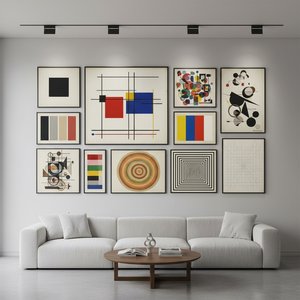
Explore 10 defining masterpieces of Geometric Abstraction! Discover Kandinsky, Mondrian & Malevich’s iconic works. Find museum-quality art reproductions and curated decor ideas to elevate your home at Most-Famous-Paintings.com.
Journey through Wassily Kandinsky's 25 most iconic abstract paintings. Explore his revolutionary use of color, form & spiritual expressionism. Find museum-quality Kandinsky reproductions and elevate your home decor with Most-Famous-Paintings.com. Discover all masterpieces on Most-Famous-Paintings.com!

Explore 10 iconic artworks – from Monet to Matisse – that masterfully use color! Discover the stories behind these vibrant paintings, their techniques & emotional impact. Find museum-quality art reproductions and inspiring decor ideas on Most-Famous-Paintings.com.

Explore the fascinating evolution of color theory in art history! Discover Impressionism, Neo-Impressionism & beyond with expert insights for collectors and enthusiasts. Learn about Seurat's techniques & the psychology of color.

Explore Josef Albers's groundbreaking color theory & the 'Homage to the Square' series. Discover how his work revolutionized visual perception and influenced modern art movements like Minimalism & Op Art. Learn about his Bauhaus roots & lasting legacy.


Stay updated with the latest art news, exclusive offers, and decoration ideas.
Tell us about your project and our art experts will provide you with 3 personalized art suggestions.
Let Us Curate 3 Options Just for You - Free!


 Buy print
 Send
Send Share
Share
 Details

 Download
 Similars
 X-Ray
X-Ray Diaporama
 Read More







 Glass option is only available in size under 110 CM


