x


 Acrylic On CanvasWallArtHigh Renaissance
 Early Medieval
 20.0 x 28.0 cm
 Kupferstichkabinett
Hand-painted oil on canvas in your size and frame, made to order by our artists.





























Pick from our preset sizes that match the artwork's original proportions.

You may enter your own dimensions to fit a specific frame or space. If your selected size does not match the original image's proportions, we will either crop the artwork or extend the painting with additional hand-painted elements. A digital mockup will be sent for your approval before production begins.
Please note that the on-screen preview does not reflect the actual cropping or extension. Only the mockup will accurately show the final composition.
While custom sizes are available, we recommend selecting a dimension from the predefined list to preserve the original proportions.
Worldwide Delivery () in 3/4 weeks instead of standard 5 weeks. (18 July). No compromise on quality.


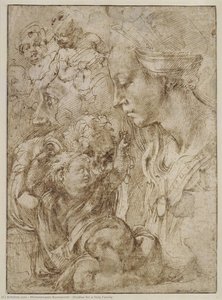
Studies for a Holy Family
Reproduction Size
Michelangelo Buonarroti's “Studies for a Holy Family,” a remarkably intimate and intensely personal drawing, offers an unparalleled window into the mind of one of history’s greatest artistic titans. Dating from around 1503-1506, this sheet isn’t merely a preparatory sketch; it’s a vibrant demonstration of Michelangelo's creative process – a restless exploration of form, composition, and ultimately, profound human emotion. The drawing, measuring just 20 x 28 cm, belies the monumental scale of his later works, yet within its compact confines resides an astonishing depth of observation and artistic ambition.
The scene itself is deceptively simple: a Madonna cradling the Infant Jesus, accompanied by Saint Joseph. However, Michelangelo doesn’t present a polished, idealized depiction. Instead, he captures the *process* of creation. The figures are rendered with a remarkable immediacy – the baby Jesus, vigorously turning his head and outstretched arms, seems to be actively engaging with the viewer; the Madonna's profile is delicately hatched, imbued with an almost ethereal beauty, while Joseph’s face emerges from the surrounding lines, hinting at a poignant self-portrait. Scholars have long recognized this latter detail – a small, sketched visage within Joseph’s features – as a deeply revealing gesture of introspection and perhaps even melancholy, reflecting Michelangelo's own complex relationship with his family.
What truly sets this drawing apart is its extraordinary virtuosity in line. Michelangelo employs a breathtaking range of hatching, cross-hatching, and rapid sketching techniques, mirroring the dynamism of his later works in painting and relief sculpture like the “Tondo Doni.” The density of lines isn’t merely decorative; it's integral to conveying volume, texture, and movement. Notice how the hatching creates a sense of weight and solidity for the figures, while the looser, more gestural strokes capture the fleeting quality of their expressions. This technique was honed during his apprenticeship with Ghirlandaio, but Michelangelo pushed its boundaries here, demonstrating an unparalleled command of line as both a means of representation and a vehicle for emotional expression.
The drawing’s style is deeply rooted in the classical ideals he absorbed from Roman sculpture – particularly the emphasis on anatomical accuracy and idealized beauty. Yet, it also possesses a distinctly Renaissance sensibility, evident in its psychological depth and the artist's willingness to reveal his own thoughts and feelings through this intimate study. The echoes of works like the “Tondo Taddei” and “Tondo Pitti,” executed around the same period, are palpable, suggesting that this drawing served as a crucial stepping stone in Michelangelo’s development of his distinctive visual language.
Beyond its technical brilliance, "Studies for a Holy Family" is profoundly symbolic. The depiction of the family – particularly Joseph's self-portrait – speaks to themes of lineage, identity, and perhaps even artistic struggle. The infant Jesus, with his active gestures, embodies innocence, vitality, and the promise of future greatness. The Madonna’s serene expression suggests a quiet strength and devotion. Michelangelo wasn’t simply illustrating a biblical scene; he was exploring fundamental human relationships and grappling with questions of faith, family, and self-awareness.
The drawing's emotional impact is immediate and compelling. It invites us to connect with the artist on a deeply personal level, offering a rare glimpse into his creative process and revealing a vulnerability rarely seen in his more monumental works. It’s a testament to Michelangelo’s belief that art wasn’t merely about replicating reality but about capturing its essence – its beauty, its sorrow, and its enduring power.
Most-Famous-Paintings is proud to offer meticulously crafted hand-painted reproductions of this extraordinary drawing. Our skilled artisans painstakingly recreate Michelangelo’s intricate lines and subtle tonal variations, ensuring that the full richness and emotional depth of the original are preserved. Available in a range of sizes, including this intimate 20 x 28 cm edition, our reproduction allows you to bring this masterpiece into your home or studio – a tangible connection to one of history's greatest artistic geniuses. Consider it not just a decoration, but an investment in art history and a celebration of human creativity.


1475 - 1564 , Italy

Journey through Michelangelo's 25 greatest artworks – from David’s strength to the Sistine Chapel’s beauty. Explore Renaissance masterpieces, art history & find museum-quality reproductions for your home at Most-Famous-Paintings.com.
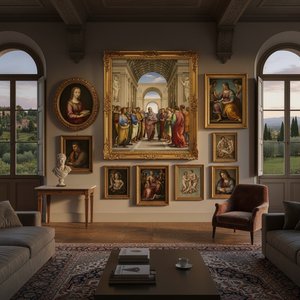
Explore 25 breathtaking Raphael paintings! Journey through the Italian Renaissance with masterpieces like 'School of Athens' & iconic Madonnas. Find museum-quality art reproductions and elevate your home decor on Most-Famous-Paintings.com.

Journey through the Uffizi Gallery's 25 most iconic Renaissance artworks! Explore Botticelli, Leonardo da Vinci & Michelangelo’s masterpieces. Find museum-quality art reproductions and curated decor ideas to bring timeless Italian beauty into your home. Discover all masterpieces on Most-Famous-Paintings.com

Journey through the High Renaissance! Explore 10 iconic masterpieces by Leonardo da Vinci, Michelangelo & Raphael. Discover art history, techniques & find museum-quality reproductions to elevate your home decor on .
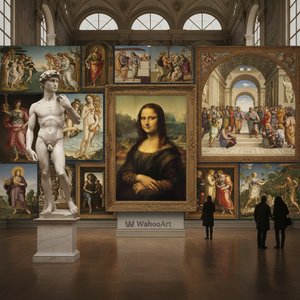
Journey through the Italian Renaissance with 10 iconic masterpieces by Leonardo da Vinci, Michelangelo & Raphael. Explore art history, techniques & timeless beauty. Find museum-quality reproductions and elevate your home decor on .


Stay updated with the latest art news, exclusive offers, and decoration ideas.
Tell us about your project and our art experts will provide you with 3 personalized art suggestions.
Let Us Curate 3 Options Just for You - Free!


 Buy print
 Send
Send Share
Share
 Details

 Download
 Similars
 X-Ray
X-Ray Diaporama
 Read More







 Glass option is only available in size under 110 CM