x

Museum-quality giclée or canvas print with fast production and flexible finish options. ( Buy Hand Made Painting Buy Image)





























Pick from our preset sizes that match the artwork's original proportions.

You may enter your own dimensions to fit a specific frame or space. If your selected size does not match the original image's proportions, we will either crop the artwork or extend the image with a mirrored or solid-fill edge. A digital mockup will be sent for your approval before production begins.
Please note that the on-screen preview does not reflect the actual cropping or extension. Only the mockup will accurately show the final composition.
While custom sizes are available, we recommend selecting a dimension from the predefined list to preserve the original proportions.
Worldwide Delivery () in 2 weeks instead of standard 4/5 weeks. (18 August)


Dalet Tet
Reproduction Size
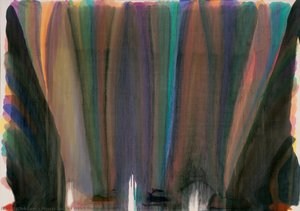
Morris Louis’s *Dalet Tet*, painted in 1959, isn't merely a canvas filled with color; it’s an immersive experience, a deliberate descent into the heart of darkness and a testament to the revolutionary techniques he pioneered. This monumental Color Field painting immediately commands attention with its overwhelming dominance of black, yet within this apparent void lies a complex interplay of subtle hues—whispers of orange, red, and yellow—that suggest a hidden vitality. It’s a work that invites prolonged contemplation, rewarding those willing to surrender to its quiet intensity.
Louis, a pivotal figure in the mid-20th century art world, sought to dismantle traditional notions of painting by rejecting representation altogether. Instead, he embraced abstraction as a means of exploring pure color and process. *Dalet Tet* exemplifies this approach perfectly, drawing heavily from the Color Field movement’s emphasis on large areas of unbroken hue. The painting's genesis lies in Louis’s groundbreaking experimentation with Magna paint – a newly developed acrylic resin that allowed for unprecedented fluidity and transparency when applied to unprimed canvas. This innovative material became central to his “veil” technique, where diluted paint was poured directly onto the fabric, creating cascading layers of color that bled and merged organically.
The composition of *Dalet Tet* is deceptively simple yet profoundly effective. Vertical bands or ribbons of color—the “veils,” as Louis termed them—cascade downwards, seemingly defying gravity. These aren’t sharply defined lines but rather the edges of expanding fields, creating a sense of dynamic movement and an illusion of depth despite the painting's predominantly two-dimensional nature. The absence of geometric precision contributes to the work’s organic quality; the forms feel fluid and responsive, as if reacting to the forces of gravity and chance.
The layering process itself is crucial to understanding *Dalet Tet*. Louis meticulously controlled the dilution of the Magna paint, allowing it to flow freely across the canvas. The resulting effect isn’t one of deliberate brushstrokes but rather a spontaneous, almost chaotic, dance of color. This technique—a departure from traditional painting methods—was incredibly risky at the time, as it challenged established notions of control and skill. Yet, Louis's willingness to embrace this process resulted in paintings that are both visually arresting and emotionally resonant.
The overwhelming darkness of *Dalet Tet* immediately evokes feelings of melancholy, introspection, or perhaps even a sense of the sublime. It’s not a cheerful or celebratory work; rather, it feels deeply contemplative, inviting viewers to confront their own inner landscapes. The subtle hints of color—the flashes of orange, red, and yellow—suggest a glimmer of hope or resilience within the darkness, hinting at the possibility of transformation and renewal.
The title *Dalet Tet*, derived from the Hebrew alphabet, adds another layer of meaning. It refers to the first four letters, representing “creation” or “beginning.” This suggests that the painting isn’t simply an exploration of darkness but also a meditation on emergence—the potential for something new to arise from within it.
Morris Louis's *Dalet Tet* stands as a landmark achievement in American art history, profoundly influencing generations of artists. His pioneering use of Magna paint and his embrace of spontaneous process revolutionized the way painting was conceived and executed. His work paved the way for subsequent Color Field painters like Helen Frankenthaler and Kenneth Noland, establishing a vibrant tradition that continues to inspire today.
Reproductions of *Dalet Tet* offer a remarkable opportunity to experience Louis’s vision firsthand. The rich textures and subtle color variations are beautifully captured in high-quality prints, allowing viewers to appreciate the depth and complexity of this iconic work. Whether adorning a contemporary living space or serving as a focal point in a gallery setting, *Dalet Tet* remains a powerful testament to the transformative potential of color and process.

1912 - 1962 , United States of America

Explore the profound emotional depth of Color Field painting. Discover the history of mid-century abstraction, from Rothko to Newman, and learn how pure color transforms the viewer's experience through our expert art history guide.

Explore the profound history and emotional depth of Color Field painting. From Mark Rothko to Barnett Newman, discover how pure color redefined modern art through our expert-led guide for students and collectors alike.
Explore the profound emotional depth of Lyrical Abstraction. Discover how masters like Raymond Parker used color and form to bridge Impressionism and Abstract Expressionism. Learn about this pivotal movement through our expert-led art history guide.


Stay updated with the latest art news, exclusive offers, and decoration ideas.
Tell us about your project and our art experts will provide you with 3 personalized art suggestions.
Let Us Curate 3 Options Just for You - Free!


 Preview
 Send
Send Share
Share
 Details

 Download
 Similars
 X-Ray
X-Ray Diaporama


 Read More







 Glass option is only available in size under 110 CM