x


Museum-quality giclée or canvas print with fast production and flexible finish options. ( Switch to hand made Painting Switch to Image)





























Pick from our preset sizes that match the artwork's original proportions.

You may enter your own dimensions to fit a specific frame or space. If your selected size does not match the original image's proportions, we will either crop the artwork or extend the image with a mirrored or solid-fill edge. A digital mockup will be sent for your approval before production begins.
Please note that the on-screen preview does not reflect the actual cropping or extension. Only the mockup will accurately show the final composition.
While custom sizes are available, we recommend selecting a dimension from the predefined list to preserve the original proportions.
Worldwide Delivery () in 2 weeks instead of standard 4/5 weeks. (1 August)


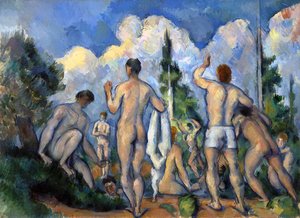
Bathers (Hermitage)
Reproduction Size
"Bathers (Hermitage)," painted by Paul Cézanne around 1891-1892, depicts a group of nude male figures relaxing in a natural setting. The composition is characterized by its deliberate arrangement of forms rather than a realistic portrayal of the scene. Five bathers are present: one standing prominently on the left, another on the right, and three seated or reclining between them. Cézanne's focus isn’t on narrative; instead, he explores the interplay of shapes, volumes, and planes within the landscape. The figures are integrated into the environment—trees rise behind them, birds fly overhead, and a sense of tranquility pervades the scene.
This artwork exemplifies Cézanne’s distinctive style within the Post-Impressionist movement. Departing from Impressionism’s emphasis on fleeting moments and optical effects, Cézanne sought to represent underlying structures and forms. He employed a technique of building up the image through short, visible brushstrokes, creating a textured surface that emphasizes the materiality of paint. The colors are not blended smoothly but rather applied in distinct planes, contributing to the painting’s geometric quality. Cézanne's approach can be seen as a precursor to Cubism, influencing artists like Picasso and Braque who would further deconstruct forms into abstract shapes.
“Bathers (Hermitage)” was created during a pivotal period in art history. The late 19th century witnessed the decline of traditional academic painting and the rise of new artistic movements challenging established conventions. Cézanne, along with artists like Van Gogh and Gauguin, pushed beyond Impressionism’s focus on capturing light and color to explore more subjective and expressive forms of representation. This work reflects a shift towards abstraction and a greater emphasis on the artist's individual vision—a key characteristic of modern art. The series of "Bathers" paintings was Cézanne's attempt to create a monumental, timeless depiction of human figures in nature, inspired by classical sculpture but reinterpreted through his unique lens.
While seemingly straightforward in its subject matter, “Bathers (Hermitage)” carries layers of symbolic meaning. The nude male figures evoke themes of vitality, physicality, and the connection between humanity and nature. Cézanne’s deliberate distortion of perspective and his emphasis on geometric forms create a sense of timelessness and universality. The painting's emotional impact is subtle yet profound—it invites viewers to contemplate the relationship between form and feeling, representation and reality. It evokes a sense of calm contemplation and appreciation for the beauty of the natural world.

1839 - 1906 , France

Explore the transformative era of Post-Impressionism. Discover how masters like Van Gogh moved beyond light to embrace emotion, structure, and vibrant color, redefining modern art history through expressive brushwork and symbolic depth.


Stay updated with the latest art news, exclusive offers, and decoration ideas.
Tell us about your project and our art experts will provide you with 3 personalized art suggestions.
Let Us Curate 3 Options Just for You - Free!


 Preview
 Send
Send Share
Share
 Details

 Download
 Similars
 X-Ray
X-Ray Diaporama

 Read More







 Glass option is only available in size under 110 CM