x

Hand-painted oil on canvas in your size and frame, made to order by our artists. ( Buy Print Buy Image)





























Pick from our preset sizes that match the artwork's original proportions.

You may enter your own dimensions to fit a specific frame or space. If your selected size does not match the original image's proportions, we will either crop the artwork or extend the painting with additional hand-painted elements. A digital mockup will be sent for your approval before production begins.
Please note that the on-screen preview does not reflect the actual cropping or extension. Only the mockup will accurately show the final composition.
While custom sizes are available, we recommend selecting a dimension from the predefined list to preserve the original proportions.
Worldwide Delivery () in 3/4 weeks instead of standard 5 weeks. (20 August). No compromise on quality.


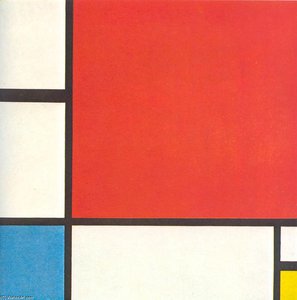
Composition No. 8
Reproduction Size
Piet Mondrian’s “Composition No. 8,” created in 1921, stands as an undeniable emblem of Neoplasticism – a movement that fundamentally reshaped the landscape of early twentieth-century art and continues to resonate with contemporary sensibilities. More than just a painting; it's a manifesto of pure abstraction, distilled into its most elemental components: black lines intersecting rectangular shapes filled with vibrant hues of red, yellow, and blue.
The artwork’s visual impact is immediately arresting due to its uncompromising geometric rigor. Mondrian meticulously crafted this piece using oil paint on canvas, rejecting any illusionistic representation in favor of a flattened plane where forms exist solely as discrete entities governed by mathematical precision. The grid structure—a hallmark of De Stijl—dominates the composition, dividing the canvas into orthogonal zones that convey an unparalleled sense of order and balance.
Beyond its formal elegance lies a profound symbolic significance. Mondrian’s intention wasn't merely to depict visual elements; he sought to express universal harmonies underlying the natural world. The selection of primary colors – red, yellow, and blue – represents fundamental forces of nature, mirroring the belief that these hues embody the essence of existence itself. Simultaneously, the black lines serve as structural anchors, emphasizing stability and conveying a deliberate rejection of organic forms—a conscious departure from Impressionism and Cubism.
Technically speaking, Mondrian approached his task with unwavering dedication. He painstakingly measured and aligned each line to achieve perfect proportions, ensuring that every element contributed to the overall equilibrium. The application of color is remarkably flat and unmodulated; there’s no blending or shading—a deliberate stylistic choice designed to heighten the painting's clarity and purity.
“Composition No. 8” transcends its aesthetic qualities to become a powerful statement about artistic philosophy. It embodies the spirit of modernity, reflecting a desire for rational thought and an unwavering belief in the transformative potential of geometric abstraction. Its enduring appeal lies not only in its visual beauty but also in its ability to inspire contemplation on fundamental questions concerning form, color, and the pursuit of universal harmony—a legacy that continues to captivate art historians and collectors alike.


1872 - 1944 , Netherlands

Discover the profound intersection of geometry and emotion in Cubist Expressionism. Explore art history through our expert analysis of modern masters and find museum-quality, hand-painted oil reproductions of iconic masterpieces for your collection.

Master the complexities of Geometric Abstraction. Our expert guide explores the evolution from Cubist deconstruction to Bauhaus precision, decoding the power of shape and form. Perfect for art students seeking deep historical context and academic insight into modern masterpieces.

Explore the profound impact of Minimalism and Geometric Abstraction. From Mondrian to Malevich, discover how stripping art to its essential forms revolutionized modern aesthetics through our expert-led historical guide.


Stay updated with the latest art news, exclusive offers, and decoration ideas.
Tell us about your project and our art experts will provide you with 3 personalized art suggestions.
Let Us Curate 3 Options Just for You - Free!


 Preview
 Send
Send Share
Share
 Details

 Download
 Similars
 X-Ray
X-Ray Diaporama
 Read More







 Glass option is only available in size under 110 CM