


x

 Oil On CanvasWallArtHudson River School
 1852
1852 278.0 x 193.0 cm
 Taft Museum of Art
Hand-painted oil on canvas in your size and frame, made to order by our artists.





























Pick from our preset sizes that match the artwork's original proportions.

You may enter your own dimensions to fit a specific frame or space. If your selected size does not match the original image's proportions, we will either crop the artwork or extend the painting with additional hand-painted elements. A digital mockup will be sent for your approval before production begins.
Please note that the on-screen preview does not reflect the actual cropping or extension. Only the mockup will accurately show the final composition.
While custom sizes are available, we recommend selecting a dimension from the predefined list to preserve the original proportions.
Worldwide Delivery () in 3/4 weeks instead of standard 5 weeks. (18 July). No compromise on quality.


Landscape Mural
Reproduction Size
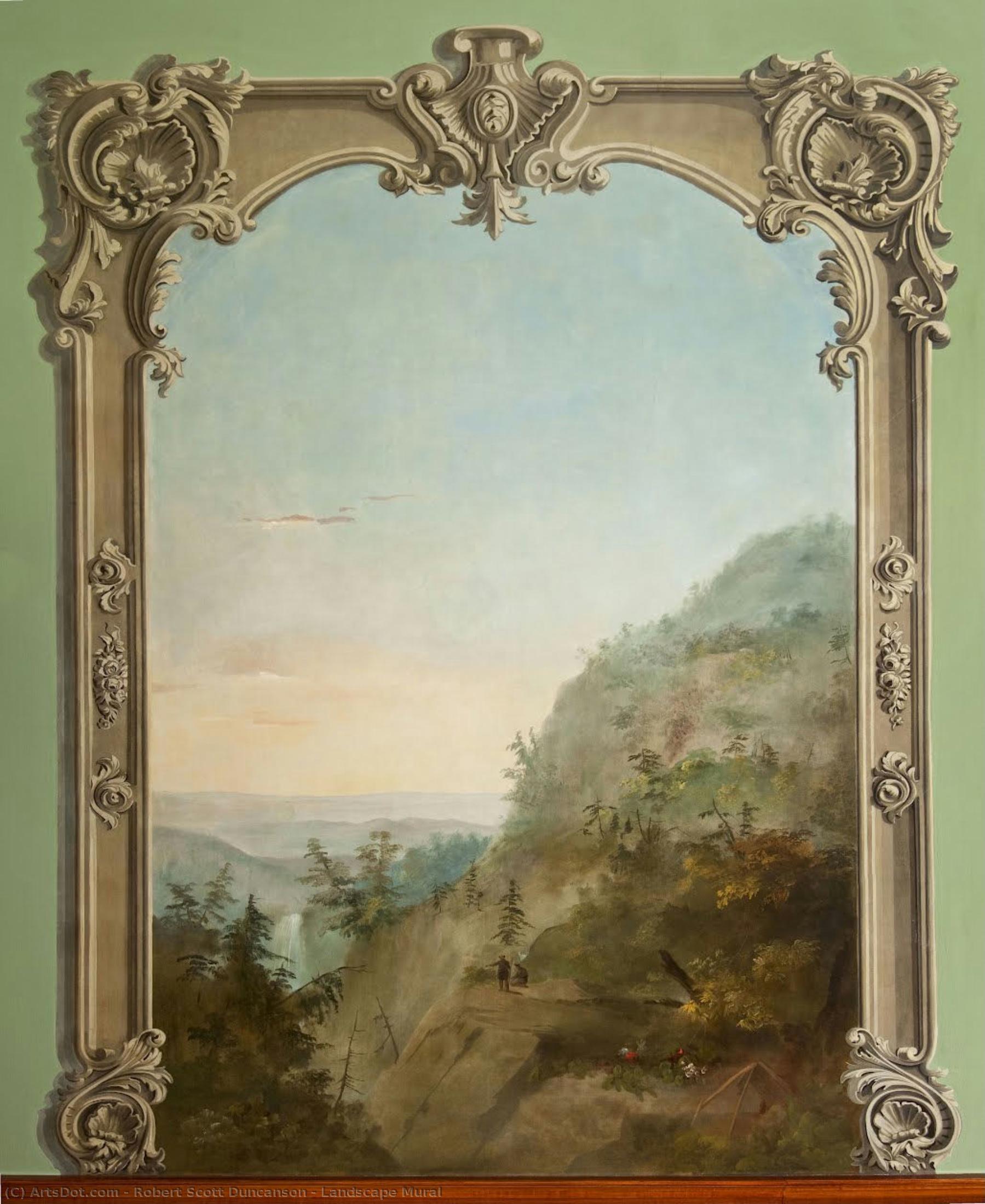
Robert Seldon Duncanson's "Landscape Mural," painted in 1852, is more than just a depiction of an American vista; it’s a carefully constructed meditation on nature, spirituality, and the burgeoning identity of a nation grappling with its own history. This monumental work, now residing within the Taft Museum of Art in Cincinnati, Ohio, offers a glimpse into the world of the Hudson River School, while simultaneously hinting at Duncanson's unique perspective as an African American artist navigating a complex social landscape.
The mural immediately draws the viewer into a scene of profound tranquility. A meandering river, rendered with meticulous detail and atmospheric perspective, dominates the composition, reflecting the sky above in a shimmering dance of light and shadow. Rolling hills, dotted with trees – primarily oaks and maples – stretch towards the horizon, creating a sense of vastness and serenity. The figures of two men, standing on a hillside, are subtly integrated into the landscape, appearing almost as part of the natural world itself. Their postures suggest contemplation and connection to the surrounding environment, inviting the viewer to share in their quiet observation.
Duncanson’s artistic trajectory is particularly compelling. Initially trained as a carpenter and house painter, he developed an early passion for art through diligent study of European prints – primarily those of the Dutch Masters and the German Romantic landscape painters. This foundational knowledge informed his approach to American landscapes, allowing him to master techniques like atmospheric perspective—the subtle blurring of distant objects to create depth—and carefully rendered foliage. Crucially, Duncanson eschewed purely academic training, preferring instead to learn through direct observation of nature, a hallmark of the Hudson River School movement.
Born in Fayetteville, New York, into a family with roots tracing back to enslaved people in Virginia, Duncanson’s life was shaped by racial prejudice. Despite these challenges, he persevered, establishing himself as one of the first African American artists to achieve international recognition. His work often subtly explored themes of identity and belonging, reflecting his own experiences within a racially divided society.
Beyond its purely visual appeal, “Landscape Mural” is rich in symbolic meaning. The river, a recurring motif in Duncanson’s oeuvre, represents the flow of time, the passage of life, and perhaps even the spiritual journey. The figures on the hillside are often interpreted as representing humanity's connection to nature and the divine—a sentiment deeply rooted in the Romantic tradition. Some scholars have suggested that the composition subtly references biblical themes of paradise and redemption, reflecting Duncanson’s own faith.
Furthermore, the mural’s scale – nearly nine feet tall and six and a half feet wide – elevates it beyond a simple landscape painting, transforming it into a monumental statement about the beauty and power of the natural world. The deliberate use of light and shadow creates an almost ethereal quality, evoking a sense of timelessness and spiritual contemplation.
Today, reproductions of “Landscape Mural” offer art lovers a chance to experience the profound beauty and emotional depth of this remarkable work. When selecting a high-quality reproduction, consider factors such as archival quality paper and pigment inks to ensure that the colors and details are faithfully reproduced for generations to come. Whether displayed in a grand salon or a cozy study, Duncanson’s “Landscape Mural” continues to inspire with its serene vision of the American landscape and its quiet celebration of the human spirit.


1821 - 1872 , United States of America

Journey through America's breathtaking landscapes with our guide to the Top 10 Hudson River School masterpieces. Explore Thomas Cole, Frederic Church & more! Find museum-quality art reproductions and elevate your home decor at Most-Famous-Paintings.com.

Explore the captivating world of Luminism & the Hudson River School with our expert analysis. Discover the history, artists, and enduring beauty of 19th-century American landscape painting. Find museum-quality reproductions at Most-Famous-Paintings.

Explore the captivating world of the Hudson River School! Discover the history, artists, and defining characteristics of this iconic American art movement. Learn about Romanticism's influence & find inspiration for your collection.
Journey through 10 breathtaking landscape paintings by Monet, Van Gogh & more! Explore iconic artworks, artistic techniques & find inspiration for your home decor. Museum-quality reproductions at Most-Famous-Paintings.com. Discover all masterpieces on Most-Famous-Paintings.com

Discover Robert Seldon Duncanson, the first internationally acclaimed African American landscape artist. Explore his connection to the Hudson River School, abolitionism, and enduring legacy through serene vistas & powerful symbolism.


Stay updated with the latest art news, exclusive offers, and decoration ideas.
Tell us about your project and our art experts will provide you with 3 personalized art suggestions.
Let Us Curate 3 Options Just for You - Free!


 Buy print
 Send
Send Share
Share
 Details

 Download
 Similars
 X-Ray
X-Ray Diaporama
 Read More







 Glass option is only available in size under 110 CM


![[waterfall In Dusky Bay With Maori Canoe] — William Hodges](/media/artworks/images/thumbnails/27/8f/278ff51d554648d9a8f50fc36be4388b.jpg)


